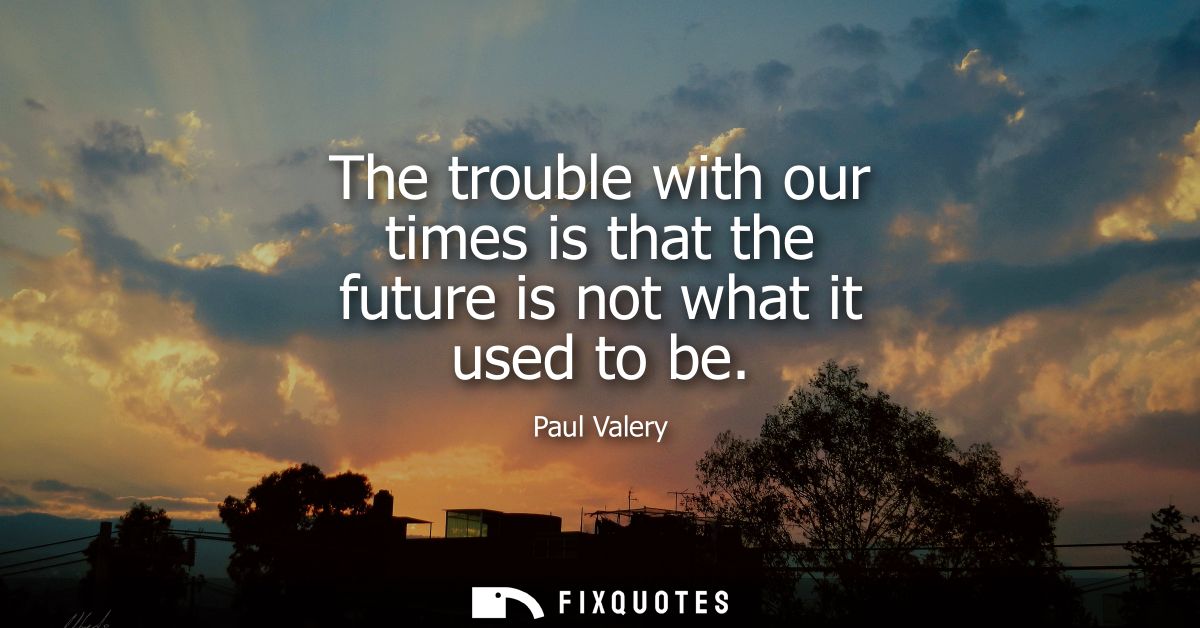
"The trouble with our times is that the future is not what it used to be"
About this Quote
As a poet writing through the shattering of Europe (Valery lives across the Belle Epoque, World War I, and the anxious interwar years), he’s not lamenting gadgets or fashion. He’s marking the death of a nineteenth-century faith: that history had direction, that rationality and industry would steadily improve life, that the next generation would inherit something legible. After mechanized slaughter and political volatility, the future stops behaving like an extension of the present; it becomes alien, discontinuous, even threatening.
The subtext is psychological and political. When the future no longer feels "like it used to be", public life gets jumpy: people cling harder to myths, leaders promise restoration instead of invention, and culture swings between avant-garde thrills and reactionary panic. Valery’s irony is that the future never was stable; only our story about it was. His line captures the moment that story collapses - and our times still read it as if he wrote it this morning.
Quote Details
| Topic | Time |
|---|---|
| Source | Verified source: Regards sur le monde actuel (Paul Valery, 1931)
Evidence: L’avenir est comme le reste : il n’est plus ce qu’il était. (null). This is the closest verifiable PRIMARY-source phrasing from Paul Valéry that matches the widely-circulated English version (“The trouble with our times is that the future is not what it used to be” / “The future is not what it used to be”). Multiple secondary references attribute the French sentence to Valéry’s collection *Regards sur le monde actuel* (often dated 1931). However, I was not able (in this browsing session) to open a scan/text of the 1931 edition itself to confirm the exact page/chapter or to prove it is the *first* appearance (e.g., whether it first appeared earlier in an essay, lecture, or periodical publication later collected in the 1931 volume). One scholarly secondary source explicitly states that Clarke took his title from an essay by Valéry in the 1920s, supporting the idea that the sentiment predates many later attributions but not giving the precise original venue. To definitively establish first publication/spoken instance, the next step would be to consult the earliest printing of *Regards sur le monde actuel* (Gallimard, 1931) or the original essay/lecture version if it appeared earlier, and extract bibliographic details (page, essay title, and publication history). Other candidates (1) The Change Imperative (Paul Ronalds, 2012) compilation95.0% ... Paul Valery (1989) famously said, “the trouble with our times is that the future is not what it used to be.” This... |
| Cite |
Citation Formats
APA Style (7th ed.)
Valery, Paul. (2026, February 23). The trouble with our times is that the future is not what it used to be. FixQuotes. https://fixquotes.com/quotes/the-trouble-with-our-times-is-that-the-future-is-86838/
Chicago Style
Valery, Paul. "The trouble with our times is that the future is not what it used to be." FixQuotes. February 23, 2026. https://fixquotes.com/quotes/the-trouble-with-our-times-is-that-the-future-is-86838/.
MLA Style (9th ed.)
"The trouble with our times is that the future is not what it used to be." FixQuotes, 23 Feb. 2026, https://fixquotes.com/quotes/the-trouble-with-our-times-is-that-the-future-is-86838/. Accessed 25 Mar. 2026.