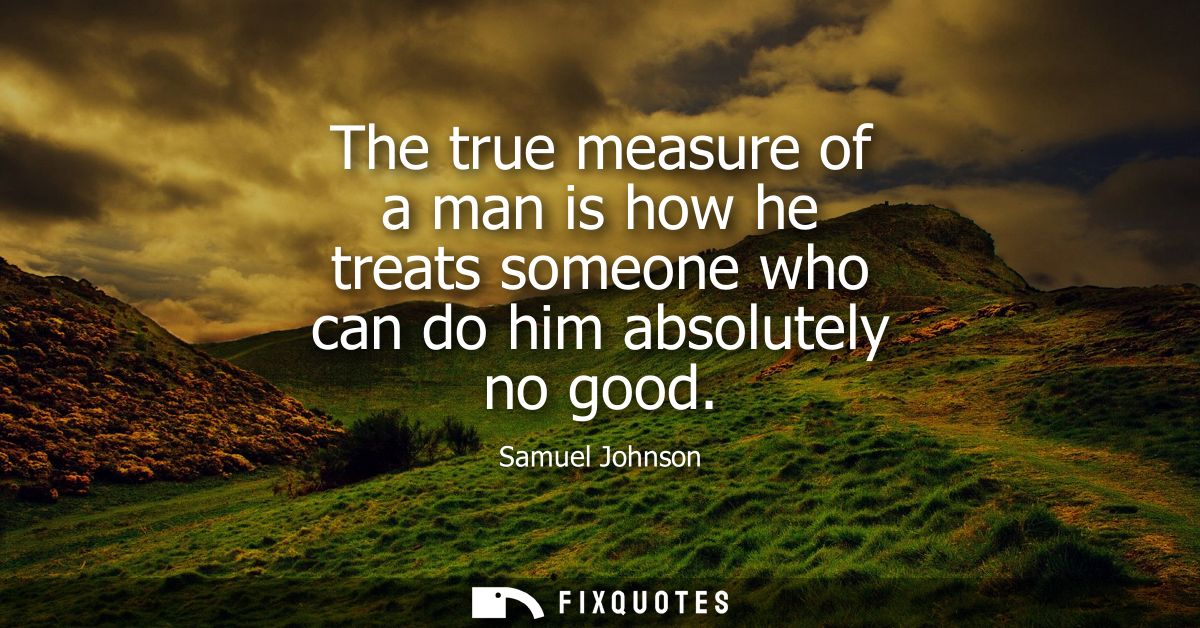
"The true measure of a man is how he treats someone who can do him absolutely no good"
About this Quote
The subtext is an indictment of transactional civility. In Johnson’s 18th-century Britain, status was infrastructure. Patronage, class etiquette, and the theater of politeness shaped who ate, who wrote, who advanced. Johnson knew both the literary marketplace and the social marketplace, and he knew how easily “respect” attaches itself to rank rather than personhood. The quote presumes that most public virtue is contaminated by incentive. It’s a moral stress test: remove leverage and see what holds.
It also smuggles in a quiet political claim. The people who “can do him no good” are, by definition, those without power. Johnson is saying that the moral life is legible precisely at the point where society stops rewarding it. That’s why the line still lands: it reframes kindness not as softness but as evidence, the kind you can’t fake when there’s nothing to gain.
Quote Details
| Topic | Kindness |
|---|---|
| Source | Help us find the source |
| Cite |
Citation Formats
APA Style (7th ed.)
Johnson, Samuel. (2026, January 15). The true measure of a man is how he treats someone who can do him absolutely no good. FixQuotes. https://fixquotes.com/quotes/the-true-measure-of-a-man-is-how-he-treats-21095/
Chicago Style
Johnson, Samuel. "The true measure of a man is how he treats someone who can do him absolutely no good." FixQuotes. January 15, 2026. https://fixquotes.com/quotes/the-true-measure-of-a-man-is-how-he-treats-21095/.
MLA Style (9th ed.)
"The true measure of a man is how he treats someone who can do him absolutely no good." FixQuotes, 15 Jan. 2026, https://fixquotes.com/quotes/the-true-measure-of-a-man-is-how-he-treats-21095/. Accessed 12 Feb. 2026.