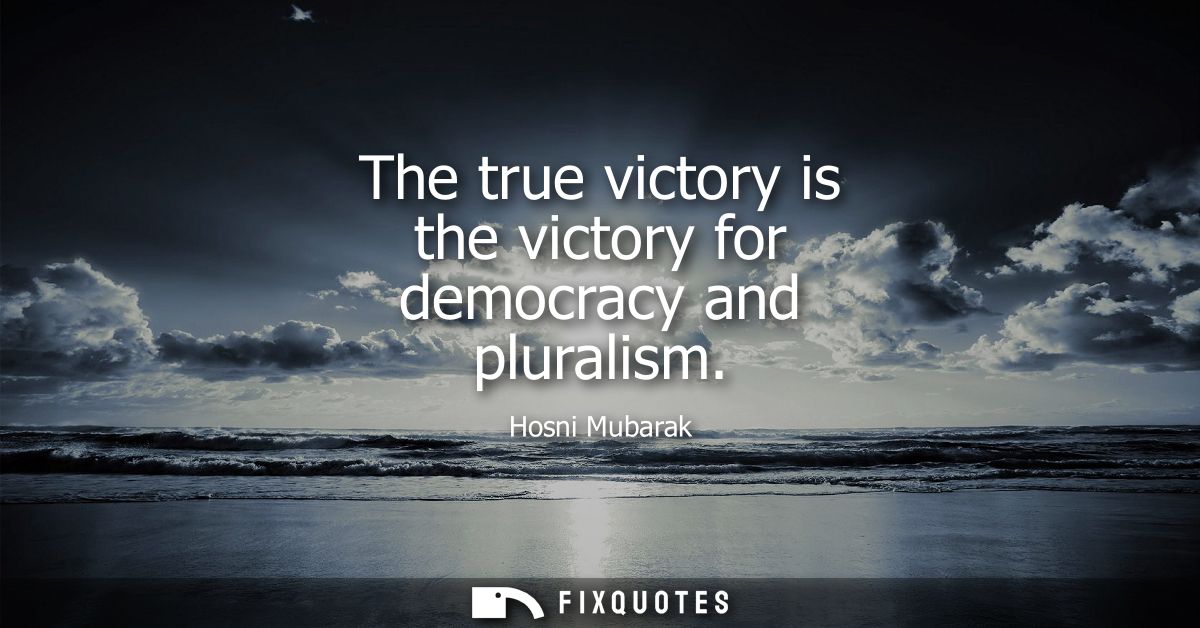
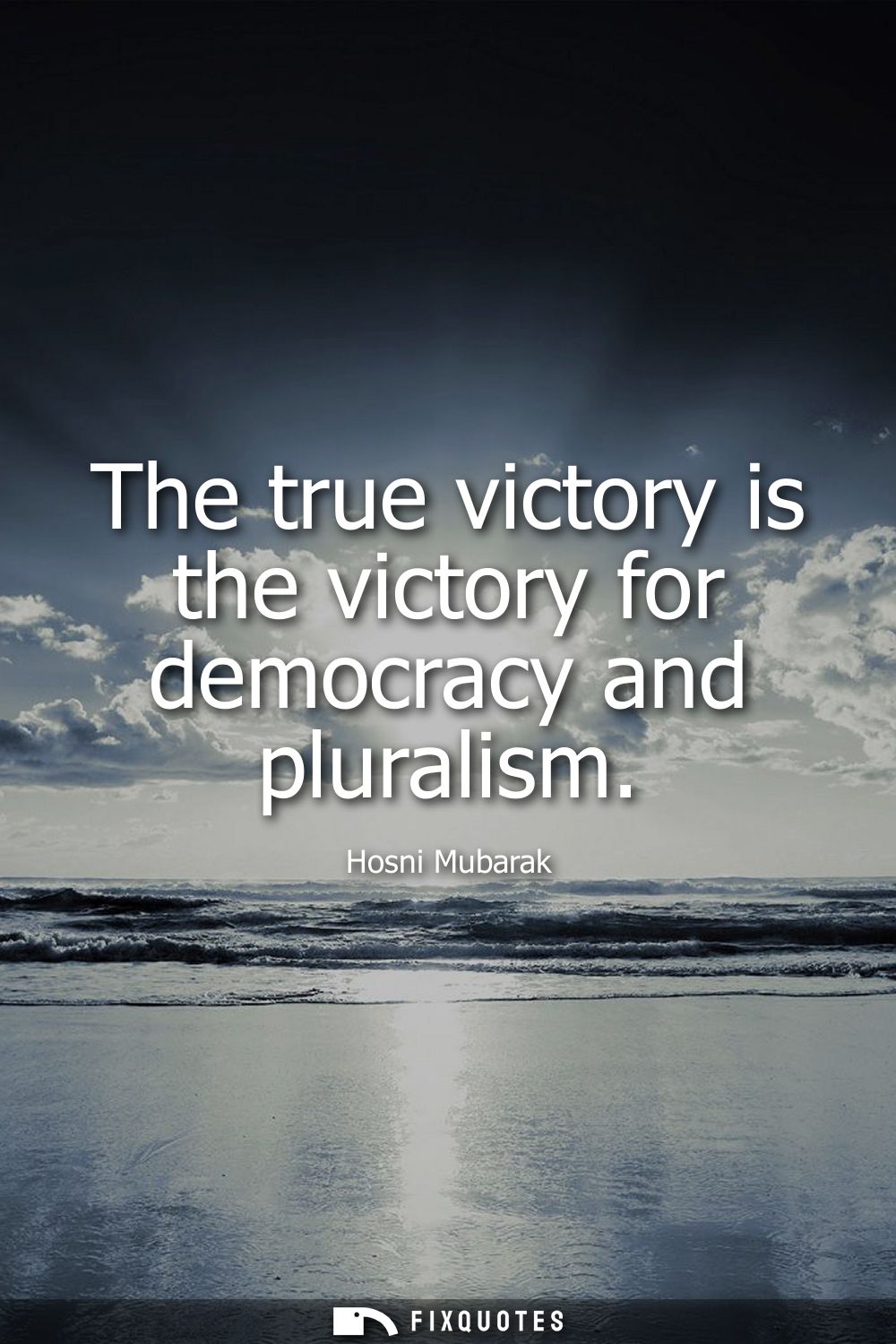
"The true victory is the victory for democracy and pluralism"
About this Quote
A line like this is designed to sound like a historical verdict while quietly controlling who gets to write the history. When Hosni Mubarak declares, "The true victory is the victory for democracy and pluralism", he’s not just praising an ideal; he’s trying to define the scoreboard. "True" signals a moral arbitration: whatever just happened - an election, a crackdown, a referendum, an uprising - its legitimacy will be measured by criteria he gets to invoke, reinterpret, or delay. It’s the language of closure, offered by a leader whose power depended on keeping politics open enough to look modern and closed enough to remain safe.
The pairing of "democracy" and "pluralism" is strategic. Democracy can be reduced to procedure: ballots, parliaments, constitutional tweaks. Pluralism is messier: competing parties, independent media, dissent with consequences. Putting them together lets the speaker borrow the glow of the second while maintaining the manageability of the first. It’s a promise that sounds expansive and, in authoritarian hands, becomes elastic - pluralism as curated diversity, democracy as stability.
Context does the heavy lifting. Mubarak governed Egypt for three decades under emergency law, with tightly bounded opposition and periodic gestures toward liberalization that often served as pressure valves. In that setting, "victory" reads less like a celebration than a preemptive claim: the state, not the street, will decide which outcomes count as democratic. It’s rhetorical legitimacy as crowd control - a regime’s preferred anthem when it wants applause for restraint while keeping its grip.
The pairing of "democracy" and "pluralism" is strategic. Democracy can be reduced to procedure: ballots, parliaments, constitutional tweaks. Pluralism is messier: competing parties, independent media, dissent with consequences. Putting them together lets the speaker borrow the glow of the second while maintaining the manageability of the first. It’s a promise that sounds expansive and, in authoritarian hands, becomes elastic - pluralism as curated diversity, democracy as stability.
Context does the heavy lifting. Mubarak governed Egypt for three decades under emergency law, with tightly bounded opposition and periodic gestures toward liberalization that often served as pressure valves. In that setting, "victory" reads less like a celebration than a preemptive claim: the state, not the street, will decide which outcomes count as democratic. It’s rhetorical legitimacy as crowd control - a regime’s preferred anthem when it wants applause for restraint while keeping its grip.
Quote Details
| Topic | Human Rights |
|---|---|
| Source | Help us find the source |
| Cite |
Citation Formats
APA Style (7th ed.)
Mubarak, Hosni. (2026, January 17). The true victory is the victory for democracy and pluralism. FixQuotes. https://fixquotes.com/quotes/the-true-victory-is-the-victory-for-democracy-and-48883/
Chicago Style
Mubarak, Hosni. "The true victory is the victory for democracy and pluralism." FixQuotes. January 17, 2026. https://fixquotes.com/quotes/the-true-victory-is-the-victory-for-democracy-and-48883/.
MLA Style (9th ed.)
"The true victory is the victory for democracy and pluralism." FixQuotes, 17 Jan. 2026, https://fixquotes.com/quotes/the-true-victory-is-the-victory-for-democracy-and-48883/. Accessed 3 Apr. 2026.
More Quotes by Hosni
Add to List