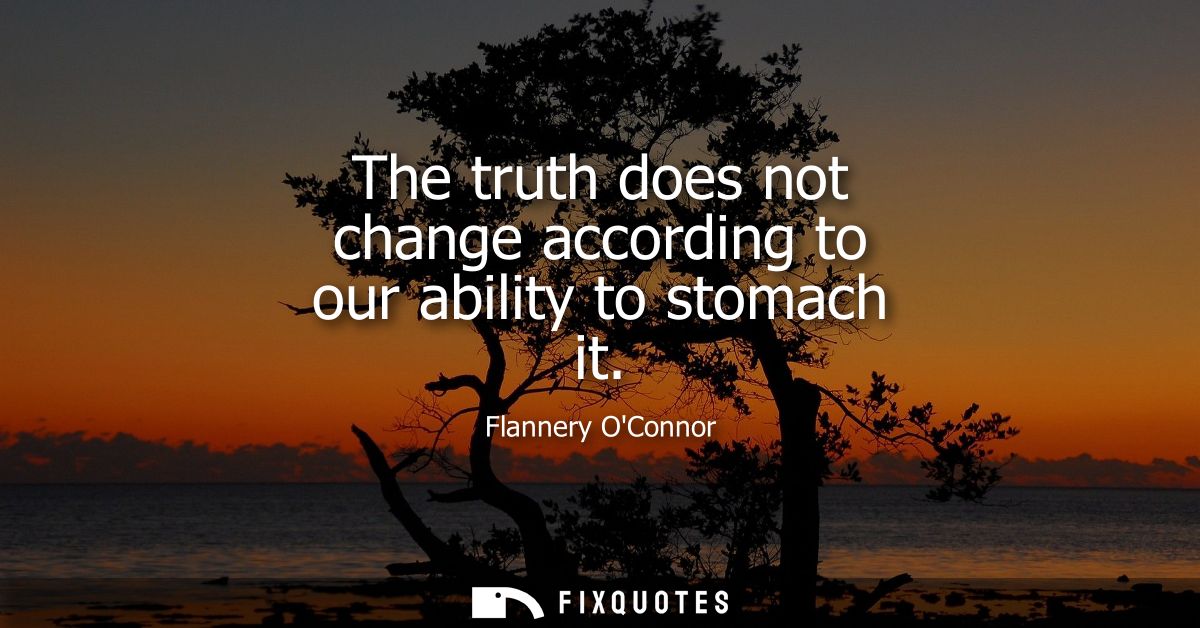
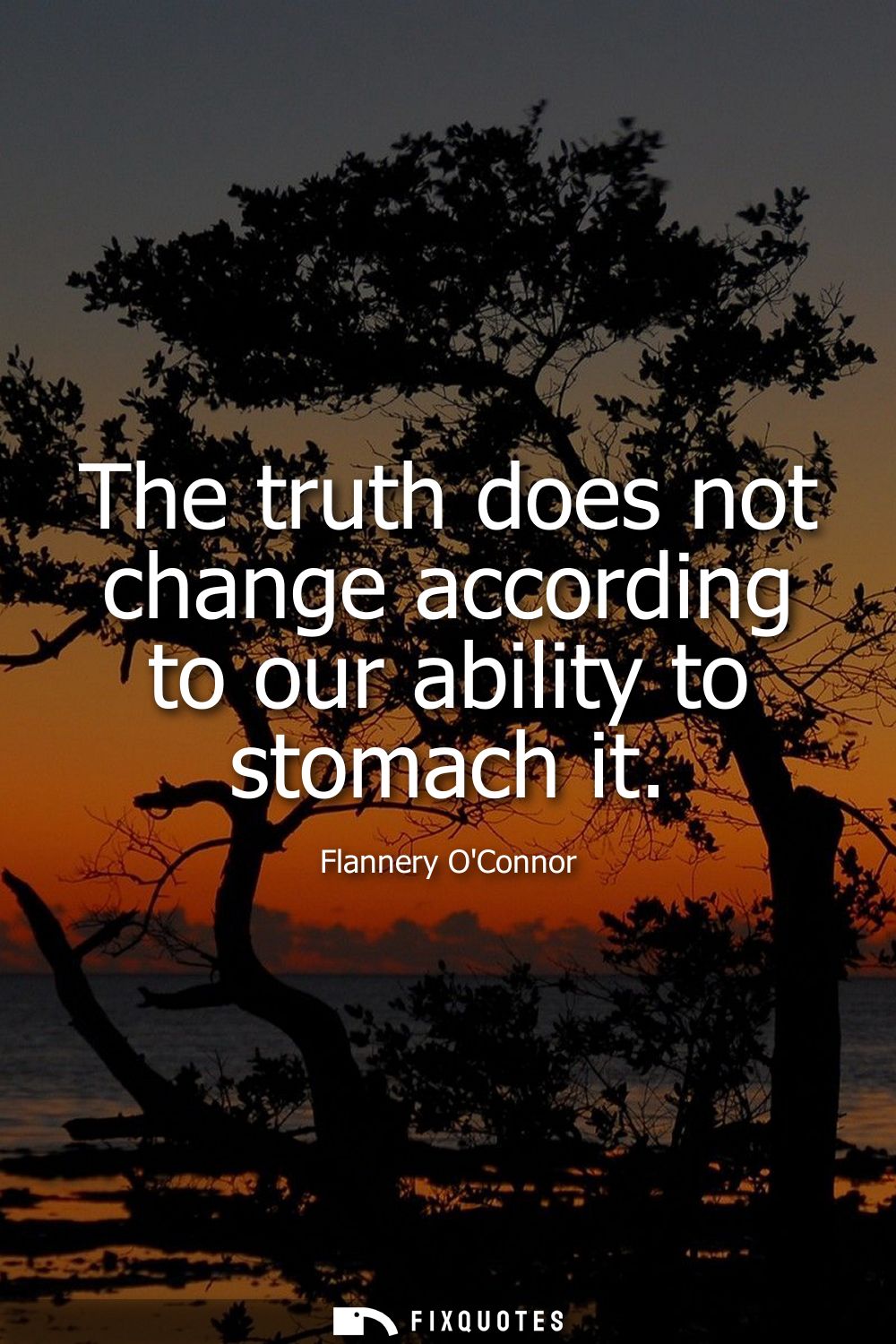
"The truth does not change according to our ability to stomach it"
About this Quote
O'Connor lands this line like a cold spoon on a fevered forehead: truth is not a lifestyle choice, and your nausea is not an argument. The sentence is built to deny the reader their favorite modern escape hatch, the idea that reality becomes negotiable once it feels unsafe. "Ability to stomach it" is doing sly work here. It's bodily, faintly comic, and faintly accusing. She frames denial not as intellectual confusion but as a kind of weak digestion, a failure of appetite for the world as it is. That makes the target less "ignorance" than self-protective squeamishness, the curated delicacy of people who want their convictions served without bones.
The intent is theological without preaching. O'Connor, a Catholic writing in mid-century Protestant Georgia, was obsessed with the gap between grace and comfort. Her fiction is full of characters who insist on their own goodness right up until reality breaks in - often violently - and exposes what they've refused to know about themselves. In that light, the line reads as a warning about sentimentality: the soft-focus moral worldview that collapses the moment it has to metabolize sin, suffering, or responsibility.
The subtext is also a jab at a culture that confuses emotional readiness with moral legitimacy. If you can't "stomach" a fact, you can label it harsh, unkind, or "not your truth" and move on. O'Connor isn't impressed. She suggests that maturity isn't having a truth that fits you; it's developing the gut to live with one that doesn't.
The intent is theological without preaching. O'Connor, a Catholic writing in mid-century Protestant Georgia, was obsessed with the gap between grace and comfort. Her fiction is full of characters who insist on their own goodness right up until reality breaks in - often violently - and exposes what they've refused to know about themselves. In that light, the line reads as a warning about sentimentality: the soft-focus moral worldview that collapses the moment it has to metabolize sin, suffering, or responsibility.
The subtext is also a jab at a culture that confuses emotional readiness with moral legitimacy. If you can't "stomach" a fact, you can label it harsh, unkind, or "not your truth" and move on. O'Connor isn't impressed. She suggests that maturity isn't having a truth that fits you; it's developing the gut to live with one that doesn't.
Quote Details
| Topic | Truth |
|---|---|
| Source | Help us find the source |
| Cite |
Citation Formats
APA Style (7th ed.)
O'Connor, Flannery. (2026, January 18). The truth does not change according to our ability to stomach it. FixQuotes. https://fixquotes.com/quotes/the-truth-does-not-change-according-to-our-14443/
Chicago Style
O'Connor, Flannery. "The truth does not change according to our ability to stomach it." FixQuotes. January 18, 2026. https://fixquotes.com/quotes/the-truth-does-not-change-according-to-our-14443/.
MLA Style (9th ed.)
"The truth does not change according to our ability to stomach it." FixQuotes, 18 Jan. 2026, https://fixquotes.com/quotes/the-truth-does-not-change-according-to-our-14443/. Accessed 18 Mar. 2026.
More Quotes by Flannery
Add to List