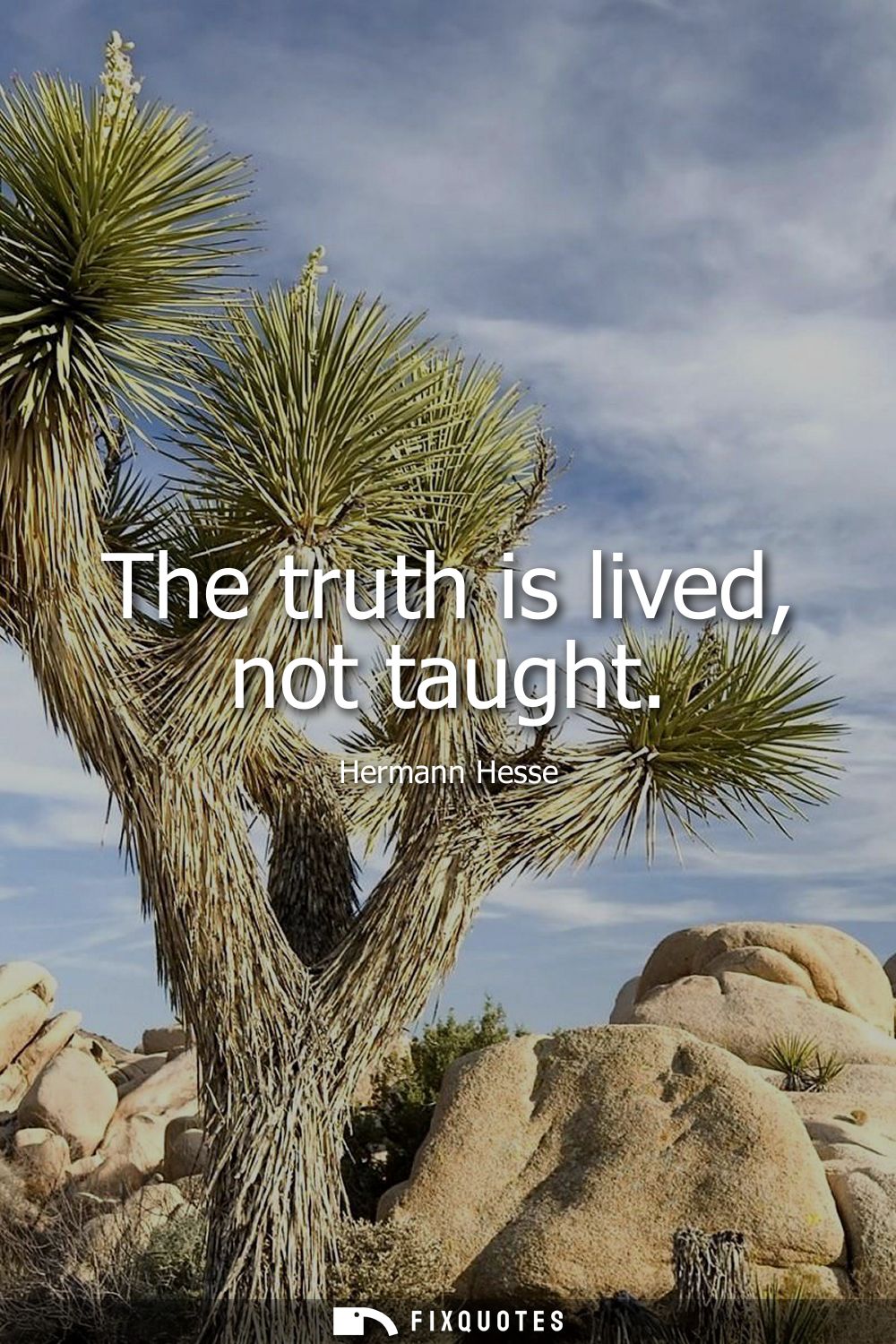
"The truth is lived, not taught"
About this Quote
Hesse’s line has the quiet bite of a novelist who distrusted sermons more than sin. “The truth is lived, not taught” isn’t anti-intellectual so much as anti-lecture: it treats secondhand wisdom as a counterfeit currency. You can memorize doctrines, recite philosophies, even pass examinations in enlightenment, and still remain untouched by the thing itself. The sentence works because it collapses the usual hierarchy: the teacher, the guru, the book all get demoted; experience gets promoted to the only credible authority.
The subtext is partly a rebuke to modernity’s obsession with instruction-as-salvation. If the world is messy, uncertain, and contradictory, then a tidy curriculum can feel like a comfort blanket. Hesse pulls it away. “Lived” implies risk, embarrassment, failure, appetite, and time - the unteachable textures that make convictions real. “Taught” implies replication: an idea transferred intact from one mind to another. Hesse suggests that the transfer is exactly where truth goes inert, turning from insight into posture.
Context matters. Writing in the aftermath of European upheaval and spiritual disillusionment, Hesse repeatedly stages the conflict between inherited systems and inner necessity. His protagonists don’t “learn” their way into authenticity; they stumble, break, wander, relapse. That’s not romanticizing suffering; it’s recognizing that certain understandings only arrive when the self is forced to negotiate with reality, not just interpret it.
The line also flatters no one. It denies both the teacher’s authority and the student’s shortcut. Truth demands participation, not attendance.
The subtext is partly a rebuke to modernity’s obsession with instruction-as-salvation. If the world is messy, uncertain, and contradictory, then a tidy curriculum can feel like a comfort blanket. Hesse pulls it away. “Lived” implies risk, embarrassment, failure, appetite, and time - the unteachable textures that make convictions real. “Taught” implies replication: an idea transferred intact from one mind to another. Hesse suggests that the transfer is exactly where truth goes inert, turning from insight into posture.
Context matters. Writing in the aftermath of European upheaval and spiritual disillusionment, Hesse repeatedly stages the conflict between inherited systems and inner necessity. His protagonists don’t “learn” their way into authenticity; they stumble, break, wander, relapse. That’s not romanticizing suffering; it’s recognizing that certain understandings only arrive when the self is forced to negotiate with reality, not just interpret it.
The line also flatters no one. It denies both the teacher’s authority and the student’s shortcut. Truth demands participation, not attendance.
Quote Details
| Topic | Truth |
|---|---|
| Source | Help us find the source |
| Cite |
Citation Formats
APA Style (7th ed.)
Hesse, Hermann. (2026, January 17). The truth is lived, not taught. FixQuotes. https://fixquotes.com/quotes/the-truth-is-lived-not-taught-55495/
Chicago Style
Hesse, Hermann. "The truth is lived, not taught." FixQuotes. January 17, 2026. https://fixquotes.com/quotes/the-truth-is-lived-not-taught-55495/.
MLA Style (9th ed.)
"The truth is lived, not taught." FixQuotes, 17 Jan. 2026, https://fixquotes.com/quotes/the-truth-is-lived-not-taught-55495/. Accessed 30 Mar. 2026.
More Quotes by Hermann
Add to List