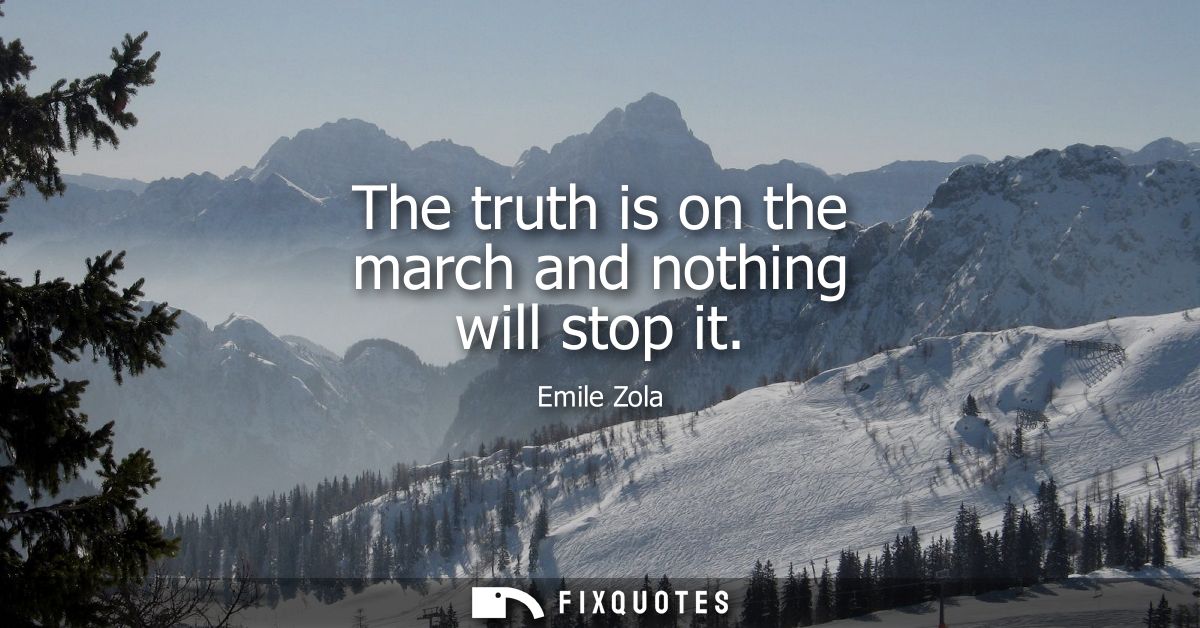
"The truth is on the march, and nothing will stop it"
About this Quote
A phrase like this is less a prediction than a provocation: truth as a street movement, boots on pavement, pushing through cordons. Zola isn’t arguing in the polite, salon sense; he’s mobilizing. “On the march” steals the vocabulary of armies and revolutions, turning an abstract ideal into a disciplined force with direction, momentum, and numbers. It’s rhetoric designed to stiffen spines when institutions are wobbling and the cost of clarity feels personal.
The line lands hardest in the shadow of the Dreyfus Affair, when Zola’s “J’accuse...!” made him a target for the French state and its allies in the press. He knew firsthand that “truth” doesn’t float to the surface on its own; it gets buried under nationalism, antisemitism, and bureaucratic self-protection. So the confidence here is strategic. “Nothing will stop it” isn’t naivete about power; it’s a refusal to grant power the final word. Zola is trying to outlast the smear, the lawsuit, the exile, the fatigue.
The subtext is a rebuke to the comfortable skeptic: you can pretend the facts are debatable, but history’s pressure is building. Still, the sentence carries a novelist’s sense of narrative inevitability. Zola frames truth as the protagonist in a long plot: delayed, obstructed, nearly killed off, yet structurally destined to return. It works because it converts moral outrage into forward motion, giving readers a role not just as observers, but as the legs that make “the march” real.
The line lands hardest in the shadow of the Dreyfus Affair, when Zola’s “J’accuse...!” made him a target for the French state and its allies in the press. He knew firsthand that “truth” doesn’t float to the surface on its own; it gets buried under nationalism, antisemitism, and bureaucratic self-protection. So the confidence here is strategic. “Nothing will stop it” isn’t naivete about power; it’s a refusal to grant power the final word. Zola is trying to outlast the smear, the lawsuit, the exile, the fatigue.
The subtext is a rebuke to the comfortable skeptic: you can pretend the facts are debatable, but history’s pressure is building. Still, the sentence carries a novelist’s sense of narrative inevitability. Zola frames truth as the protagonist in a long plot: delayed, obstructed, nearly killed off, yet structurally destined to return. It works because it converts moral outrage into forward motion, giving readers a role not just as observers, but as the legs that make “the march” real.
Quote Details
| Topic | Truth |
|---|---|
| Source | Help us find the source |
| Cite |
Citation Formats
APA Style (7th ed.)
Zola, Emile. (2026, February 20). The truth is on the march, and nothing will stop it. FixQuotes. https://fixquotes.com/quotes/the-truth-is-on-the-march-and-nothing-will-stop-it-4216/
Chicago Style
Zola, Emile. "The truth is on the march, and nothing will stop it." FixQuotes. February 20, 2026. https://fixquotes.com/quotes/the-truth-is-on-the-march-and-nothing-will-stop-it-4216/.
MLA Style (9th ed.)
"The truth is on the march, and nothing will stop it." FixQuotes, 20 Feb. 2026, https://fixquotes.com/quotes/the-truth-is-on-the-march-and-nothing-will-stop-it-4216/. Accessed 1 Apr. 2026.
More Quotes by Emile
Add to List