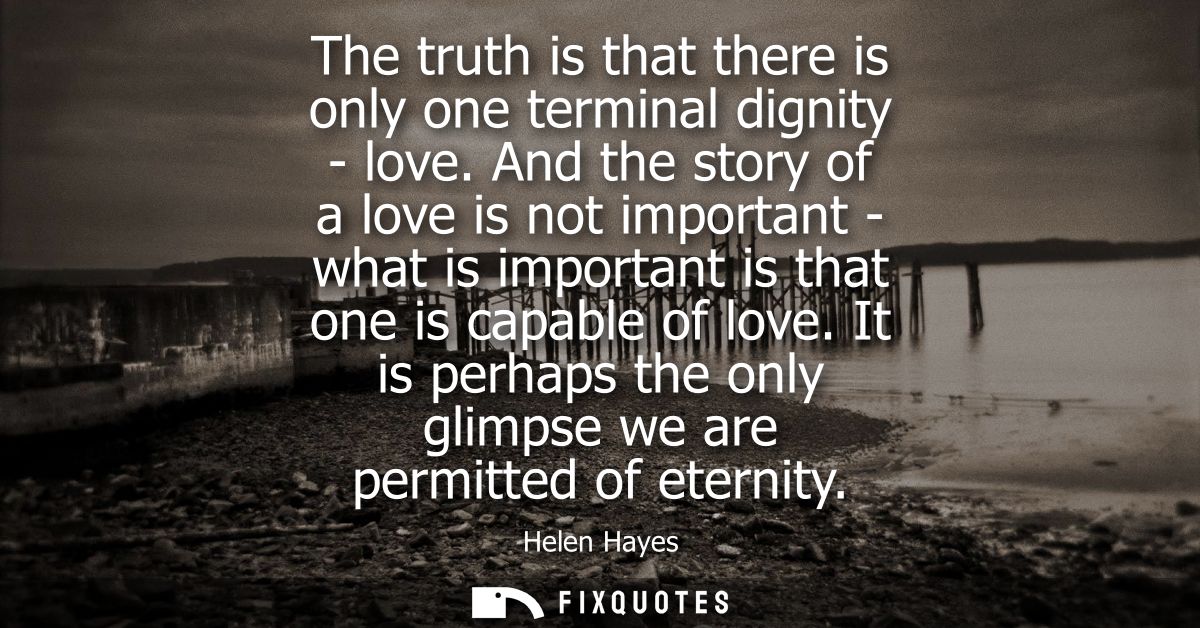
"The truth is that there is only one terminal dignity - love. And the story of a love is not important - what is important is that one is capable of love. It is perhaps the only glimpse we are permitted of eternity"
About this Quote
The phrasing is strategic. "Terminal" smuggles in mortality; dignity is what you hope to have when you’re out of options. Love becomes the one thing that can’t be taken away by age, illness, failure, or public forgetting - all hazards Hayes would have understood in an industry built to replace you. By calling it "one terminal dignity", she also suggests that other dignities are conditional: status, reputation, even self-possession depend on circumstances. Love, in her telling, is the dignity you can still choose.
Then she takes the sharpest turn: "the story of a love is not important". That’s not anti-romance; it’s anti-spectacle. The subtext reads like a rebuke to the romantic marketplace that turns private attachment into public content. Love’s value is interior and ethical, measured by what it makes you capable of - attention, sacrifice, mercy.
"Eternity" arrives not as theology but as a brief sensory window: love as the one human experience that feels larger than time. Not proof of the afterlife, but a moment when the self stops being the main character and time briefly loosens its grip.
Quote Details
| Topic | Love |
|---|---|
| Source | Help us find the source |
| Cite |
Citation Formats
APA Style (7th ed.)
Hayes, Helen. (2026, January 17). The truth is that there is only one terminal dignity - love. And the story of a love is not important - what is important is that one is capable of love. It is perhaps the only glimpse we are permitted of eternity. FixQuotes. https://fixquotes.com/quotes/the-truth-is-that-there-is-only-one-terminal-26321/
Chicago Style
Hayes, Helen. "The truth is that there is only one terminal dignity - love. And the story of a love is not important - what is important is that one is capable of love. It is perhaps the only glimpse we are permitted of eternity." FixQuotes. January 17, 2026. https://fixquotes.com/quotes/the-truth-is-that-there-is-only-one-terminal-26321/.
MLA Style (9th ed.)
"The truth is that there is only one terminal dignity - love. And the story of a love is not important - what is important is that one is capable of love. It is perhaps the only glimpse we are permitted of eternity." FixQuotes, 17 Jan. 2026, https://fixquotes.com/quotes/the-truth-is-that-there-is-only-one-terminal-26321/. Accessed 3 Apr. 2026.