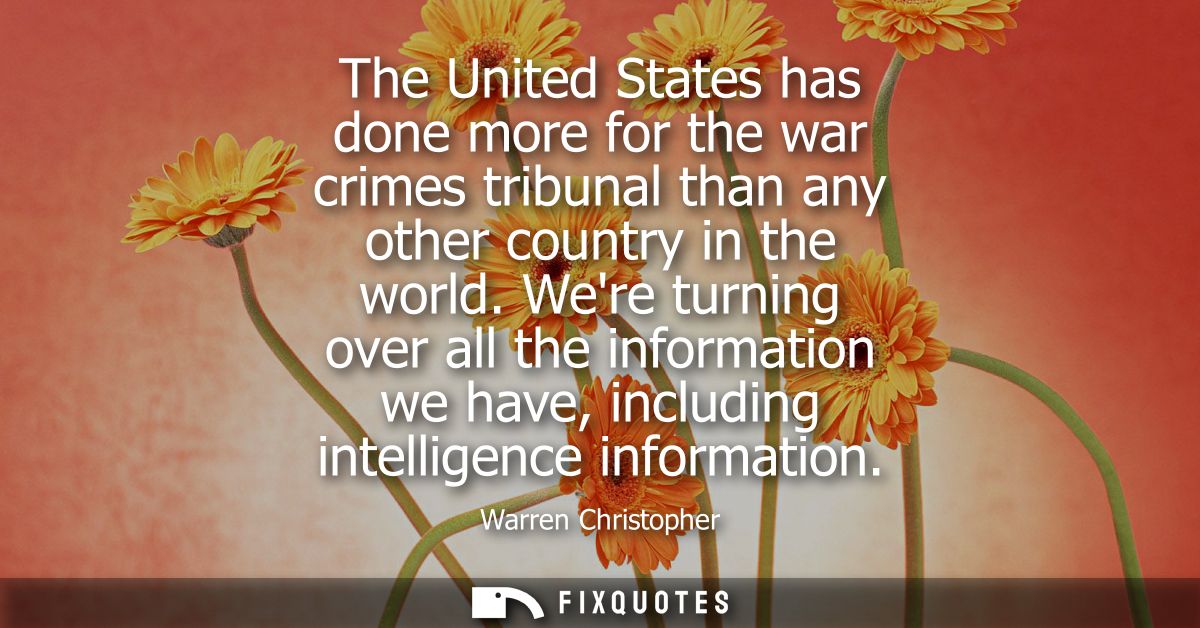
"The United States has done more for the war crimes tribunal than any other country in the world. We're turning over all the information we have, including intelligence information"
About this Quote
The second sentence is where the real work happens. “We’re turning over all the information we have” sounds absolute, then immediately narrows into a controlled disclosure: “including intelligence information.” That qualifier functions like a pressure release valve. Intelligence is the currency of modern conflict - also the thing most governments guard, redact, or launder through allies. By emphasizing intelligence sharing, Christopher signals seriousness while also reassuring skeptics that the tribunal won’t be starved of proof. At the same time, it preemptively blunts accusations of selective transparency: if the U.S. is giving up its most sensitive material, who can call it half-hearted?
Context matters: post-Cold War humanitarian interventions and the rise of ad hoc tribunals (notably for the former Yugoslavia and Rwanda) put U.S. power in a new role - less conqueror, more custodian of “rules-based order,” even as Washington remained wary of legal constraints on its own actions. The subtext is transactional: we’ll feed you evidence, and in return the tribunal’s legitimacy - and its targets - won’t drift beyond the boundaries of U.S. strategic comfort.
Quote Details
| Topic | Justice |
|---|---|
| Source | Help us find the source |
| Cite |
Citation Formats
APA Style (7th ed.)
Christopher, Warren. (2026, January 18). The United States has done more for the war crimes tribunal than any other country in the world. We're turning over all the information we have, including intelligence information. FixQuotes. https://fixquotes.com/quotes/the-united-states-has-done-more-for-the-war-12188/
Chicago Style
Christopher, Warren. "The United States has done more for the war crimes tribunal than any other country in the world. We're turning over all the information we have, including intelligence information." FixQuotes. January 18, 2026. https://fixquotes.com/quotes/the-united-states-has-done-more-for-the-war-12188/.
MLA Style (9th ed.)
"The United States has done more for the war crimes tribunal than any other country in the world. We're turning over all the information we have, including intelligence information." FixQuotes, 18 Jan. 2026, https://fixquotes.com/quotes/the-united-states-has-done-more-for-the-war-12188/. Accessed 4 Apr. 2026.