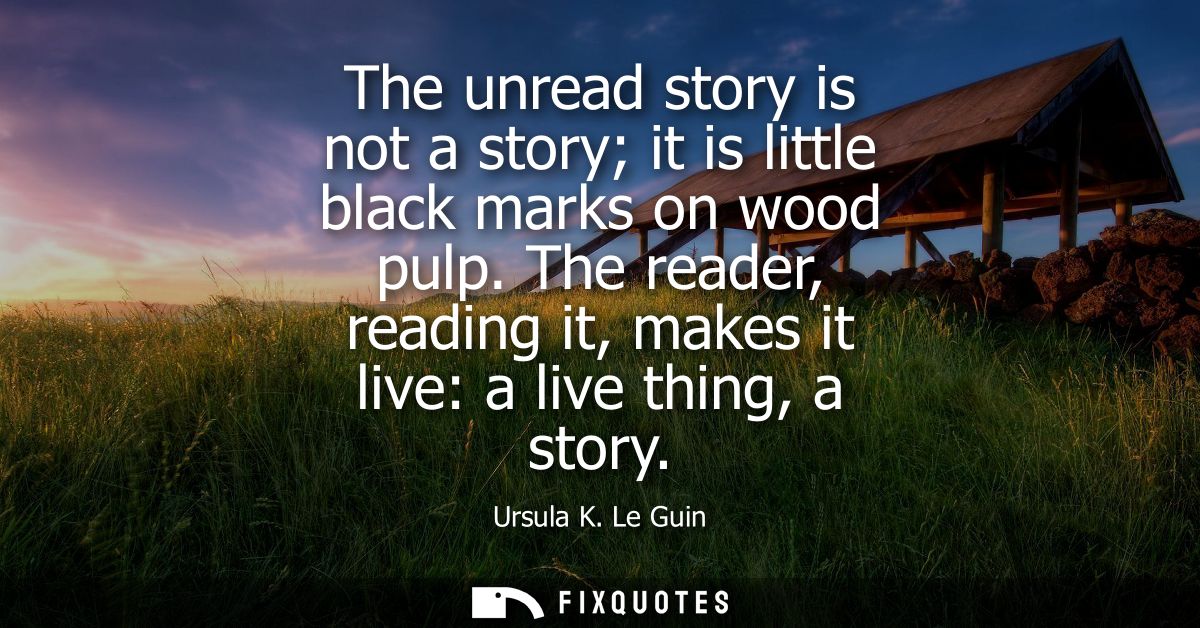
"The unread story is not a story; it is little black marks on wood pulp. The reader, reading it, makes it live: a live thing, a story"
About this Quote
The subtext is a quiet rebuke to author-worship and to the idea of the text as a sealed container of “content.” Le Guin is insisting on co-authorship without flattening the writer’s craft. A story can be exquisitely made and still remain inert until it meets attention, imagination, memory, and desire. That shift relocates power: not away from the writer, but away from the commodity. The book is not the story; the story is the relationship.
Context helps. Le Guin spent a career writing speculative fiction that treats worlds as systems - languages, rituals, politics - and she knew how much any system depends on participation. Her line also echoes her essays on craft and on the moral seriousness of fantasy: the “live thing” is what can change a reader’s interior weather, what can smuggle in empathy, doubt, or courage under the guise of narrative pleasure.
It’s an argument for literacy as a creative act, not a box to check. The unread story isn’t dead because it failed; it’s dormant because stories, like spells, require a speaker.
Quote Details
| Topic | Writing |
|---|---|
| Source | Verified source: Dancing at the Edge of the World (Ursula K. Le Guin, 1989)ISBN: 9780802135292 · ID: QK6TYg32CocC
Evidence:
... The unread story is not a story ; it is little black marks on wood pulp . The reader , reading it , makes it live : a live thing , a story ... URSULA K. LE GUIN. |
| Cite |
Citation Formats
APA Style (7th ed.)
Guin, Ursula K. Le. (2026, March 29). The unread story is not a story; it is little black marks on wood pulp. The reader, reading it, makes it live: a live thing, a story. FixQuotes. https://fixquotes.com/quotes/the-unread-story-is-not-a-story-it-is-little-82969/
Chicago Style
Guin, Ursula K. Le. "The unread story is not a story; it is little black marks on wood pulp. The reader, reading it, makes it live: a live thing, a story." FixQuotes. March 29, 2026. https://fixquotes.com/quotes/the-unread-story-is-not-a-story-it-is-little-82969/.
MLA Style (9th ed.)
"The unread story is not a story; it is little black marks on wood pulp. The reader, reading it, makes it live: a live thing, a story." FixQuotes, 29 Mar. 2026, https://fixquotes.com/quotes/the-unread-story-is-not-a-story-it-is-little-82969/. Accessed 3 Apr. 2026.