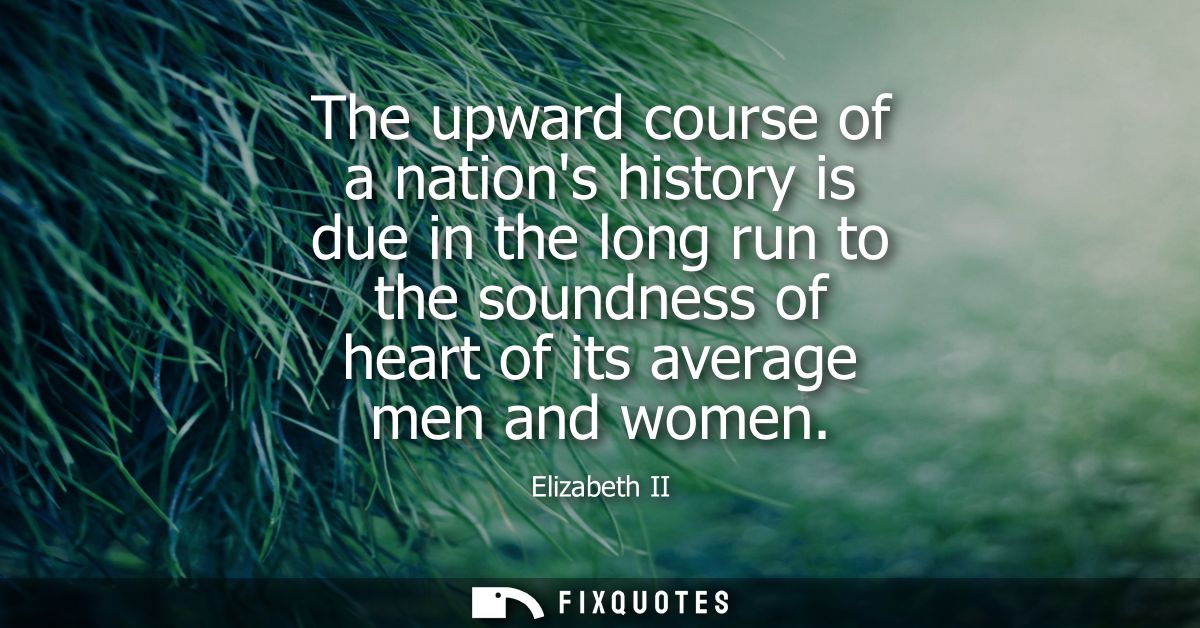
"The upward course of a nation's history is due, in the long run, to the soundness of heart of its average men and women"
About this Quote
The intent is stabilizing. Postwar Britain lived through rationing, decolonization, labor upheaval, and cultural secularization; the Crown’s survival depended on presenting continuity without demanding authority. By praising average people as the long-run authors of national ascent, Elizabeth aligns the monarchy with the public mood of service and endurance, especially the wartime mythos of quiet courage. It’s less a political claim than a civic mood board: decency, restraint, duty.
The subtext is gently prescriptive. “Average” is doing heavy lifting, elevating the mainstream over the charismatic, the extreme, the loud. “Soundness of heart” implies that the true threat to a nation isn’t merely bad policy but moral corrosion: selfishness, cynicism, cruelty. It’s a soft rebuke delivered as reassurance.
Rhetorically, it works because it offers a hopeful teleology (“upward course”) without triumphalism (“in the long run”), and it makes virtue feel collective rather than heroic. It’s monarchy speaking in the idiom of national character: not command, but calibration.
Quote Details
| Topic | Honesty & Integrity |
|---|---|
| Source | Help us find the source |
| Cite |
Citation Formats
APA Style (7th ed.)
II, Elizabeth. (2026, February 20). The upward course of a nation's history is due, in the long run, to the soundness of heart of its average men and women. FixQuotes. https://fixquotes.com/quotes/the-upward-course-of-a-nations-history-is-due-in-15460/
Chicago Style
II, Elizabeth. "The upward course of a nation's history is due, in the long run, to the soundness of heart of its average men and women." FixQuotes. February 20, 2026. https://fixquotes.com/quotes/the-upward-course-of-a-nations-history-is-due-in-15460/.
MLA Style (9th ed.)
"The upward course of a nation's history is due, in the long run, to the soundness of heart of its average men and women." FixQuotes, 20 Feb. 2026, https://fixquotes.com/quotes/the-upward-course-of-a-nations-history-is-due-in-15460/. Accessed 3 Apr. 2026.