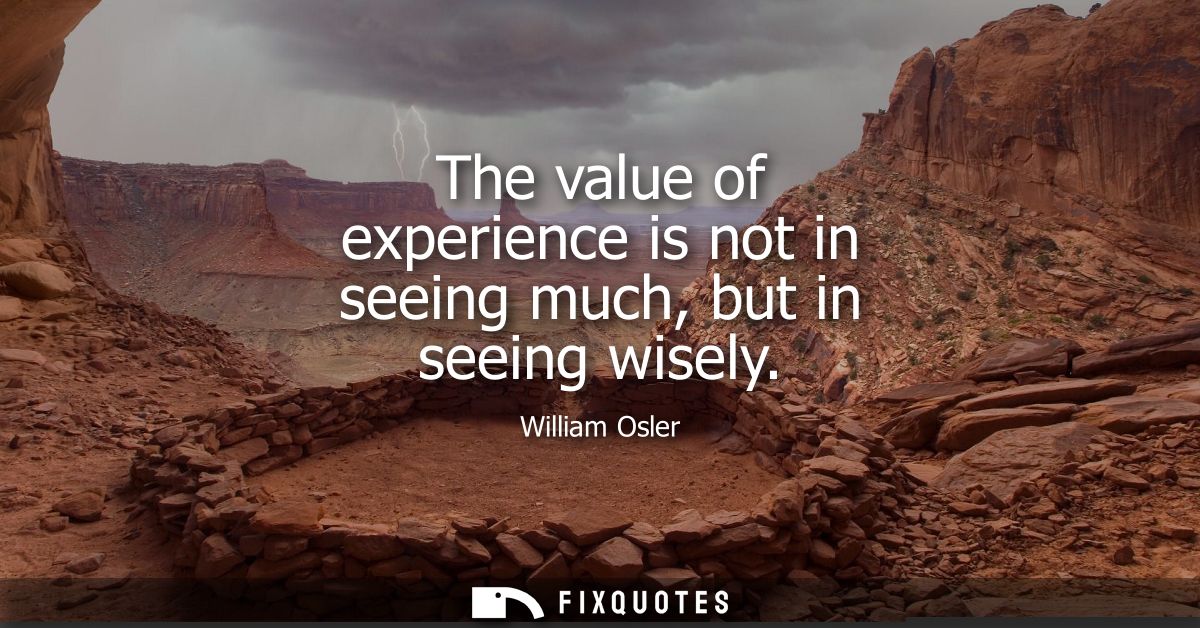
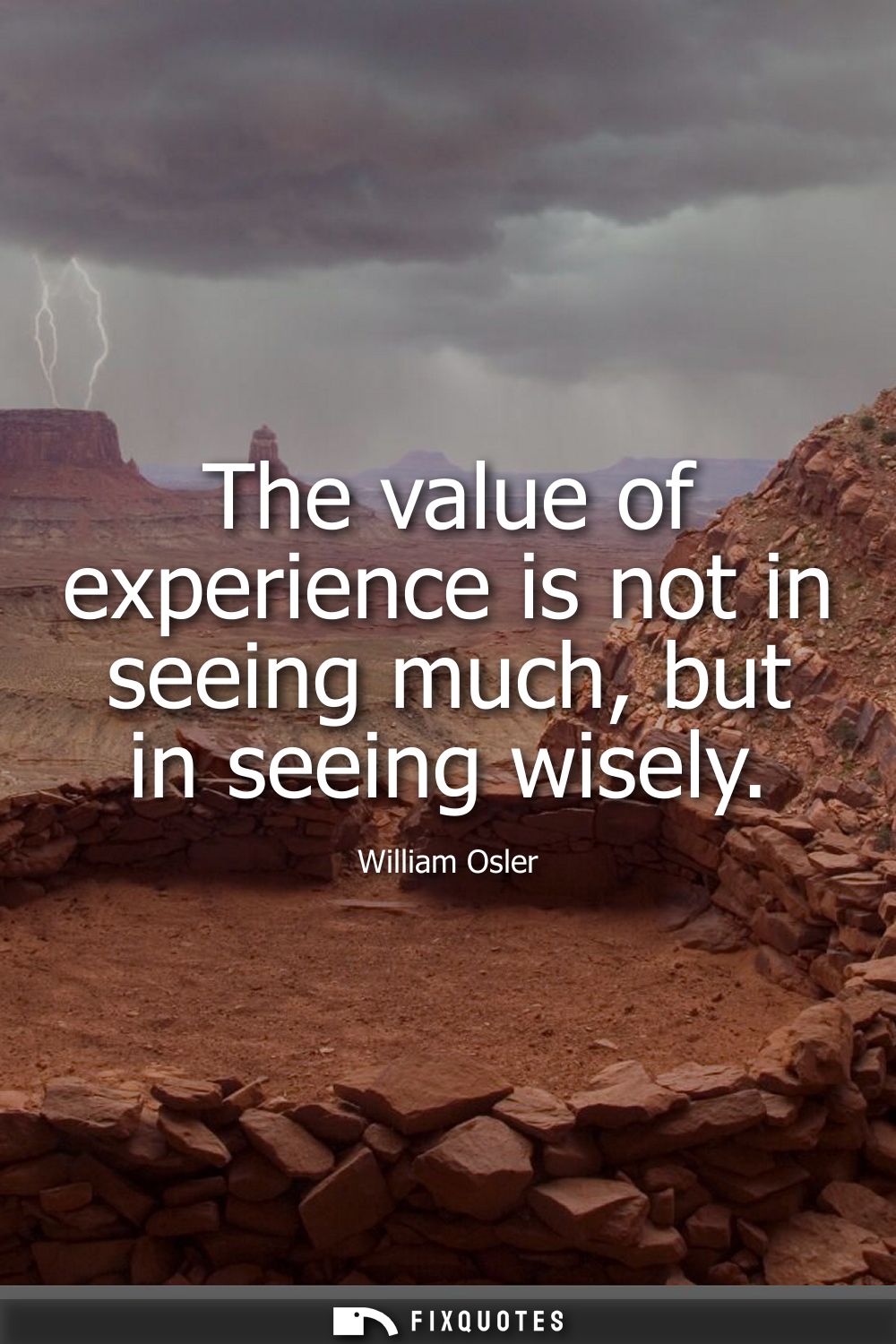
"The value of experience is not in seeing much, but in seeing wisely"
About this Quote
Osler aims a scalpel at a seductive professional myth: that sheer exposure equals expertise. In medicine, law, journalism, any field that rewards long hours and war stories, it’s easy to confuse mileage with mastery. “Seeing much” is the badge of the veteran; “seeing wisely” is the harder, quieter skill - the disciplined ability to notice what matters, doubt your first impressions, and update your judgment when reality refuses to cooperate.
The line works because it reframes experience as an interpretive act, not a trophy case. Osler isn’t dismissing volume; he’s warning that accumulation without reflection just calcifies into habit. The subtext is an attack on complacency: you can watch a thousand cases, sit through a thousand meetings, scroll through a thousand headlines, and still fail to understand the pattern underneath. Wisdom here means calibrated attention, humility about what you don’t know, and the courage to resist the comforting story your brain wants to tell.
Context sharpens the point. Osler helped professionalize modern clinical training, pushing medicine toward bedside observation and away from armchair theory. That reform created its own temptation: equating the clinic’s constant flow with automatic insight. His aphorism is a corrective for the era’s rising empiricism, insisting that facts don’t speak; practitioners do. The quote doubles as a moral instruction: your authority isn’t earned by how much you’ve witnessed, but by how responsibly you interpret what you’ve seen.
The line works because it reframes experience as an interpretive act, not a trophy case. Osler isn’t dismissing volume; he’s warning that accumulation without reflection just calcifies into habit. The subtext is an attack on complacency: you can watch a thousand cases, sit through a thousand meetings, scroll through a thousand headlines, and still fail to understand the pattern underneath. Wisdom here means calibrated attention, humility about what you don’t know, and the courage to resist the comforting story your brain wants to tell.
Context sharpens the point. Osler helped professionalize modern clinical training, pushing medicine toward bedside observation and away from armchair theory. That reform created its own temptation: equating the clinic’s constant flow with automatic insight. His aphorism is a corrective for the era’s rising empiricism, insisting that facts don’t speak; practitioners do. The quote doubles as a moral instruction: your authority isn’t earned by how much you’ve witnessed, but by how responsibly you interpret what you’ve seen.
Quote Details
| Topic | Wisdom |
|---|---|
| Source | Help us find the source |
| Cite |
Citation Formats
APA Style (7th ed.)
Osler, William. (2026, January 16). The value of experience is not in seeing much, but in seeing wisely. FixQuotes. https://fixquotes.com/quotes/the-value-of-experience-is-not-in-seeing-much-but-97906/
Chicago Style
Osler, William. "The value of experience is not in seeing much, but in seeing wisely." FixQuotes. January 16, 2026. https://fixquotes.com/quotes/the-value-of-experience-is-not-in-seeing-much-but-97906/.
MLA Style (9th ed.)
"The value of experience is not in seeing much, but in seeing wisely." FixQuotes, 16 Jan. 2026, https://fixquotes.com/quotes/the-value-of-experience-is-not-in-seeing-much-but-97906/. Accessed 12 Feb. 2026.
More Quotes by William
Add to List