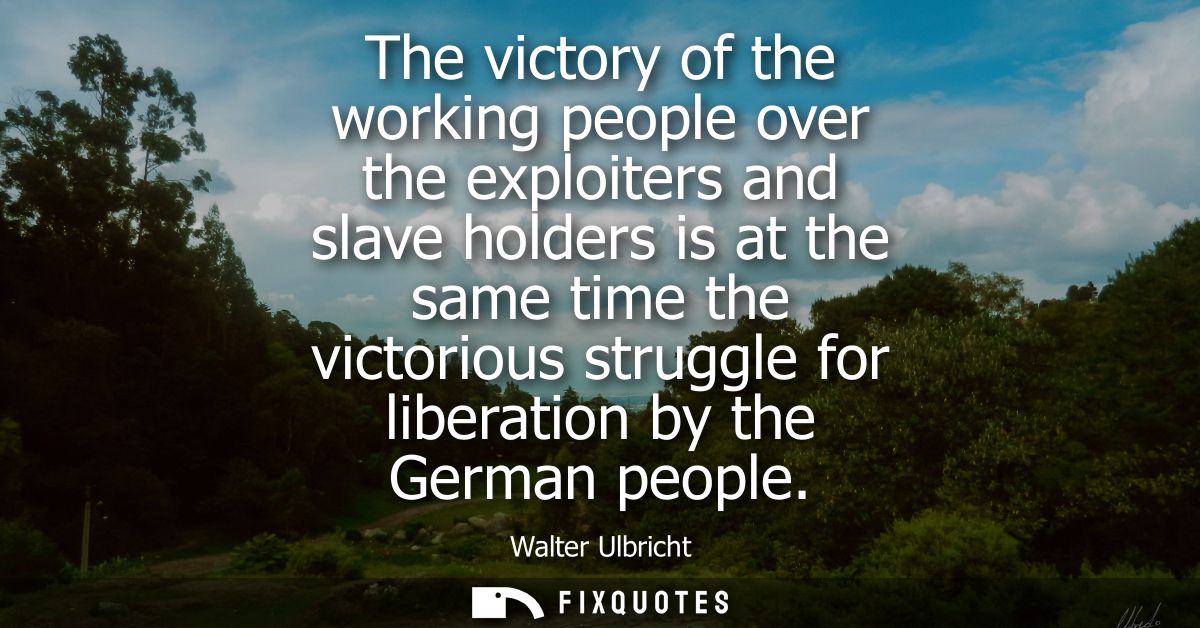
"The victory of the working people over the exploiters and slave holders is at the same time the victorious struggle for liberation by the German people"
About this Quote
That identity claim matters in Ulbricht’s context. As the Soviet-backed leader of East Germany, he needed socialism to read not as foreign imposition but as the authentic answer to Germany’s catastrophe: fascism, war, occupation, and division. By labeling opponents “exploiters and slave holders,” he collapses a wide range of targets into a single moral category: capitalists, landowners, industrialists, but also anyone resisting the new order. The language is deliberately archaic and absolutist. “Slave holders” isn’t an economic descriptor so much as a stigma, a way to deny legitimacy to rival parties and to cast coercive state-building as emancipatory cleanup.
The subtext is a demand for unity under the party’s definition of “the people.” If the working class’s triumph equals the nation’s liberation, then dissent becomes something darker than disagreement - it becomes betrayal of Germany itself. It’s a rhetorical preemption of pluralism: there can be no competing route to “liberation,” because Ulbricht has already welded the national interest to a single ideological outcome.
In the Cold War, that weld did real work. It reframed geopolitical alignment with Moscow as patriotic necessity, while turning the domestic consolidation of power into a moral crusade.
Quote Details
| Topic | Freedom |
|---|---|
| Source | Help us find the source |
| Cite |
Citation Formats
APA Style (7th ed.)
Ulbricht, Walter. (2026, January 17). The victory of the working people over the exploiters and slave holders is at the same time the victorious struggle for liberation by the German people. FixQuotes. https://fixquotes.com/quotes/the-victory-of-the-working-people-over-the-73383/
Chicago Style
Ulbricht, Walter. "The victory of the working people over the exploiters and slave holders is at the same time the victorious struggle for liberation by the German people." FixQuotes. January 17, 2026. https://fixquotes.com/quotes/the-victory-of-the-working-people-over-the-73383/.
MLA Style (9th ed.)
"The victory of the working people over the exploiters and slave holders is at the same time the victorious struggle for liberation by the German people." FixQuotes, 17 Jan. 2026, https://fixquotes.com/quotes/the-victory-of-the-working-people-over-the-73383/. Accessed 13 Mar. 2026.