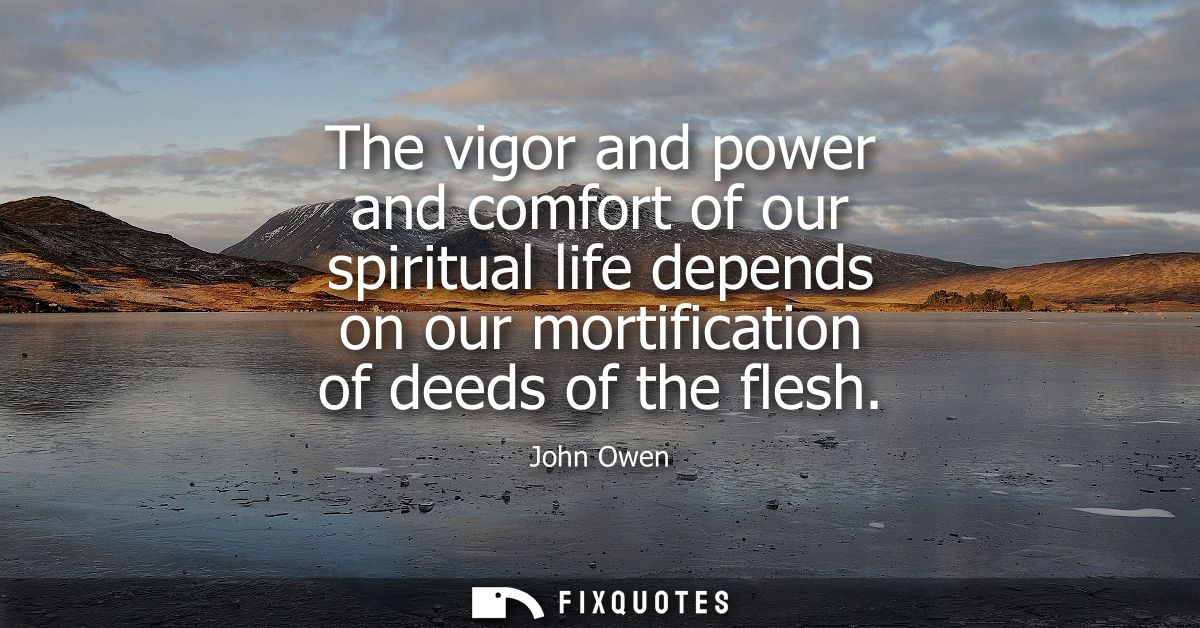
"The vigor and power and comfort of our spiritual life depends on our mortification of deeds of the flesh"
About this Quote
The intent is pastoral and polemical at once. Owen is trying to make holiness feel mechanically reliable: spiritual vitality is not a mood bestowed by heaven; it is the predictable consequence of disciplined self-denial. That rhetorical move matters in a 17th-century Puritan world anxious about assurance, always scanning for evidence that grace is real. Mortification becomes an audit trail. If you can name the desire, resist it, and let it wither, you can also believe you’re alive to God.
The subtext is stern but oddly consoling: suffering can be translated into meaning. "Comfort" is the tell. Owen isn’t romanticizing misery for its own sake; he’s selling a kind of inner stability purchased through restraint. There’s also a quiet warning embedded in "depends": fail here, and the entire spiritual economy goes soft. In an age of civil upheaval and moral suspicion, the private war against the flesh doubles as social argument - the godly self, governed from within, is fit to help govern the world.
Quote Details
| Topic | Faith |
|---|---|
| Source | Help us find the source |
| Cite |
Citation Formats
APA Style (7th ed.)
Owen, John. (2026, January 18). The vigor and power and comfort of our spiritual life depends on our mortification of deeds of the flesh. FixQuotes. https://fixquotes.com/quotes/the-vigor-and-power-and-comfort-of-our-spiritual-9425/
Chicago Style
Owen, John. "The vigor and power and comfort of our spiritual life depends on our mortification of deeds of the flesh." FixQuotes. January 18, 2026. https://fixquotes.com/quotes/the-vigor-and-power-and-comfort-of-our-spiritual-9425/.
MLA Style (9th ed.)
"The vigor and power and comfort of our spiritual life depends on our mortification of deeds of the flesh." FixQuotes, 18 Jan. 2026, https://fixquotes.com/quotes/the-vigor-and-power-and-comfort-of-our-spiritual-9425/. Accessed 12 Feb. 2026.