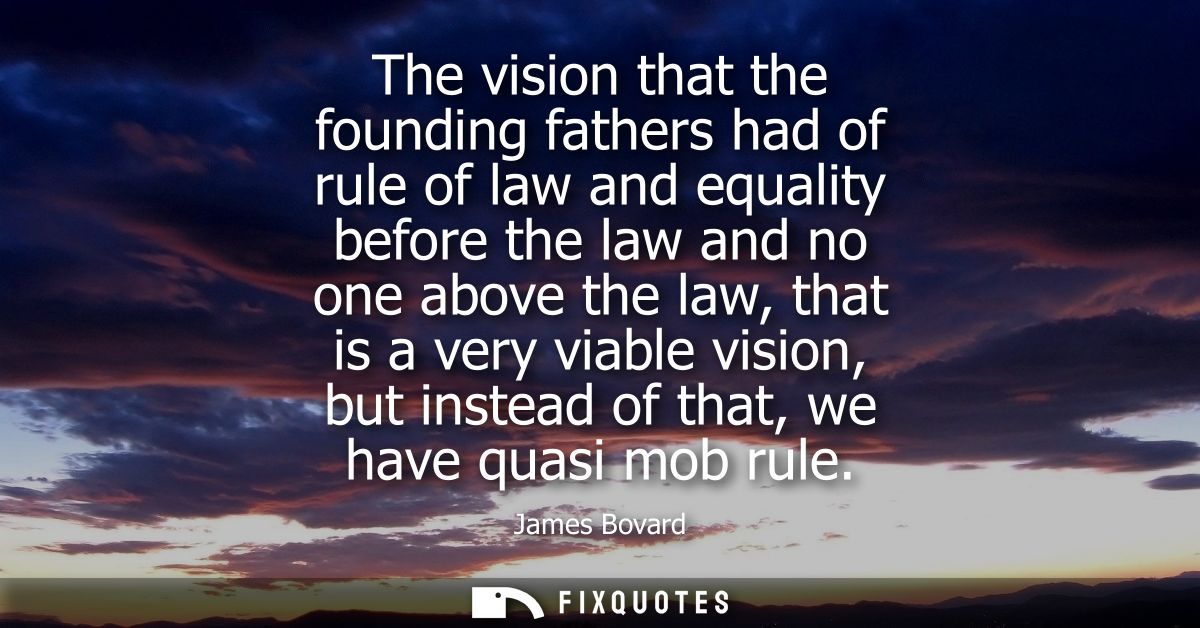
"The vision that the Founding Fathers had of rule of law and equality before the law and no one above the law, that is a very viable vision, but instead of that, we have quasi mob rule"
About this Quote
Then comes the pivot: “instead of that.” The contrast is not policy-versus-policy; it’s civilization-versus-crowd. “Quasi mob rule” is carefully calibrated outrage. “Mob rule” alone would be pure alarm; “quasi” adds a libertarian journalist’s fingerprint - a claim that our systems still wear the costume of legality (courts, procedures, official rhetoric) while operating with the logic of selective enforcement, factional payback, and public intimidation. It suggests a state that prosecutes like a clan and governs like a pressure campaign.
Contextually, Bovard has spent decades critiquing executive power, surveillance, and bureaucratic impunity. This quote fits that project: it frames contemporary politics as a drift from neutral rules to situational justice, where status and allegiance determine consequences. The subtext is less “society is chaotic” than “authority has learned to outsource its lawlessness to the crowd - and then call it democracy.”
Quote Details
| Topic | Justice |
|---|---|
| Source | Help us find the source |
| Cite |
Citation Formats
APA Style (7th ed.)
Bovard, James. (2026, February 18). The vision that the Founding Fathers had of rule of law and equality before the law and no one above the law, that is a very viable vision, but instead of that, we have quasi mob rule. FixQuotes. https://fixquotes.com/quotes/the-vision-that-the-founding-fathers-had-of-rule-86035/
Chicago Style
Bovard, James. "The vision that the Founding Fathers had of rule of law and equality before the law and no one above the law, that is a very viable vision, but instead of that, we have quasi mob rule." FixQuotes. February 18, 2026. https://fixquotes.com/quotes/the-vision-that-the-founding-fathers-had-of-rule-86035/.
MLA Style (9th ed.)
"The vision that the Founding Fathers had of rule of law and equality before the law and no one above the law, that is a very viable vision, but instead of that, we have quasi mob rule." FixQuotes, 18 Feb. 2026, https://fixquotes.com/quotes/the-vision-that-the-founding-fathers-had-of-rule-86035/. Accessed 31 Mar. 2026.