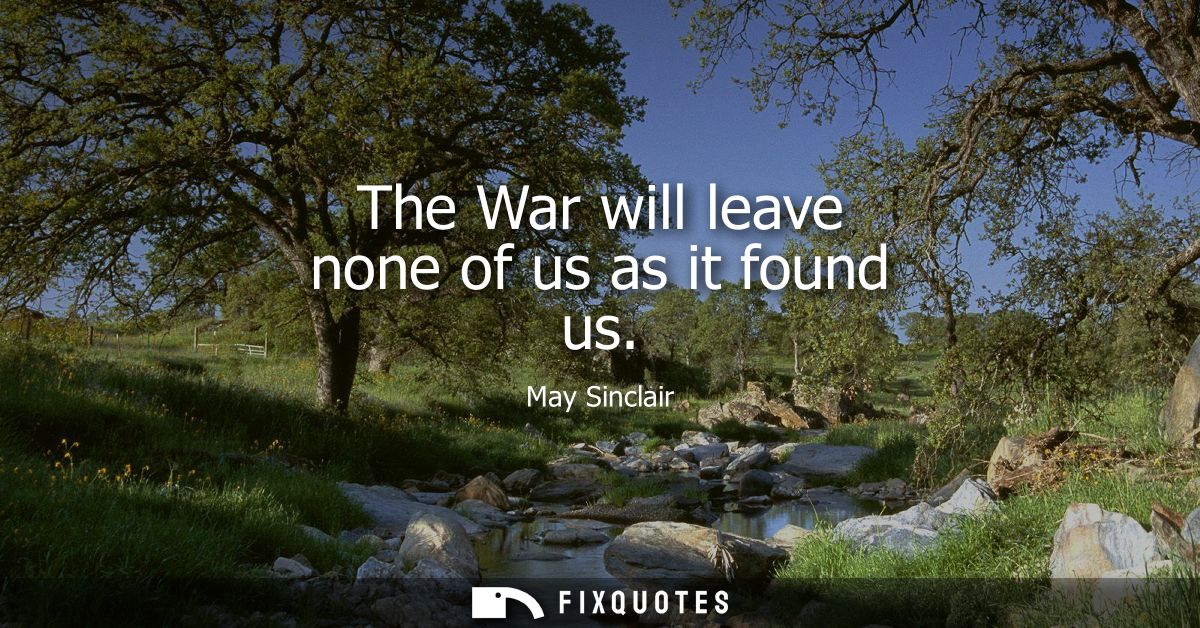
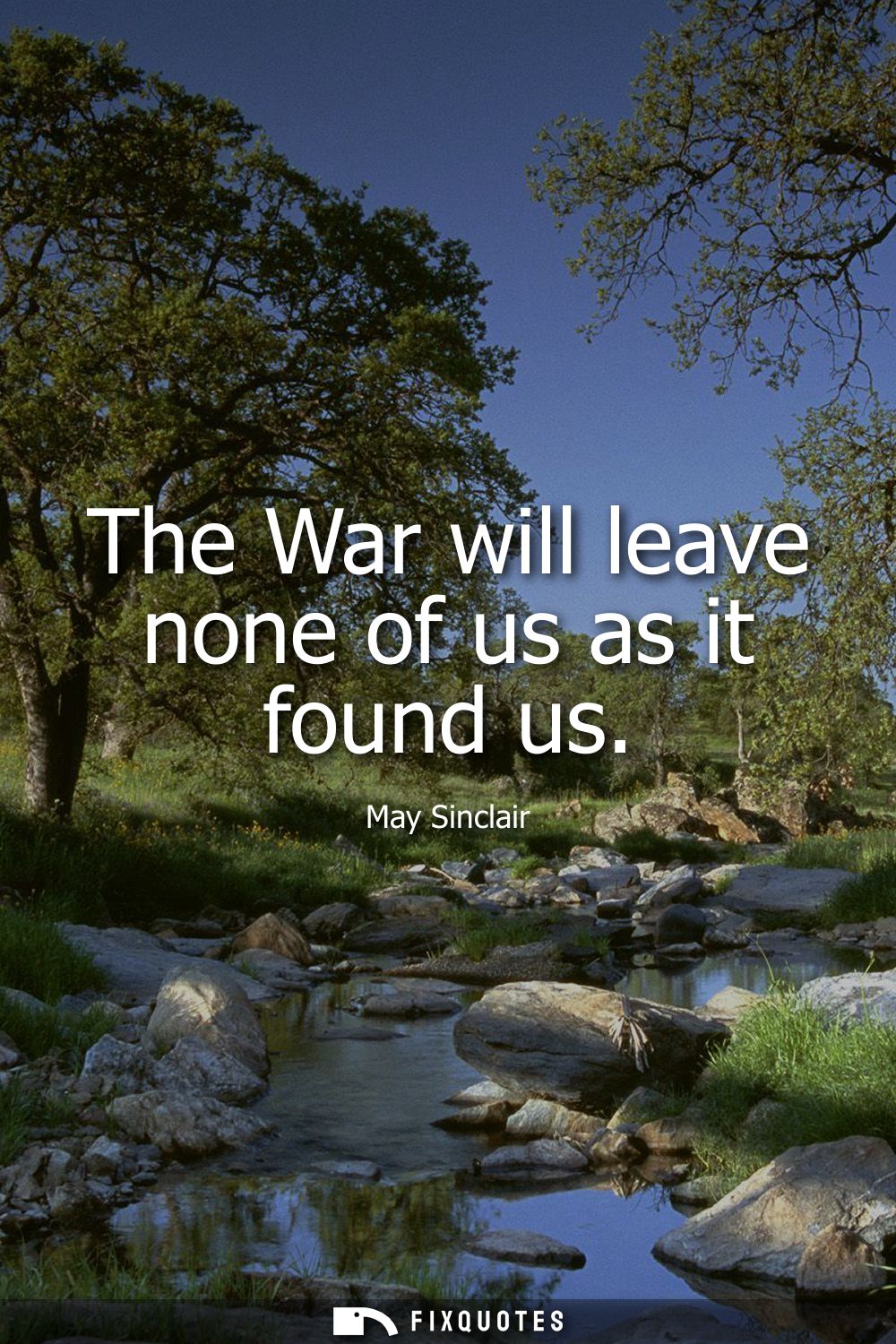
"The War will leave none of us as it found us"
About this Quote
“The War will leave none of us as it found us” lands with the quiet menace of a sentence that refuses heroics. May Sinclair isn’t selling glory or even grief; she’s issuing a moral forecast. The line works because it frames war less as an event than as an acid, something that doesn’t merely destroy bodies and cities but alters the very material of a society. “Leave” is doing the heavy lifting: war is personified as a visitor with bad manners, moving through homes, institutions, and minds, rearranging everything, then pretending it was just passing through.
Written in the shadow of World War I, Sinclair’s phrasing also pressures the comforting idea that civilians remain “untouched.” She collapses the boundary between front line and home front: even those who never see a trench are drafted into shortages, propaganda, bereavement, disillusionment, and the psychic noise of total war. The subtext is pointedly egalitarian. “None of us” includes the patriotic and the skeptical, the privileged and the poor, the volunteers and the conscripts. War is presented as a democratizing force, but in the darkest sense: it distributes damage widely, then dares you to call it “character-building.”
Sinclair, a modernist attuned to interior life, knows that the most consequential casualties may be invisible. The sentence anticipates shell shock, fractured faith in institutions, and the way wartime narratives rewrite personal identities after the fighting stops. It’s also a warning about memory: once war remakes you, the old self becomes a kind of myth you can’t fully return to.
Written in the shadow of World War I, Sinclair’s phrasing also pressures the comforting idea that civilians remain “untouched.” She collapses the boundary between front line and home front: even those who never see a trench are drafted into shortages, propaganda, bereavement, disillusionment, and the psychic noise of total war. The subtext is pointedly egalitarian. “None of us” includes the patriotic and the skeptical, the privileged and the poor, the volunteers and the conscripts. War is presented as a democratizing force, but in the darkest sense: it distributes damage widely, then dares you to call it “character-building.”
Sinclair, a modernist attuned to interior life, knows that the most consequential casualties may be invisible. The sentence anticipates shell shock, fractured faith in institutions, and the way wartime narratives rewrite personal identities after the fighting stops. It’s also a warning about memory: once war remakes you, the old self becomes a kind of myth you can’t fully return to.
Quote Details
| Topic | War |
|---|---|
| Source | Help us find the source |
| Cite |
Citation Formats
APA Style (7th ed.)
Sinclair, May. (2026, January 16). The War will leave none of us as it found us. FixQuotes. https://fixquotes.com/quotes/the-war-will-leave-none-of-us-as-it-found-us-114765/
Chicago Style
Sinclair, May. "The War will leave none of us as it found us." FixQuotes. January 16, 2026. https://fixquotes.com/quotes/the-war-will-leave-none-of-us-as-it-found-us-114765/.
MLA Style (9th ed.)
"The War will leave none of us as it found us." FixQuotes, 16 Jan. 2026, https://fixquotes.com/quotes/the-war-will-leave-none-of-us-as-it-found-us-114765/. Accessed 1 Apr. 2026.
More Quotes by May
Add to List