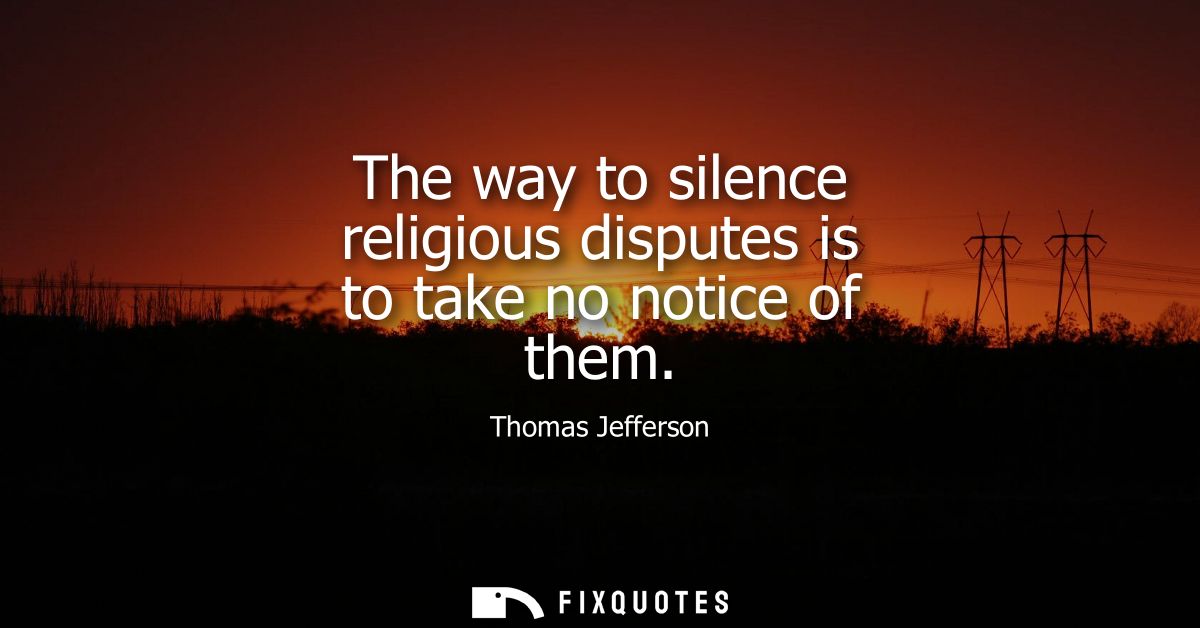
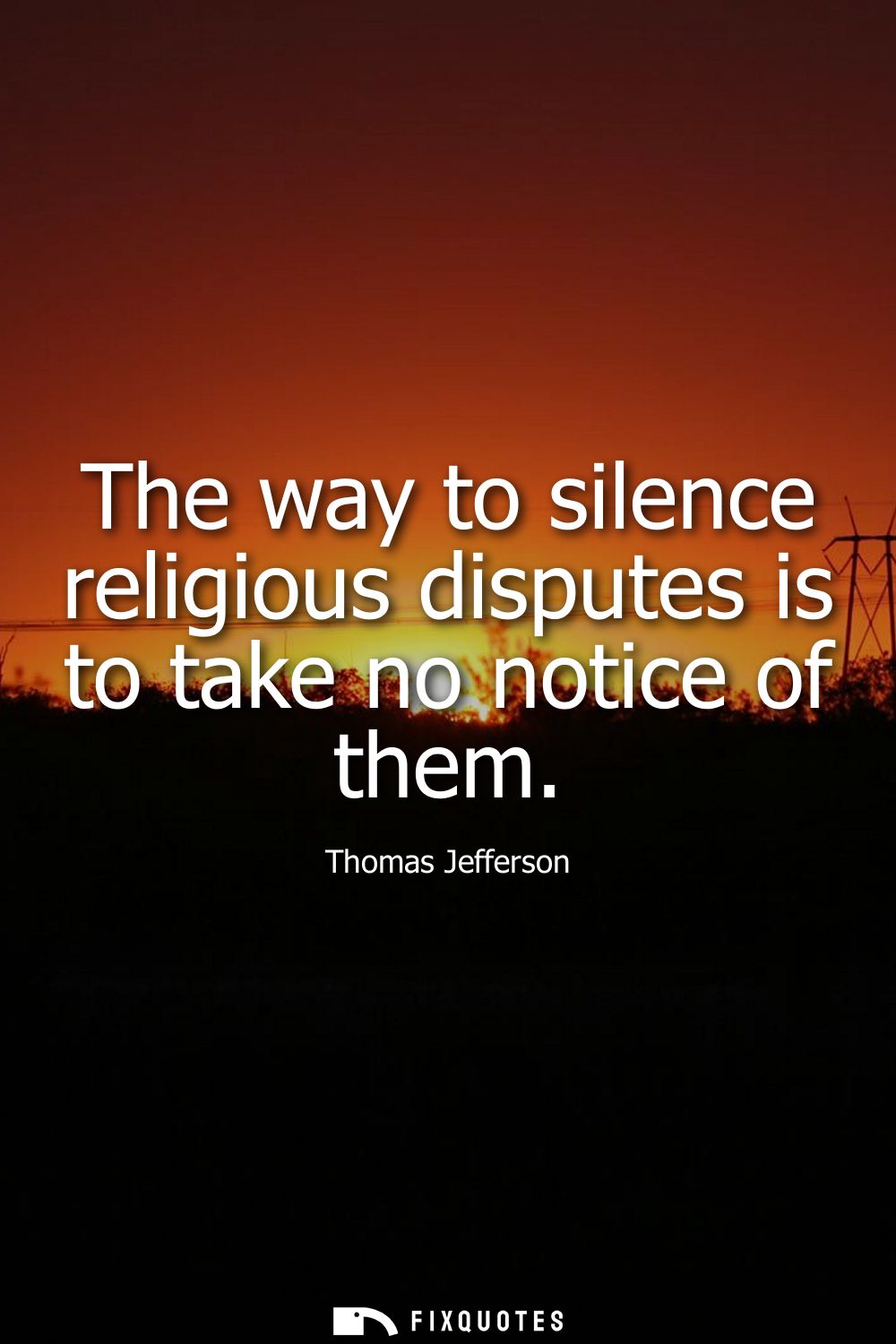
"The way to silence religious disputes is to take no notice of them"
About this Quote
Ignore the argument, and the argument starves. Jefferson’s line isn’t a plea for spiritual harmony; it’s a piece of political engineering from a leader who understood that religious conflict gains power by being treated as a matter of state. “Take no notice” is doing heavy lifting here. It signals an institutional posture: government shouldn’t referee doctrine, because the moment it does, it validates the premise that public authority can pick winners in metaphysical fights.
The subtext is tactical, even faintly impatient. Jefferson isn’t imagining people suddenly becoming tolerant; he’s betting on incentives. If churches and sects can’t win legal privileges, subsidies, or punishments through government, then disputes lose their sharpest weapon: coercion. Attention becomes a currency. State attention turns theology into policy, and policy into a zero-sum contest. Withholding notice isn’t indifference to belief; it’s indifference to demands that belief be enforced.
Context matters: Jefferson is writing as a founder of a new republic trying to avoid Europe’s old script, where sectarian conflict routinely bled into law and violence. His Virginia Statute for Religious Freedom and his “wall of separation” language both aim at the same outcome: religion thrives (or fails) on persuasion, not power. The rhetoric is deceptively calm, but the stakes are consequential. Jefferson frames secular governance not as hostility to faith, but as a way to keep faith from becoming a tool of governance - and governance from becoming a weapon in the hands of faith.
The subtext is tactical, even faintly impatient. Jefferson isn’t imagining people suddenly becoming tolerant; he’s betting on incentives. If churches and sects can’t win legal privileges, subsidies, or punishments through government, then disputes lose their sharpest weapon: coercion. Attention becomes a currency. State attention turns theology into policy, and policy into a zero-sum contest. Withholding notice isn’t indifference to belief; it’s indifference to demands that belief be enforced.
Context matters: Jefferson is writing as a founder of a new republic trying to avoid Europe’s old script, where sectarian conflict routinely bled into law and violence. His Virginia Statute for Religious Freedom and his “wall of separation” language both aim at the same outcome: religion thrives (or fails) on persuasion, not power. The rhetoric is deceptively calm, but the stakes are consequential. Jefferson frames secular governance not as hostility to faith, but as a way to keep faith from becoming a tool of governance - and governance from becoming a weapon in the hands of faith.
Quote Details
| Topic | Wisdom |
|---|---|
| Source | Verified source: Notes on the State of Virginia (Thomas Jefferson, 1785)
Evidence: They have made the happy discovery, that the way to si|lence religious disputes, is to take no notice of them. (Query XVII ("The different religions received into that state?"); in the 1794 Mathew Carey (Philadelphia) edition: page 234). This sentence appears in Thomas Jefferson’s only book-length work, in Query XVII on religion, in the discussion praising Pennsylvania and New York for flourishing without an established religion. The quote is often modernized (removing commas and Jefferson’s longer lead-in clause) to: “The way to silence religious disputes is to take no notice of them.” The URL provided is a primary-text transcription of a historical edition (Mathew Carey, Philadelphia, dated November 12, 1794) that contains the line on page 234; earlier publication of the work is 1785 (first edition, published anonymously in Paris). Other candidates (1) Thomas Jefferson’s 'Notes on the State of Virginia': A Pr... (M. Andrew Holowchak, 2023) compilation95.0% ... Jefferson supported religious freedom more because of a wish to rid of the toxicity of religious coercion than ..... |
| Cite |
Citation Formats
APA Style (7th ed.)
Jefferson, Thomas. (2026, February 27). The way to silence religious disputes is to take no notice of them. FixQuotes. https://fixquotes.com/quotes/the-way-to-silence-religious-disputes-is-to-take-27372/
Chicago Style
Jefferson, Thomas. "The way to silence religious disputes is to take no notice of them." FixQuotes. February 27, 2026. https://fixquotes.com/quotes/the-way-to-silence-religious-disputes-is-to-take-27372/.
MLA Style (9th ed.)
"The way to silence religious disputes is to take no notice of them." FixQuotes, 27 Feb. 2026, https://fixquotes.com/quotes/the-way-to-silence-religious-disputes-is-to-take-27372/. Accessed 3 Apr. 2026.
More Quotes by Thomas
Add to List