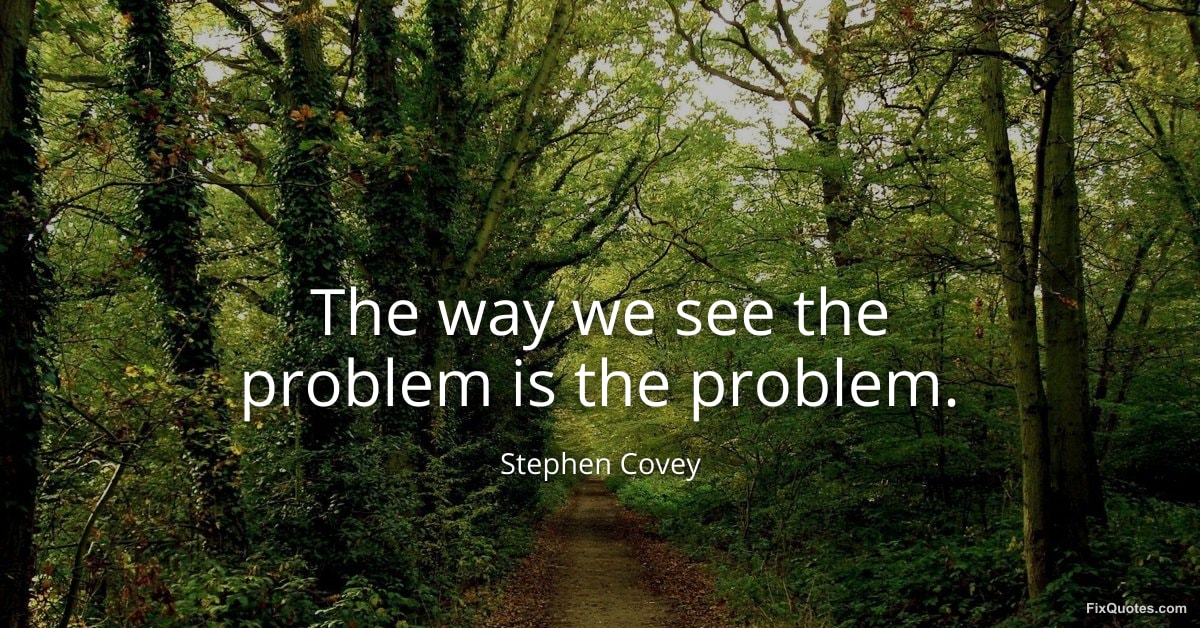
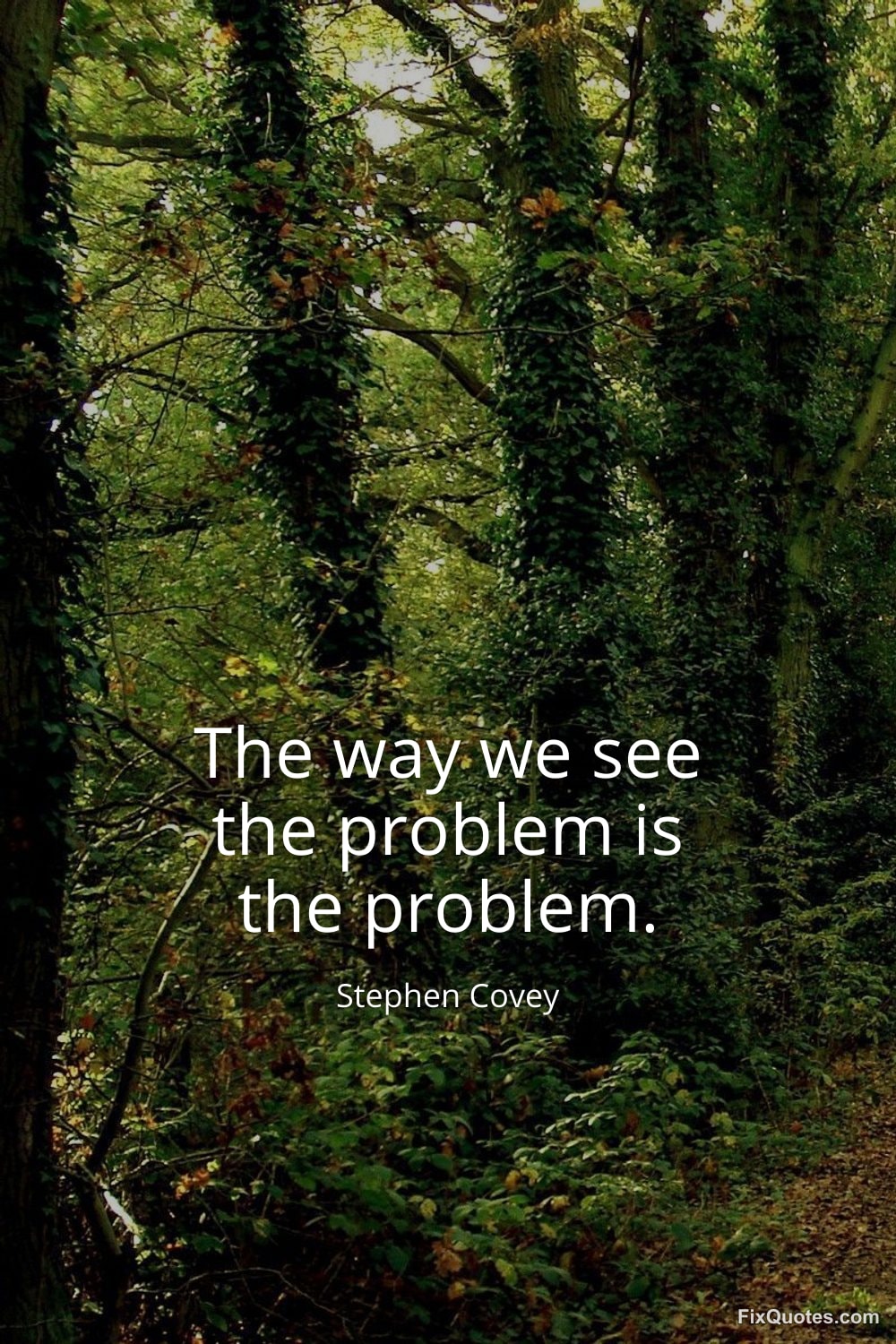
"The way we see the problem is the problem"
About this Quote
Covey’s line is corporate self-help with a scalpel hidden inside: the bottleneck isn’t the market, the team, or the timeline, it’s the frame you’re using to interpret all of it. Coming from a businessman-turned-leadership-guru, the intent is practical, almost managerial. He’s not asking you to contemplate reality like a philosopher; he’s trying to get you to stop bleeding time and morale by misdiagnosing what’s actually going on.
The subtext is a quiet power move. If “the way we see” is the true culprit, then problems become less like external assaults and more like internal design flaws. That shifts agency back to the individual or the organization, which is both liberating and conveniently demanding: you can’t outsource the fix to a scapegoat, and you can’t wait for conditions to change. It also smuggles in a critique of workplace culture: companies love “solutions,” but they often protect the assumptions that created the mess. Covey’s sentence pressures leaders to interrogate their default lenses - scarcity thinking, victim narratives, zero-sum competition, “busy equals productive” - because those lenses don’t just describe reality; they manufacture it.
Context matters: Covey’s broader brand is principle-centered leadership, the idea that effectiveness is upstream from perception and habit. The quote works because it’s tautological in a way that sticks. It sounds like a riddle, but it lands like a directive: before you reorganize the org chart, reorganize the story you’re telling about what’s broken.
The subtext is a quiet power move. If “the way we see” is the true culprit, then problems become less like external assaults and more like internal design flaws. That shifts agency back to the individual or the organization, which is both liberating and conveniently demanding: you can’t outsource the fix to a scapegoat, and you can’t wait for conditions to change. It also smuggles in a critique of workplace culture: companies love “solutions,” but they often protect the assumptions that created the mess. Covey’s sentence pressures leaders to interrogate their default lenses - scarcity thinking, victim narratives, zero-sum competition, “busy equals productive” - because those lenses don’t just describe reality; they manufacture it.
Context matters: Covey’s broader brand is principle-centered leadership, the idea that effectiveness is upstream from perception and habit. The quote works because it’s tautological in a way that sticks. It sounds like a riddle, but it lands like a directive: before you reorganize the org chart, reorganize the story you’re telling about what’s broken.
Quote Details
| Topic | Self-Improvement |
|---|---|
| Source | Verified source: The 7 Habits of Highly Effective People (Stephen Covey, 1989)
Evidence: The way we see the problem is the problem. (Part One: Paradigms and Principles (subheading: "The Way We SEE the Problem IS the Problem")). This line appears in Stephen R. Covey’s own text in the opening paradigms section of The 7 Habits of Highly Effective People (commonly dated to first publication in 1989 by Free Press). I was able to verify the exact sentence in an excerpted transcription of that section, but I could not verify (from a publisher-controlled preview) the exact first-edition page number. Page numbers vary by edition (hardcover/paperback, anniversary editions, etc.), so you’ll need to check the specific 1989 Free Press first edition (or its first printing) to pin down the first-publication page reference. Other candidates (1) Stephen Covey (Robert Heller, 2001) compilation95.0% ... Covey teaches that " the way we see the problem is the problem . ” In a marriage that has gone flat , for example... |
| Cite |
Citation Formats
APA Style (7th ed.)
Covey, Stephen. (2026, February 20). The way we see the problem is the problem. FixQuotes. https://fixquotes.com/quotes/the-way-we-see-the-problem-is-the-problem-183979/
Chicago Style
Covey, Stephen. "The way we see the problem is the problem." FixQuotes. February 20, 2026. https://fixquotes.com/quotes/the-way-we-see-the-problem-is-the-problem-183979/.
MLA Style (9th ed.)
"The way we see the problem is the problem." FixQuotes, 20 Feb. 2026, https://fixquotes.com/quotes/the-way-we-see-the-problem-is-the-problem-183979/. Accessed 5 Mar. 2026.
More Quotes by Stephen
Add to List