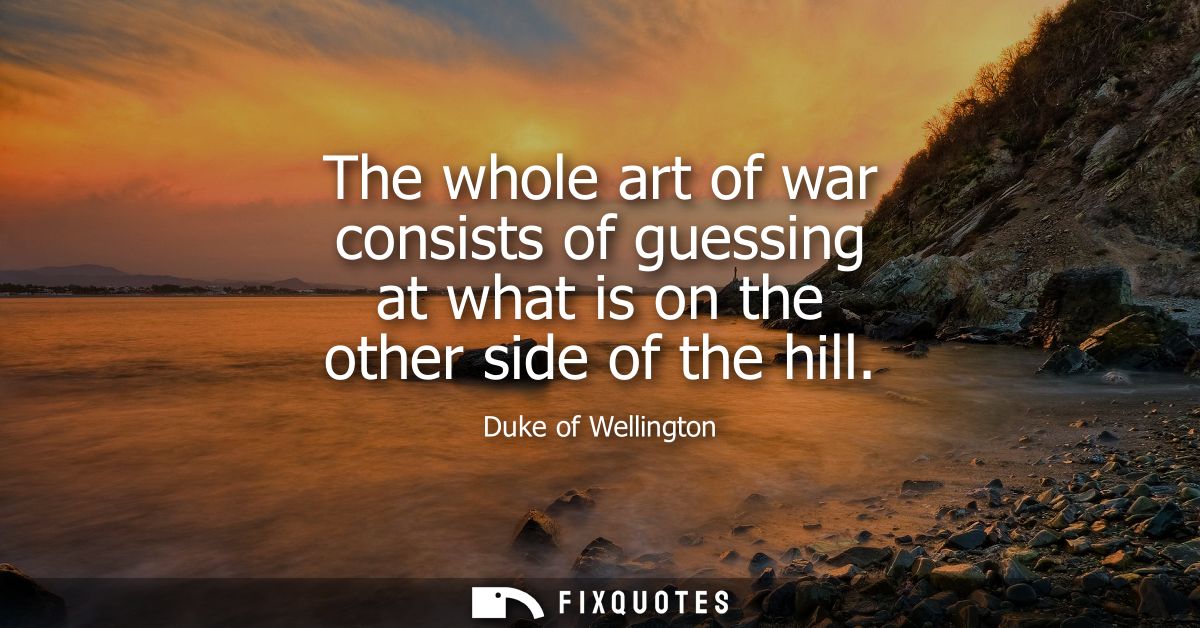
"The whole art of war consists of guessing at what is on the other side of the hill"
About this Quote
The brilliance is how calmly it demotes “art” from creativity to risk management. Wellington isn’t praising bold charges; he’s defining generalship as disciplined guessing. Not knowing becomes the baseline condition, and the commander’s job is to act anyway, with consequences attached. That’s why the sentence lands with the blunt authority of someone who fought Napoleon and lived: it reads like a veteran’s correction to civilians who think war is a chessboard.
Context matters. Wellington’s campaigns depended on coalition politics, strained logistics, and uneven troops. He was famous for defensive positioning and for holding until the moment was readable. Behind the aphorism sits a doctrine: keep reserves, build contingencies, assume friction, punish overconfidence. It’s also a quiet argument against the cult of the “master plan.” If the other side of the hill is unknowable, flexibility beats fantasy.
Subtext: the enemy always gets a vote, and so does chance. The “whole art” is humility weaponized.
Quote Details
| Topic | War |
|---|---|
| Source | Help us find the source |
| Cite |
Citation Formats
APA Style (7th ed.)
Wellington, Duke of. (2026, January 15). The whole art of war consists of guessing at what is on the other side of the hill. FixQuotes. https://fixquotes.com/quotes/the-whole-art-of-war-consists-of-guessing-at-what-17310/
Chicago Style
Wellington, Duke of. "The whole art of war consists of guessing at what is on the other side of the hill." FixQuotes. January 15, 2026. https://fixquotes.com/quotes/the-whole-art-of-war-consists-of-guessing-at-what-17310/.
MLA Style (9th ed.)
"The whole art of war consists of guessing at what is on the other side of the hill." FixQuotes, 15 Jan. 2026, https://fixquotes.com/quotes/the-whole-art-of-war-consists-of-guessing-at-what-17310/. Accessed 28 Mar. 2026.