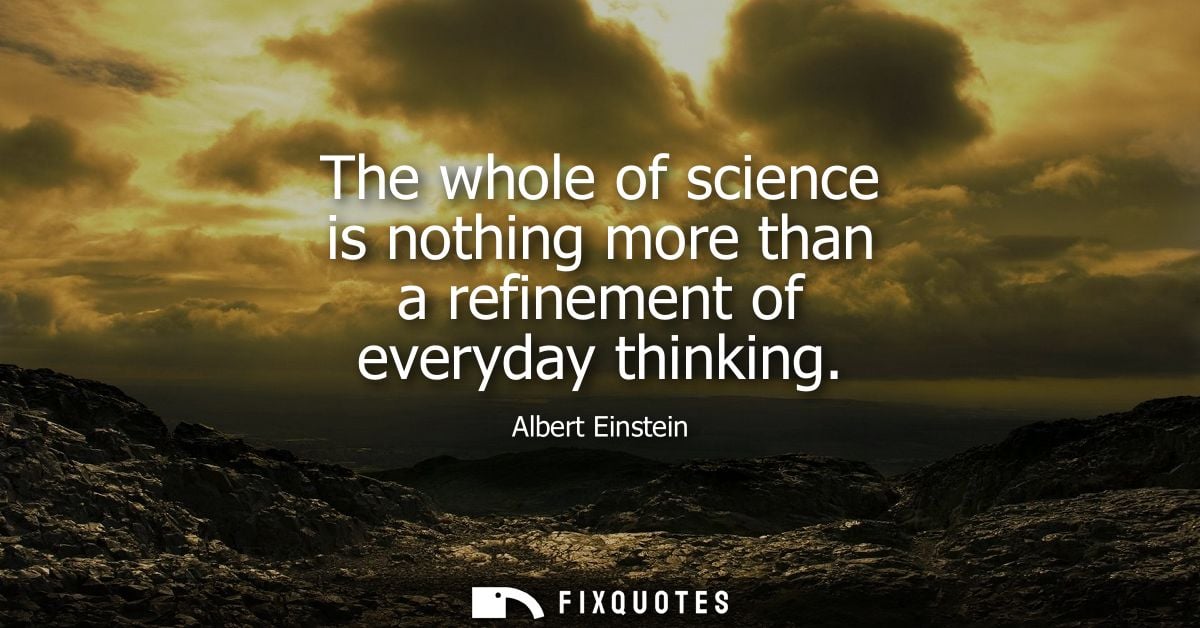
"The whole of science is nothing more than a refinement of everyday thinking"
About this Quote
The subtext is also a quiet rebuke. If scientific reasoning is just upgraded common sense, then refusing it isn’t a principled rejection of an elite priesthood; it’s a refusal to extend your own habits of judgment beyond convenience and ego. That’s a direct shot at mysticism, ideology, and the kind of armchair certainty that feels “intuitive” until measurement shows it isn’t.
Context matters: Einstein built theories that wrecked “obvious” notions of time and space. So the line isn’t a sentimental tribute to intuition. It’s closer to a warning that everyday thinking, left unrefined, hardens into prejudice. Science keeps the same basic cognitive moves but forces them to survive contact with math, experiment, and peer scrutiny. In an era when “trust your gut” is marketed as authenticity, Einstein’s cool provocation is that the gut is only step one; grown-up thinking is what happens after you make it earn its confidence.
Quote Details
| Topic | Science |
|---|---|
| Source | Verified source: Physics and Reality (Albert Einstein, 1936)
Evidence: The whole of science is nothing more than a refinement of everyday thinking. (Vol. 221, no. 3 (March 1936), pp. 349–382). Earliest primary publication I can currently corroborate is Einstein’s article “Physics and Reality” in the Journal of the Franklin Institute (March 1936). Many secondary references also point to its later reprinting in Einstein’s essay collection Out of My Later Years (often cited as 1950, p. 59), where the same sentence appears in context as part of a longer paragraph. I attempted to open the ScienceDirect record to extract the sentence directly from the scanned/PDF article, but was rate-limited (HTTP 429), so I cannot yet independently verify the page within the 1936 journal where the sentence occurs; however, the journal issue metadata (volume/issue/pages) and the consistent scholarly attributions strongly support this as the original appearance. Note that some sources also mention a German version (“Physik und Realität”) in the same journal issue (pp. 313–347), which may indicate parallel-language publication in that issue. Other candidates (1) Modes of Thought (David R. Olson, Nancy Torrance, 1996) compilation95.0% ... Albert Einstein ( 1954 , p . 290 ) , who proclaimed The whole of science is nothing more than a refinement of eve... |
| Cite |
Citation Formats
APA Style (7th ed.)
Einstein, Albert. (2026, February 9). The whole of science is nothing more than a refinement of everyday thinking. FixQuotes. https://fixquotes.com/quotes/the-whole-of-science-is-nothing-more-than-a-34869/
Chicago Style
Einstein, Albert. "The whole of science is nothing more than a refinement of everyday thinking." FixQuotes. February 9, 2026. https://fixquotes.com/quotes/the-whole-of-science-is-nothing-more-than-a-34869/.
MLA Style (9th ed.)
"The whole of science is nothing more than a refinement of everyday thinking." FixQuotes, 9 Feb. 2026, https://fixquotes.com/quotes/the-whole-of-science-is-nothing-more-than-a-34869/. Accessed 4 Apr. 2026.