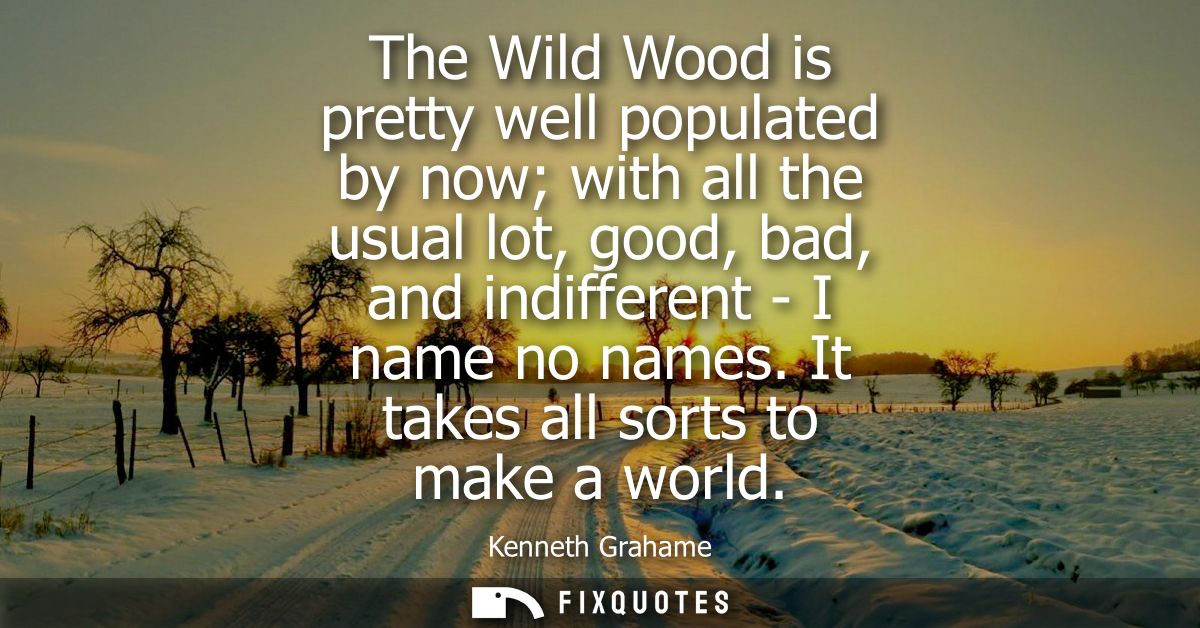
"The Wild Wood is pretty well populated by now; with all the usual lot, good, bad, and indifferent - I name no names. It takes all sorts to make a world"
About this Quote
Context matters: The Wind in the Willows is ostensibly a children's book, yet it's powered by adult observation - about class, respectability, and the thin line between cozy order (the riverbank) and untidy reality (the wood). By adding "indifferent" to "good" and "bad", Grahame punctures the moral binary that fairy tales often depend on. Most people aren't wicked or saintly; they're just there, taking up space, shaping the atmosphere.
"It takes all sorts to make a world" is a proverb, but here it functions like a narrative permission slip. The book can accommodate menace, boredom, kindness, and foolishness without forcing them into tidy lessons. The Wild Wood becomes a testing ground for tolerance: not naive acceptance, but the practical recognition that a livable world is crowded, mixed, and stubbornly uncurated.
Quote Details
| Topic | Wisdom |
|---|---|
| Source | Help us find the source |
| Cite |
Citation Formats
APA Style (7th ed.)
Grahame, Kenneth. (2026, January 14). The Wild Wood is pretty well populated by now; with all the usual lot, good, bad, and indifferent - I name no names. It takes all sorts to make a world. FixQuotes. https://fixquotes.com/quotes/the-wild-wood-is-pretty-well-populated-by-now-150670/
Chicago Style
Grahame, Kenneth. "The Wild Wood is pretty well populated by now; with all the usual lot, good, bad, and indifferent - I name no names. It takes all sorts to make a world." FixQuotes. January 14, 2026. https://fixquotes.com/quotes/the-wild-wood-is-pretty-well-populated-by-now-150670/.
MLA Style (9th ed.)
"The Wild Wood is pretty well populated by now; with all the usual lot, good, bad, and indifferent - I name no names. It takes all sorts to make a world." FixQuotes, 14 Jan. 2026, https://fixquotes.com/quotes/the-wild-wood-is-pretty-well-populated-by-now-150670/. Accessed 2 Apr. 2026.