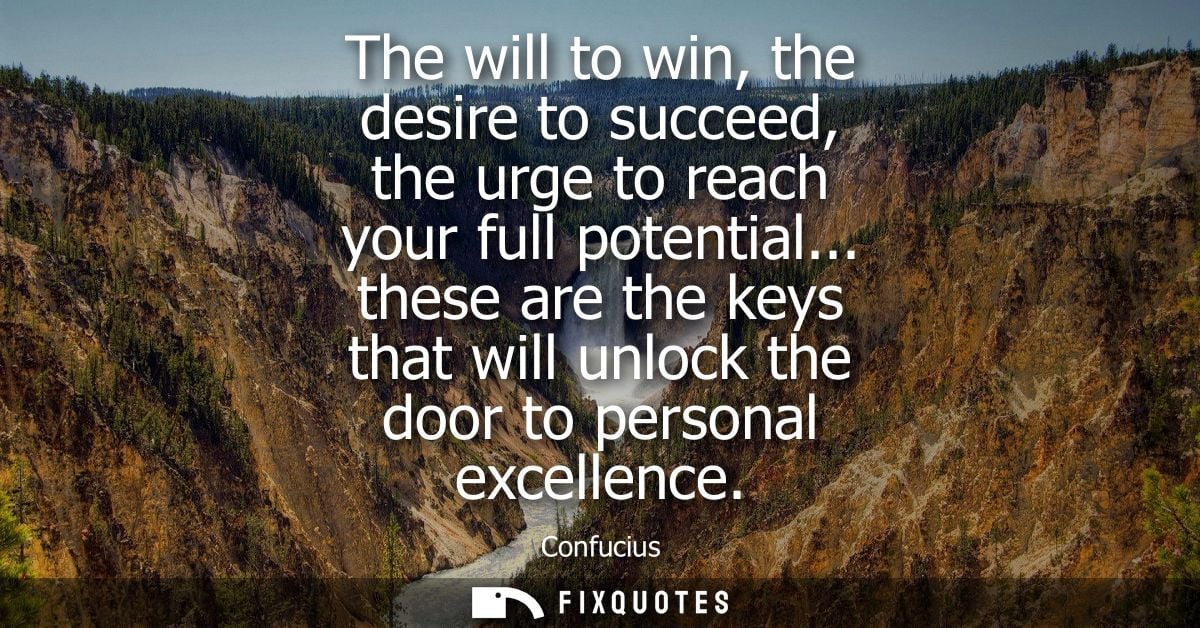
"The will to win, the desire to succeed, the urge to reach your full potential... These are the keys that will unlock the door to personal excellence"
About this Quote
The rhetorical move is a clever stacking of near-synonyms: will, desire, urge. It creates momentum, as if virtue begins not with revelation but with pressure building inside the self. Yet the subtext is less “hustle” than “self-govern.” In the Analects, the self is trained through ritual (li), learning, and constant correction in relation to others. Wanting to “win” only counts if the thing you’re winning at is worth wanting. Otherwise, ambition becomes the very disorder Confucius warns against: status-chasing that corrodes trust, family duties, and public integrity.
Placed in context, this is a sentence that contemporary culture reads through meritocracy: maximize your potential, unlock your best life. A Confucian reading is more austere. “Full potential” implies an ethical telos: becoming junzi, the exemplary person, not as a brand but as a social anchor. The intent isn’t to inflate the ego; it’s to recruit desire into a long, repetitive practice of better conduct. The door opens outward.
Quote Details
| Topic | Motivational |
|---|---|
| Source | Help us find the source |
| Cite |
Citation Formats
APA Style (7th ed.)
Confucius. (2026, February 19). The will to win, the desire to succeed, the urge to reach your full potential... These are the keys that will unlock the door to personal excellence. FixQuotes. https://fixquotes.com/quotes/the-will-to-win-the-desire-to-succeed-the-urge-to-34679/
Chicago Style
Confucius. "The will to win, the desire to succeed, the urge to reach your full potential... These are the keys that will unlock the door to personal excellence." FixQuotes. February 19, 2026. https://fixquotes.com/quotes/the-will-to-win-the-desire-to-succeed-the-urge-to-34679/.
MLA Style (9th ed.)
"The will to win, the desire to succeed, the urge to reach your full potential... These are the keys that will unlock the door to personal excellence." FixQuotes, 19 Feb. 2026, https://fixquotes.com/quotes/the-will-to-win-the-desire-to-succeed-the-urge-to-34679/. Accessed 15 Mar. 2026.