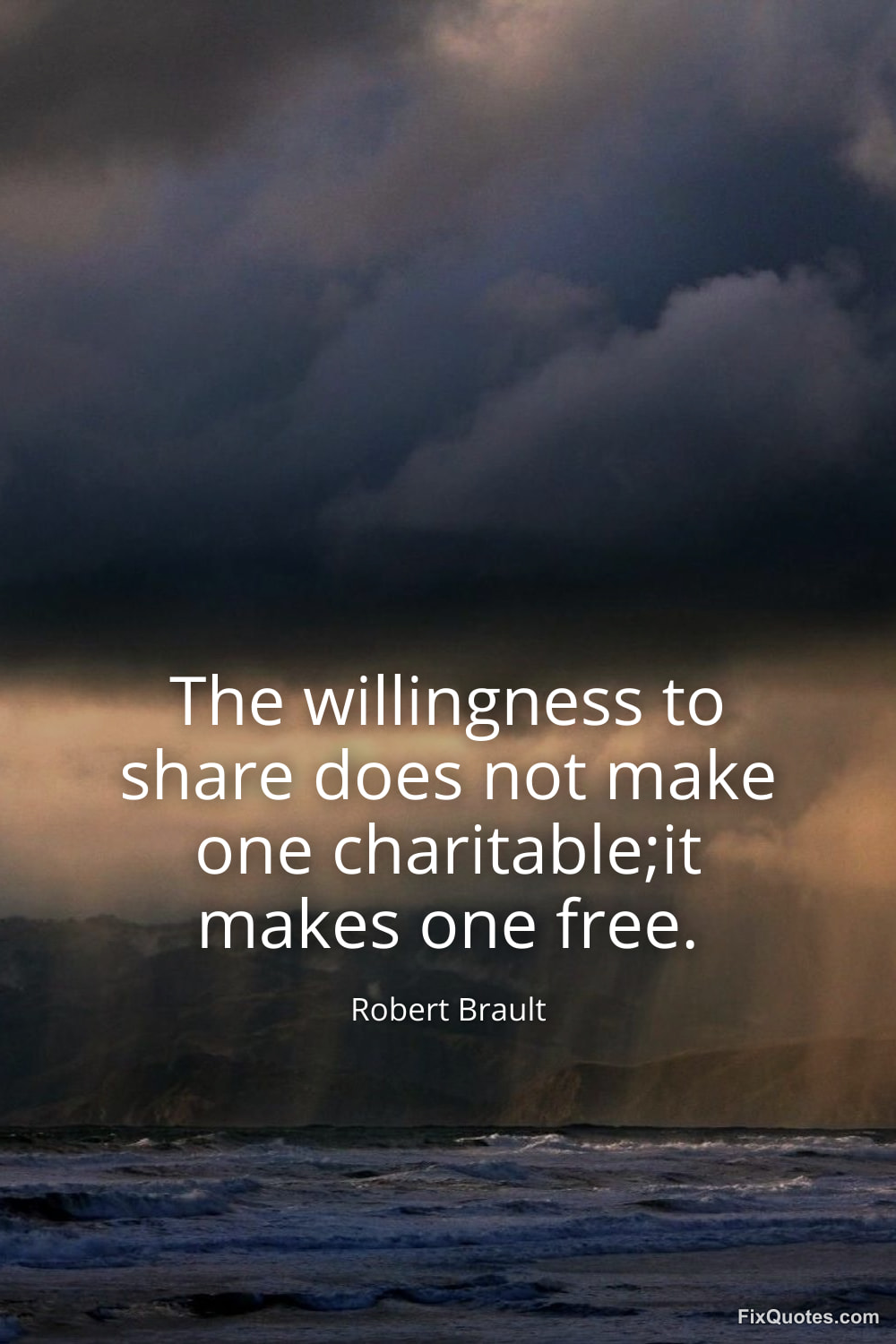
"The willingness to share does not make one charitable;it makes one free"
About this Quote
Brault’s line flips a familiar moral script: sharing isn’t framed as virtue-signaling generosity but as a jailbreak from the self. “Charitable” is the word we usually reach for because it flatters the giver and turns the act into a badge. Brault swats that away. His real target is the subtle transaction hiding inside a lot of so-called giving: I give, therefore I am good; I give, therefore you owe me gratitude; I give, therefore I get to feel in control. Charity can smuggle in hierarchy.
“Willingness” is doing heavy lifting here. He’s not praising the dramatic donation, the public check, the philanthropic performance. He’s pointing to the internal posture that makes sharing possible in the first place: the ability to loosen your grip. That’s where the freedom lives. When you’re unwilling, you’re not just protecting your stuff; you’re protecting a story about scarcity, status, or fear of being taken advantage of. The object changes - money, credit, attention, time - but the psychology stays consistent.
The subtext is almost Zen in its diagnosis: clinging is captivity. Share, and you’re less owned by anxiety about loss, less chained to the idea that security comes from hoarding. In a culture that treats accumulation as adulthood and generosity as brand identity, Brault proposes a quieter reward: not sainthood, just spaciousness. The act liberates the giver from the need to keep score.
“Willingness” is doing heavy lifting here. He’s not praising the dramatic donation, the public check, the philanthropic performance. He’s pointing to the internal posture that makes sharing possible in the first place: the ability to loosen your grip. That’s where the freedom lives. When you’re unwilling, you’re not just protecting your stuff; you’re protecting a story about scarcity, status, or fear of being taken advantage of. The object changes - money, credit, attention, time - but the psychology stays consistent.
The subtext is almost Zen in its diagnosis: clinging is captivity. Share, and you’re less owned by anxiety about loss, less chained to the idea that security comes from hoarding. In a culture that treats accumulation as adulthood and generosity as brand identity, Brault proposes a quieter reward: not sainthood, just spaciousness. The act liberates the giver from the need to keep score.
Quote Details
| Topic | Freedom |
|---|---|
| Source | Help us find the source |
| Cite |
Citation Formats
APA Style (7th ed.)
Brault, Robert. (2026, January 11). The willingness to share does not make one charitable;it makes one free. FixQuotes. https://fixquotes.com/quotes/the-willingness-to-share-does-not-make-one-183924/
Chicago Style
Brault, Robert. "The willingness to share does not make one charitable;it makes one free." FixQuotes. January 11, 2026. https://fixquotes.com/quotes/the-willingness-to-share-does-not-make-one-183924/.
MLA Style (9th ed.)
"The willingness to share does not make one charitable;it makes one free." FixQuotes, 11 Jan. 2026, https://fixquotes.com/quotes/the-willingness-to-share-does-not-make-one-183924/. Accessed 12 Feb. 2026.
More Quotes by Robert
Add to List