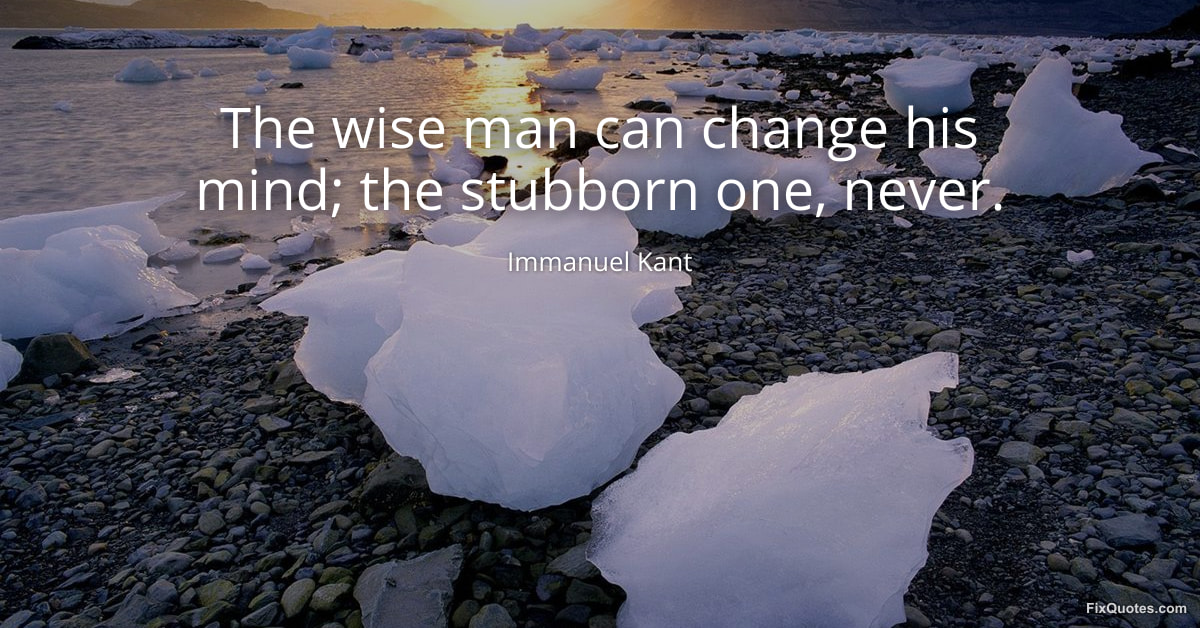
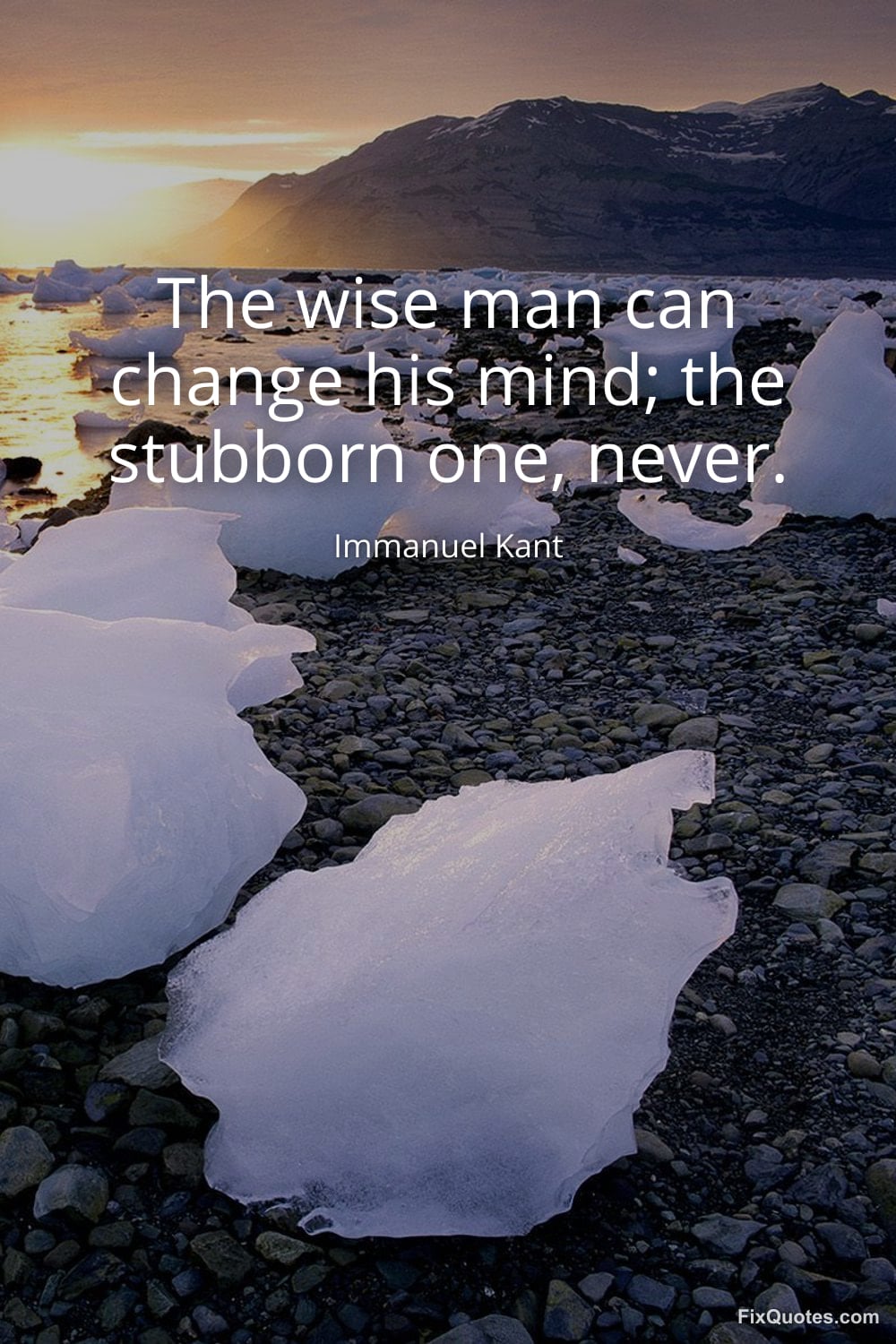
"The wise man can change his mind; the stubborn one never"
About this Quote
Kant’s line has the brisk, moral snap of an Enlightenment reprimand: if you can’t revise your beliefs, you’re not principled, you’re merely fossilized. It’s a neat reversal of a common self-flattering pose, where refusing to budge gets marketed as “conviction”. Kant flips the prestige. Wisdom isn’t a fortress; it’s an instrument calibrated to reality, and recalibration is the whole point.
The subtext is almost prosecutorial. Changing your mind is not treated as fickleness but as evidence that you’ve actually done the work: you’ve exposed an opinion to reasons, to counterarguments, to experience, and you’ve let the strongest claim win. The stubborn person, by contrast, isn’t steady; he’s trapped. Kant is sketching two relationships to the self. The wise man sees the ego as fallible and therefore correctable. The stubborn one treats the ego as a verdict that must be defended, so every new fact becomes an insult.
Context matters because Kant’s philosophy is obsessed with the conditions for rational judgment: autonomy, duty, and the discipline of reason over impulse. Enlightenment thinking wagered that progress - scientific, political, ethical - depends on the capacity to revise inherited dogma. In that light, stubbornness isn’t a personality quirk; it’s a civic danger, the psychological engine of fanaticism. The sentence works because it’s also a dare. If you bristle at it, you’ve already been placed on trial: are you protecting truth, or protecting yourself?
The subtext is almost prosecutorial. Changing your mind is not treated as fickleness but as evidence that you’ve actually done the work: you’ve exposed an opinion to reasons, to counterarguments, to experience, and you’ve let the strongest claim win. The stubborn person, by contrast, isn’t steady; he’s trapped. Kant is sketching two relationships to the self. The wise man sees the ego as fallible and therefore correctable. The stubborn one treats the ego as a verdict that must be defended, so every new fact becomes an insult.
Context matters because Kant’s philosophy is obsessed with the conditions for rational judgment: autonomy, duty, and the discipline of reason over impulse. Enlightenment thinking wagered that progress - scientific, political, ethical - depends on the capacity to revise inherited dogma. In that light, stubbornness isn’t a personality quirk; it’s a civic danger, the psychological engine of fanaticism. The sentence works because it’s also a dare. If you bristle at it, you’ve already been placed on trial: are you protecting truth, or protecting yourself?
Quote Details
| Topic | Wisdom |
|---|---|
| Source | Help us find the source |
| Cite |
Citation Formats
APA Style (7th ed.)
Kant, Immanuel. (2026, February 16). The wise man can change his mind; the stubborn one never. FixQuotes. https://fixquotes.com/quotes/the-wise-man-can-change-his-mind-the-stubborn-one-185059/
Chicago Style
Kant, Immanuel. "The wise man can change his mind; the stubborn one never." FixQuotes. February 16, 2026. https://fixquotes.com/quotes/the-wise-man-can-change-his-mind-the-stubborn-one-185059/.
MLA Style (9th ed.)
"The wise man can change his mind; the stubborn one never." FixQuotes, 16 Feb. 2026, https://fixquotes.com/quotes/the-wise-man-can-change-his-mind-the-stubborn-one-185059/. Accessed 27 Mar. 2026.
More Quotes by Immanuel
Add to List