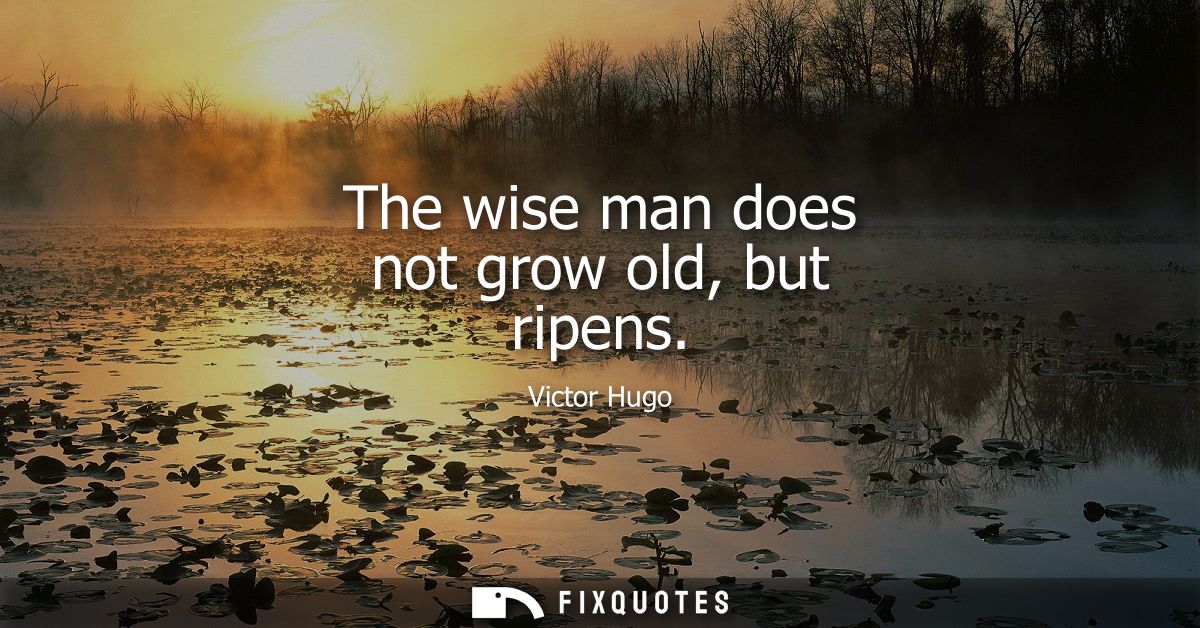
"The wise man does not grow old, but ripens"
About this Quote
Hugo’s line is a quiet act of defiance against the 19th century’s favorite cruelty: turning time into a moral downgrade. “Grow old” is passive, a biological slide into dimming relevance. “Ripens” is active, sensuous, agricultural. It implies patience, weathering, even bruising - but also concentrated sweetness. Hugo doesn’t deny decline; he reframes it as process. Wisdom, in this view, isn’t a trophy you earn young and carry intact. It’s the slow chemistry of experience, where loss and contradiction become flavor rather than damage.
The intent is less self-help than cultural critique. French modernity was busy measuring progress in machines, empires, and revolutions; Hugo, exiled and politically battered, knew that history doesn’t move in a straight, improving line. “Ripens” sneaks in a different metric: depth. A person can age in years yet remain unformed, sharp-edged, untested. The wise person, by contrast, uses time as a medium - allowing convictions to mature, shedding vanity, learning when not to perform certainty.
Subtext: wisdom is not innocence preserved but complexity digested. Ripeness comes with exposure - to storms, to rot, to the possibility of being discarded. Hugo’s romantic humanism is all over this: the individual as something grown, not manufactured. There’s also a subtle provocation to youth-worship. If age can be ripening, then the “old” aren’t obsolete; they’re potentially more themselves. The line flatters no one automatically. It makes wisdom a craft, not a calendar.
The intent is less self-help than cultural critique. French modernity was busy measuring progress in machines, empires, and revolutions; Hugo, exiled and politically battered, knew that history doesn’t move in a straight, improving line. “Ripens” sneaks in a different metric: depth. A person can age in years yet remain unformed, sharp-edged, untested. The wise person, by contrast, uses time as a medium - allowing convictions to mature, shedding vanity, learning when not to perform certainty.
Subtext: wisdom is not innocence preserved but complexity digested. Ripeness comes with exposure - to storms, to rot, to the possibility of being discarded. Hugo’s romantic humanism is all over this: the individual as something grown, not manufactured. There’s also a subtle provocation to youth-worship. If age can be ripening, then the “old” aren’t obsolete; they’re potentially more themselves. The line flatters no one automatically. It makes wisdom a craft, not a calendar.
Quote Details
| Topic | Wisdom |
|---|---|
| Source | Help us find the source |
| Cite |
Citation Formats
APA Style (7th ed.)
Hugo, Victor. (2026, January 18). The wise man does not grow old, but ripens. FixQuotes. https://fixquotes.com/quotes/the-wise-man-does-not-grow-old-but-ripens-10568/
Chicago Style
Hugo, Victor. "The wise man does not grow old, but ripens." FixQuotes. January 18, 2026. https://fixquotes.com/quotes/the-wise-man-does-not-grow-old-but-ripens-10568/.
MLA Style (9th ed.)
"The wise man does not grow old, but ripens." FixQuotes, 18 Jan. 2026, https://fixquotes.com/quotes/the-wise-man-does-not-grow-old-but-ripens-10568/. Accessed 31 Mar. 2026.
More Quotes by Victor
Add to List