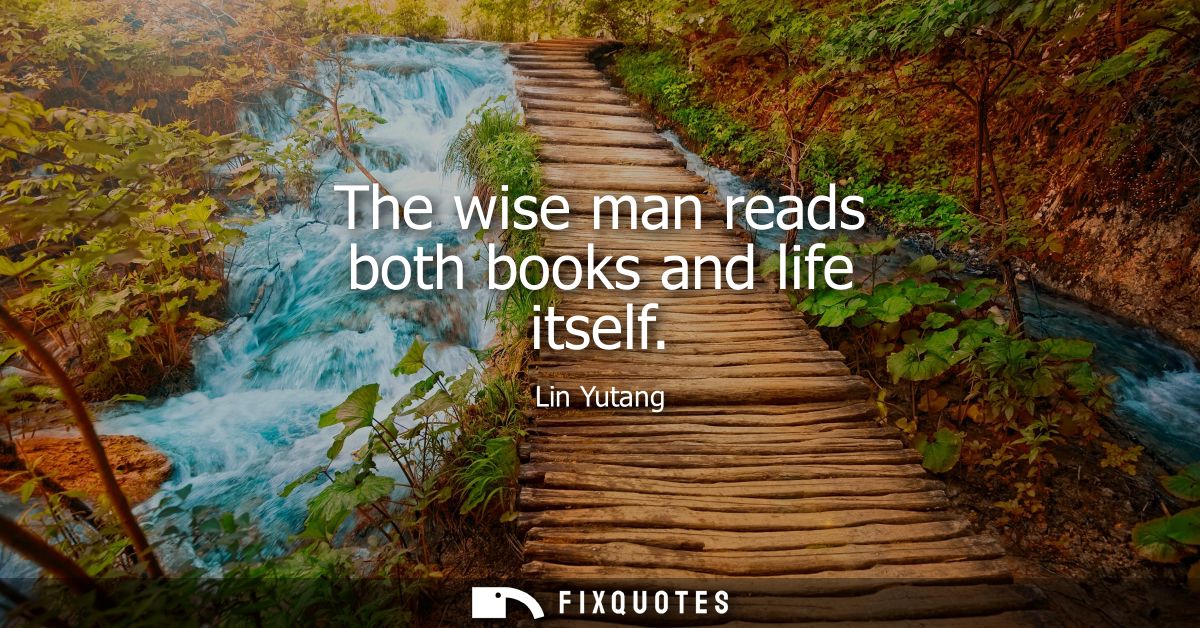
"The wise man reads both books and life itself"
About this Quote
Lin Yutang’s line lands like a gentle rebuke to two modern types: the credentialed hermit who hoards “knowledge” in footnotes, and the proudly unlettered realist who treats experience as a substitute for thought. He proposes a third figure, the “wise man,” whose education is bilingual. One language is books: accumulated argument, memory, and inherited craft. The other is life itself: the messy, sensory, contradictory world that refuses to behave like a clean thesis.
The intent isn’t anti-intellectual; it’s anti-pedantry. “Reads” is the hinge. Lin doesn’t say the wise man lives life or endures it, but reads it, turning daily encounters into text: people as characters, setbacks as plot turns, history as subtext. That verb quietly elevates attention into a moral practice. It also demotes books from authority to companion. A book can sharpen perception, but it can also anesthetize it, letting you mistake vocabulary for vision.
Context matters. Lin spent his career translating between China and the West, suspicious of rigid ideologies and enamored of humane, lived philosophy. In an era when “modernity” often meant either worshiping Western systems or rejecting them wholesale, he argues for synthesis: let literature train your mind, then test it against the street, the family table, the embarrassment, the ordinary afternoon. Wisdom, for Lin, is not a library card or a hardship resume. It’s the ability to keep learning from both, without letting either become a fortress.
The intent isn’t anti-intellectual; it’s anti-pedantry. “Reads” is the hinge. Lin doesn’t say the wise man lives life or endures it, but reads it, turning daily encounters into text: people as characters, setbacks as plot turns, history as subtext. That verb quietly elevates attention into a moral practice. It also demotes books from authority to companion. A book can sharpen perception, but it can also anesthetize it, letting you mistake vocabulary for vision.
Context matters. Lin spent his career translating between China and the West, suspicious of rigid ideologies and enamored of humane, lived philosophy. In an era when “modernity” often meant either worshiping Western systems or rejecting them wholesale, he argues for synthesis: let literature train your mind, then test it against the street, the family table, the embarrassment, the ordinary afternoon. Wisdom, for Lin, is not a library card or a hardship resume. It’s the ability to keep learning from both, without letting either become a fortress.
Quote Details
| Topic | Wisdom |
|---|---|
| Source | Help us find the source |
| Cite |
Citation Formats
APA Style (7th ed.)
Yutang, Lin. (2026, January 16). The wise man reads both books and life itself. FixQuotes. https://fixquotes.com/quotes/the-wise-man-reads-both-books-and-life-itself-131272/
Chicago Style
Yutang, Lin. "The wise man reads both books and life itself." FixQuotes. January 16, 2026. https://fixquotes.com/quotes/the-wise-man-reads-both-books-and-life-itself-131272/.
MLA Style (9th ed.)
"The wise man reads both books and life itself." FixQuotes, 16 Jan. 2026, https://fixquotes.com/quotes/the-wise-man-reads-both-books-and-life-itself-131272/. Accessed 12 Feb. 2026.
More Quotes by Lin
Add to List