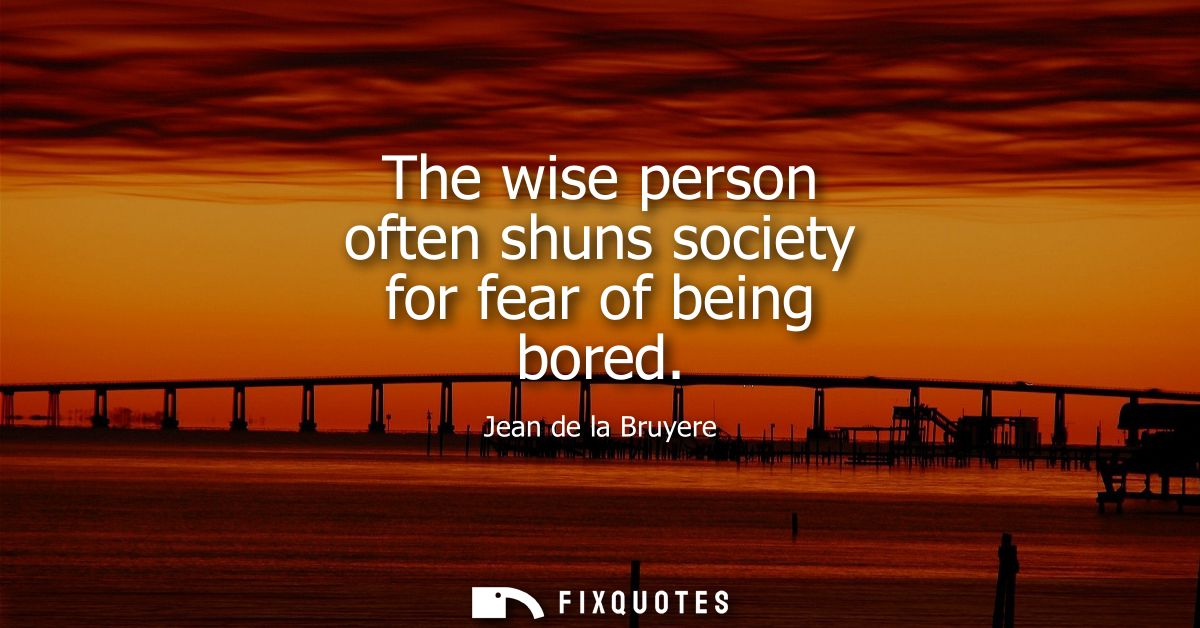
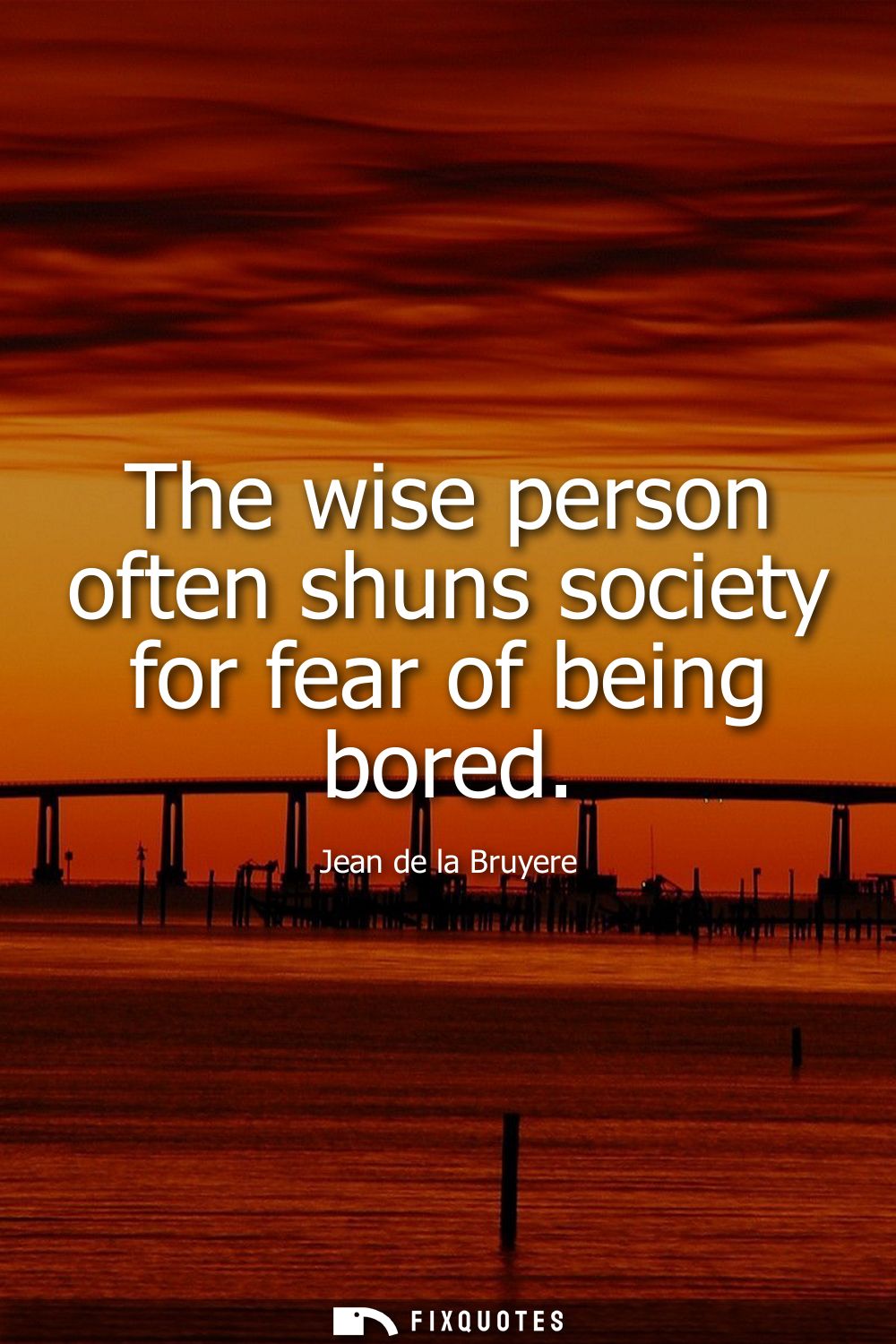
"The wise person often shuns society for fear of being bored"
About this Quote
Boredom is the dirty little motive hiding under the halo of “wisdom.” La Bruyere punctures the flattering story that the thoughtful recluse retreats out of lofty principle. Instead, he suggests a cooler, sharper reason: society, as practiced, is tedious - repetitive talk, performative politeness, status games, recycled opinions. The “wise person” isn’t fleeing people so much as fleeing the predictable scripts people insist on calling conversation.
The line’s sting comes from its quiet reversal of values. In courtly France, sociability was both currency and camouflage; to be seen, to be clever, to master small talk was a kind of survival. La Bruyere, writing in the moralist tradition, treats that world like a theater where most actors never learn new lines. Boredom becomes an ethical signal: the wise are bored because they can hear the machinery behind the charm. They recognize when wit is merely technique and when civility is merely choreography.
Subtextually, he’s also mocking “the wise” themselves. “Often” is doing real work: this is a tendency, not a law. The fear of boredom can be a mark of discernment, but it can also be a refined form of impatience, even elitism - the belief that others are rarely worth one’s attention. La Bruyere leaves the diagnosis deliberately double-edged. Society is shallow, yes, but the person who shuns it may be guarding not only their mind, but their vanity.
The line’s sting comes from its quiet reversal of values. In courtly France, sociability was both currency and camouflage; to be seen, to be clever, to master small talk was a kind of survival. La Bruyere, writing in the moralist tradition, treats that world like a theater where most actors never learn new lines. Boredom becomes an ethical signal: the wise are bored because they can hear the machinery behind the charm. They recognize when wit is merely technique and when civility is merely choreography.
Subtextually, he’s also mocking “the wise” themselves. “Often” is doing real work: this is a tendency, not a law. The fear of boredom can be a mark of discernment, but it can also be a refined form of impatience, even elitism - the belief that others are rarely worth one’s attention. La Bruyere leaves the diagnosis deliberately double-edged. Society is shallow, yes, but the person who shuns it may be guarding not only their mind, but their vanity.
Quote Details
| Topic | Wisdom |
|---|---|
| Source | Jean de La Bruyère, Les Caractères (1688). Often cited in French as "On se retire souvent de la société pour se préserver de l'ennui." |
| Cite |
Citation Formats
APA Style (7th ed.)
Bruyère, Jean de La. (2026, January 15). The wise person often shuns society for fear of being bored. FixQuotes. https://fixquotes.com/quotes/the-wise-person-often-shuns-society-for-fear-of-36487/
Chicago Style
Bruyère, Jean de La. "The wise person often shuns society for fear of being bored." FixQuotes. January 15, 2026. https://fixquotes.com/quotes/the-wise-person-often-shuns-society-for-fear-of-36487/.
MLA Style (9th ed.)
"The wise person often shuns society for fear of being bored." FixQuotes, 15 Jan. 2026, https://fixquotes.com/quotes/the-wise-person-often-shuns-society-for-fear-of-36487/. Accessed 21 Mar. 2026.
More Quotes by Jean
Add to List