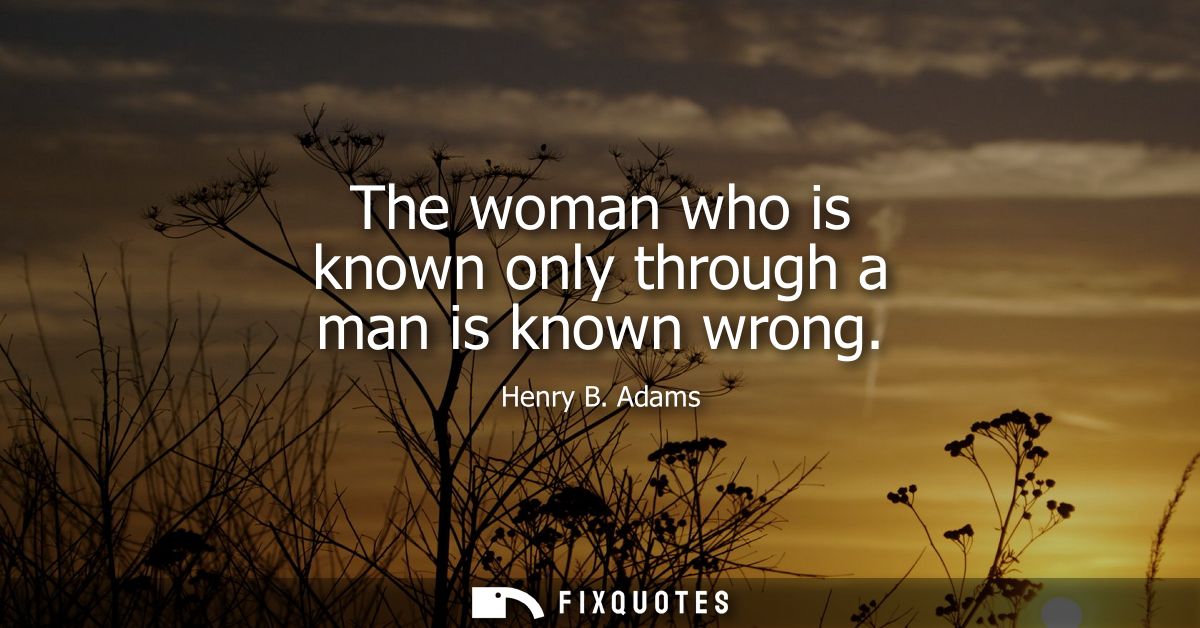
"The woman who is known only through a man is known wrong"
About this Quote
Adams drops the line like a historian tired of footnotes that erase the very people they’re supposed to document. “Known only through a man” isn’t just a social observation; it’s an indictment of an entire knowledge system, the way reputations get filed under husbands, fathers, patrons. The kicker is “known wrong”: not incomplete, not unfair, but factually distorted. Adams frames gender bias as an epistemological failure, a category error. If you build your account of a woman from the male figure nearest to her, you don’t simply miss her interior life; you produce a counterfeit.
The phrasing is doing quiet violence. “Known” repeats like a stamp on an archive box, suggesting official recognition, the kind that passes for truth in biographies, newspapers, and polite society. “Only” narrows the aperture until the woman disappears into relational identity. Adams, writing in an era when women’s public legitimacy was routinely mediated by marriage and family, exposes how easily “respectability” becomes a trap: the same structure that grants visibility also mislabels.
Context matters: this is the late 19th-century intellectual class, fluent in grand theories of progress while living amid suffrage agitation and rigid gender roles. Adams isn’t offering a sentimental defense; he’s pointing to a methodological flaw. History that uses men as the default measuring stick doesn’t just marginalize women, it falsifies the record. The line lands because it treats sexism not as bad manners but as bad information, and it dares the reader to notice how often “knowing” is really just inherited attribution.
The phrasing is doing quiet violence. “Known” repeats like a stamp on an archive box, suggesting official recognition, the kind that passes for truth in biographies, newspapers, and polite society. “Only” narrows the aperture until the woman disappears into relational identity. Adams, writing in an era when women’s public legitimacy was routinely mediated by marriage and family, exposes how easily “respectability” becomes a trap: the same structure that grants visibility also mislabels.
Context matters: this is the late 19th-century intellectual class, fluent in grand theories of progress while living amid suffrage agitation and rigid gender roles. Adams isn’t offering a sentimental defense; he’s pointing to a methodological flaw. History that uses men as the default measuring stick doesn’t just marginalize women, it falsifies the record. The line lands because it treats sexism not as bad manners but as bad information, and it dares the reader to notice how often “knowing” is really just inherited attribution.
Quote Details
| Topic | Equality |
|---|---|
| Source | Verified source: The Education of Henry Adams (Henry B. Adams, 1907)
Evidence: The woman who is known only through a man is known wrong, and excepting one or two like Madame de Sevigne, no woman has pictured herself. (Chapter 23; also appears on p. 308 in the 1907 djvu scan (Wikisource Page 322)). This line appears in Henry Adams’s own autobiographical book The Education of Henry Adams, in Chapter 23, in a passage beginning “For the moment he was rescued, as often before, by a woman. Towards midsummer, 1895…”. Wikisource’s 1907 text of Chapter 23 contains the sentence verbatim, and the 1907 djvu page image transcription shows it on the page numbered 308 (shown as Wikisource Page:...djvu/322). The work was privately printed and circulated by Adams in 1907; it was commercially published after his death in 1918. Other candidates (1) The Great Thoughts, Revised and Updated (George Seldes, 2011) compilation95.0% ... The woman who is known only through a man is known wrong . Ch . 23 Practical politics consists in ignoring facts ... |
| Cite |
Citation Formats
APA Style (7th ed.)
Adams, Henry B. (2026, February 10). The woman who is known only through a man is known wrong. FixQuotes. https://fixquotes.com/quotes/the-woman-who-is-known-only-through-a-man-is-48089/
Chicago Style
Adams, Henry B. "The woman who is known only through a man is known wrong." FixQuotes. February 10, 2026. https://fixquotes.com/quotes/the-woman-who-is-known-only-through-a-man-is-48089/.
MLA Style (9th ed.)
"The woman who is known only through a man is known wrong." FixQuotes, 10 Feb. 2026, https://fixquotes.com/quotes/the-woman-who-is-known-only-through-a-man-is-48089/. Accessed 25 Mar. 2026.
More Quotes by Henry
Add to List