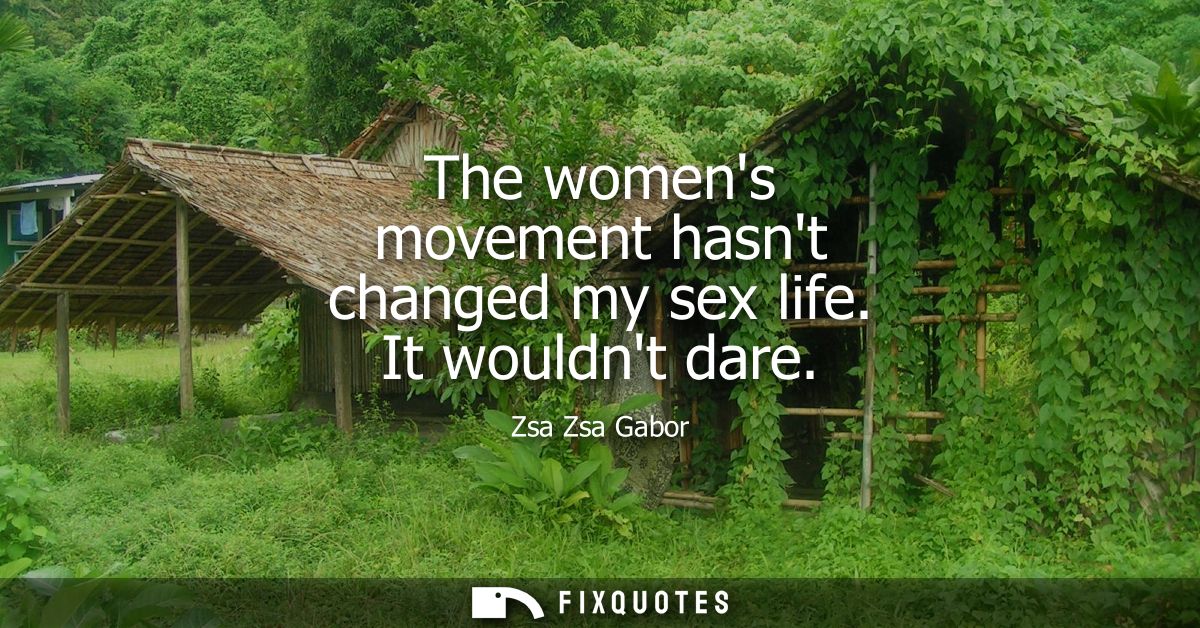
"The women's movement hasn't changed my sex life. It wouldn't dare"
About this Quote
Zsa Zsa Gabor lands this line like a perfectly timed slap in a drawing-room comedy: light on its feet, meaner than it first sounds, and designed to leave a mark. “The women’s movement hasn’t changed my sex life” sets up the expected cultural-wars confession - either a liberation testimonial or a reactionary complaint. Then she snaps the trap shut: “It wouldn’t dare.” The joke isn’t just that she’s sexually ungovernable; it’s that she positions feminism as an entity that might try to regulate her, and then preemptively intimidates it.
The intent is classic Gabor self-mythmaking. She sells herself as a sovereign flirt, too glamorous and too experienced to be revised by politics. The subtext is thornier: the women’s movement is framed as a scolding institution, while her “sex life” is cast as a private kingdom defended by celebrity nerve. It’s empowerment, but an individualist, high-gloss version - less “solidarity” than “don’t tell me what to do.” That posture flatters her audience, too: anyone can borrow her disdain for moral lecturing, even if they don’t share her diamonds.
Context matters. Second-wave feminism was challenging marriage scripts, workplace inequities, sexual double standards - the whole architecture. Gabor, famous for multiple marriages and a public persona built on erotic confidence, doesn’t argue with the movement’s goals; she sidesteps them by turning the camera back on herself. The line works because it’s a defense mechanism dressed as punchline: when history knocks, she answers with celebrity bravado and refuses to be drafted into anyone’s program.
The intent is classic Gabor self-mythmaking. She sells herself as a sovereign flirt, too glamorous and too experienced to be revised by politics. The subtext is thornier: the women’s movement is framed as a scolding institution, while her “sex life” is cast as a private kingdom defended by celebrity nerve. It’s empowerment, but an individualist, high-gloss version - less “solidarity” than “don’t tell me what to do.” That posture flatters her audience, too: anyone can borrow her disdain for moral lecturing, even if they don’t share her diamonds.
Context matters. Second-wave feminism was challenging marriage scripts, workplace inequities, sexual double standards - the whole architecture. Gabor, famous for multiple marriages and a public persona built on erotic confidence, doesn’t argue with the movement’s goals; she sidesteps them by turning the camera back on herself. The line works because it’s a defense mechanism dressed as punchline: when history knocks, she answers with celebrity bravado and refuses to be drafted into anyone’s program.
Quote Details
| Topic | Witty One-Liners |
|---|---|
| Source | Attributed to Zsa Zsa Gabor; listed on Wikiquote (Zsa Zsa Gabor). Primary contemporaneous source not specified on that page. |
| Cite |
Citation Formats
APA Style (7th ed.)
Gabor, Zsa Zsa. (2026, January 18). The women's movement hasn't changed my sex life. It wouldn't dare. FixQuotes. https://fixquotes.com/quotes/the-womens-movement-hasnt-changed-my-sex-life-it-15076/
Chicago Style
Gabor, Zsa Zsa. "The women's movement hasn't changed my sex life. It wouldn't dare." FixQuotes. January 18, 2026. https://fixquotes.com/quotes/the-womens-movement-hasnt-changed-my-sex-life-it-15076/.
MLA Style (9th ed.)
"The women's movement hasn't changed my sex life. It wouldn't dare." FixQuotes, 18 Jan. 2026, https://fixquotes.com/quotes/the-womens-movement-hasnt-changed-my-sex-life-it-15076/. Accessed 14 Mar. 2026.
More Quotes by Zsa
Add to List