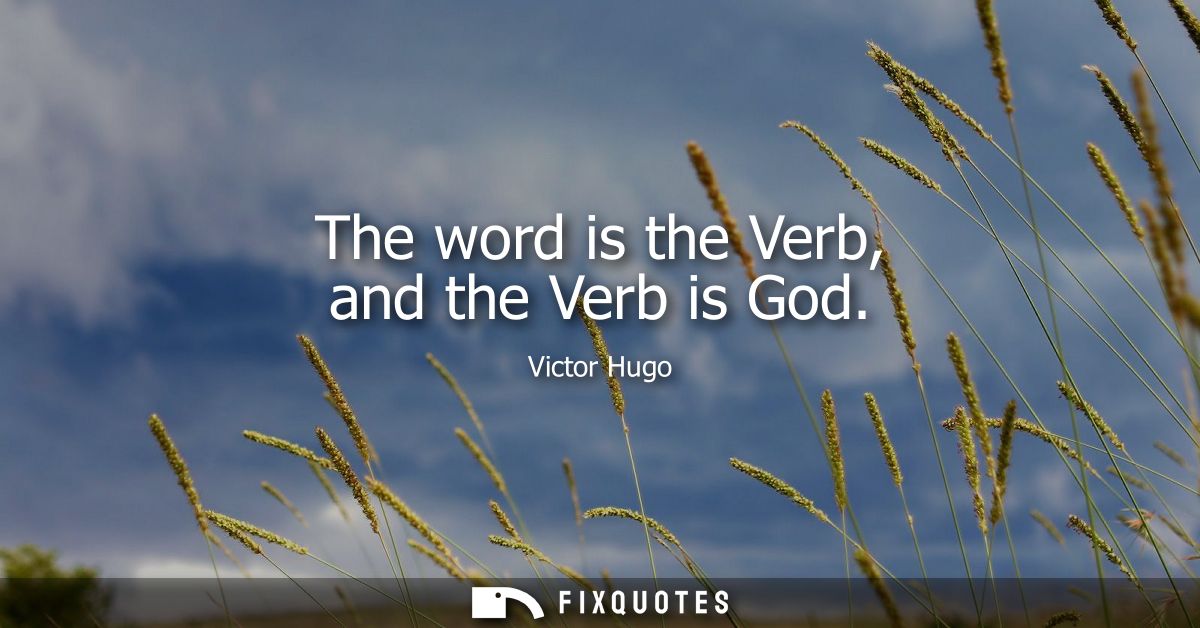
"The word is the Verb, and the Verb is God"
About this Quote
Hugo turns theology into grammar and, in the process, flatters the writer’s craft with cathedral-scale ambition. “The word is the Verb” isn’t a slip of terminology; it’s a deliberate escalation. Not any word, but the Verb: the engine of sentence and story, the part of speech that insists on movement, change, consequence. Hugo’s point is less about language as ornament than language as force - the thing that makes events happen, that converts private feeling into public reality.
The line also riffs on the Gospel of John (“In the beginning was the Word... and the Word was God”) while quietly rewriting it. John sanctifies Logos as divine reason; Hugo modernizes it into action. In a 19th-century France ricocheting between revolution, empire, and restoration, “Verb” reads like a political claim: history is made by deeds, yes, but deeds are organized, justified, and remembered through language. Words don’t merely reflect power; they are one of its primary instruments.
Subtext: the author as a kind of secular priest. If the Verb is God, then whoever commands verbs - who can name, accuse, promise, and prophesy - holds a dangerous authority. Hugo knew this firsthand as a public intellectual and exile, watching regimes rise and fall on speeches, slogans, and censorship. The sentence works because it compresses Romantic faith in creative genius with a hard-edged awareness of propaganda: language is holy, and that holiness can be weaponized.
The line also riffs on the Gospel of John (“In the beginning was the Word... and the Word was God”) while quietly rewriting it. John sanctifies Logos as divine reason; Hugo modernizes it into action. In a 19th-century France ricocheting between revolution, empire, and restoration, “Verb” reads like a political claim: history is made by deeds, yes, but deeds are organized, justified, and remembered through language. Words don’t merely reflect power; they are one of its primary instruments.
Subtext: the author as a kind of secular priest. If the Verb is God, then whoever commands verbs - who can name, accuse, promise, and prophesy - holds a dangerous authority. Hugo knew this firsthand as a public intellectual and exile, watching regimes rise and fall on speeches, slogans, and censorship. The sentence works because it compresses Romantic faith in creative genius with a hard-edged awareness of propaganda: language is holy, and that holiness can be weaponized.
Quote Details
| Topic | God |
|---|---|
| Source | Help us find the source |
| Cite |
Citation Formats
APA Style (7th ed.)
Hugo, Victor. (2026, January 15). The word is the Verb, and the Verb is God. FixQuotes. https://fixquotes.com/quotes/the-word-is-the-verb-and-the-verb-is-god-10569/
Chicago Style
Hugo, Victor. "The word is the Verb, and the Verb is God." FixQuotes. January 15, 2026. https://fixquotes.com/quotes/the-word-is-the-verb-and-the-verb-is-god-10569/.
MLA Style (9th ed.)
"The word is the Verb, and the Verb is God." FixQuotes, 15 Jan. 2026, https://fixquotes.com/quotes/the-word-is-the-verb-and-the-verb-is-god-10569/. Accessed 6 Apr. 2026.
More Quotes by Victor
Add to List