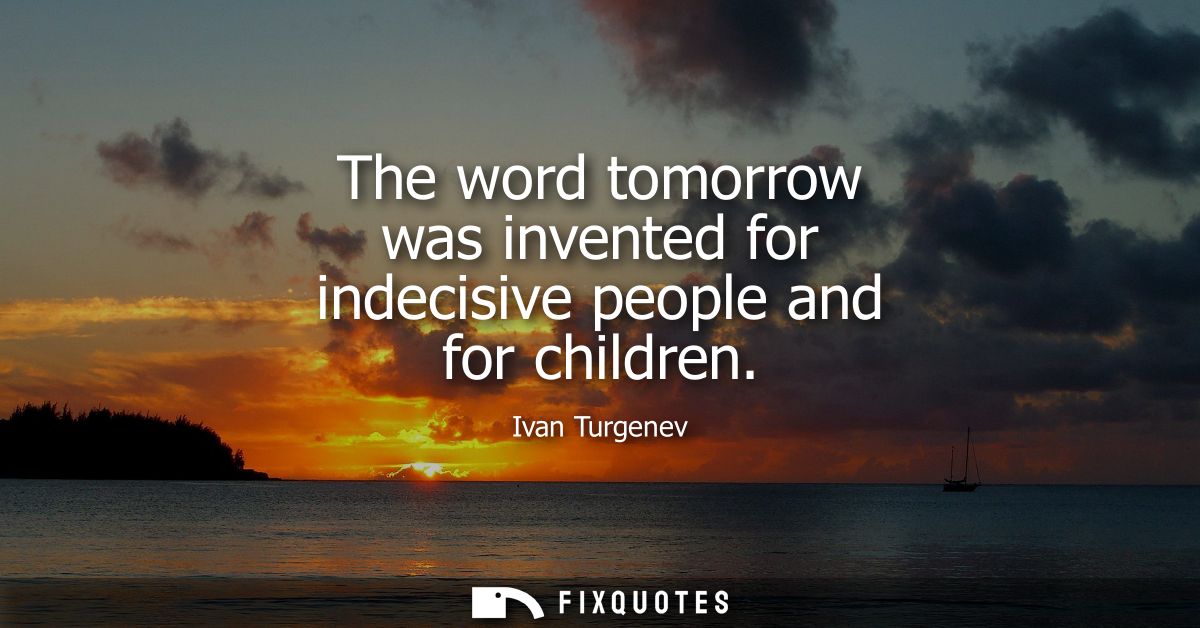
"The word tomorrow was invented for indecisive people and for children"
About this Quote
Tomorrow is where responsibility goes to take a long nap. Turgenev’s line is a neat little blade: it slices the calendar into two moral categories, adulthood and delay. By calling "tomorrow" an invention, he implies it’s less a neutral time marker than a human technology for postponement - a story we tell ourselves to make inaction feel orderly rather than cowardly.
The jab at "indecisive people" catches the obvious target: the adults who treat choice as a threat and defer it until the moment is supposedly cleaner, safer, more certain. The sharper move is pairing them with children. Kids live in "tomorrow" because their power is limited; their desires must wait on permission, money, weather, grown-ups. For an adult to use the same refuge is, in Turgenev’s framing, a kind of self-infantilization: you’re acting as if you can’t act.
That subtext lands in the 19th-century Russian world he wrote from, a society famous for "superfluous men" and paralyzed intelligentsia - educated, sensitive, eloquent, and chronically unable to convert conviction into action. Turgenev watched reform, love, and political change get talked to death, then deferred again. "Tomorrow" becomes the verbal tic of a culture that knows what’s wrong and still can’t move.
The line works because it’s not motivational poster earnestness; it’s contempt disguised as clarity. It doesn’t beg you to seize the day. It dares you not to be a child.
The jab at "indecisive people" catches the obvious target: the adults who treat choice as a threat and defer it until the moment is supposedly cleaner, safer, more certain. The sharper move is pairing them with children. Kids live in "tomorrow" because their power is limited; their desires must wait on permission, money, weather, grown-ups. For an adult to use the same refuge is, in Turgenev’s framing, a kind of self-infantilization: you’re acting as if you can’t act.
That subtext lands in the 19th-century Russian world he wrote from, a society famous for "superfluous men" and paralyzed intelligentsia - educated, sensitive, eloquent, and chronically unable to convert conviction into action. Turgenev watched reform, love, and political change get talked to death, then deferred again. "Tomorrow" becomes the verbal tic of a culture that knows what’s wrong and still can’t move.
The line works because it’s not motivational poster earnestness; it’s contempt disguised as clarity. It doesn’t beg you to seize the day. It dares you not to be a child.
Quote Details
| Topic | Live in the Moment |
|---|---|
| Source | Help us find the source |
| Cite |
Citation Formats
APA Style (7th ed.)
Turgenev, Ivan. (2026, January 15). The word tomorrow was invented for indecisive people and for children. FixQuotes. https://fixquotes.com/quotes/the-word-tomorrow-was-invented-for-indecisive-7185/
Chicago Style
Turgenev, Ivan. "The word tomorrow was invented for indecisive people and for children." FixQuotes. January 15, 2026. https://fixquotes.com/quotes/the-word-tomorrow-was-invented-for-indecisive-7185/.
MLA Style (9th ed.)
"The word tomorrow was invented for indecisive people and for children." FixQuotes, 15 Jan. 2026, https://fixquotes.com/quotes/the-word-tomorrow-was-invented-for-indecisive-7185/. Accessed 3 Apr. 2026.
More Quotes by Ivan
Add to List