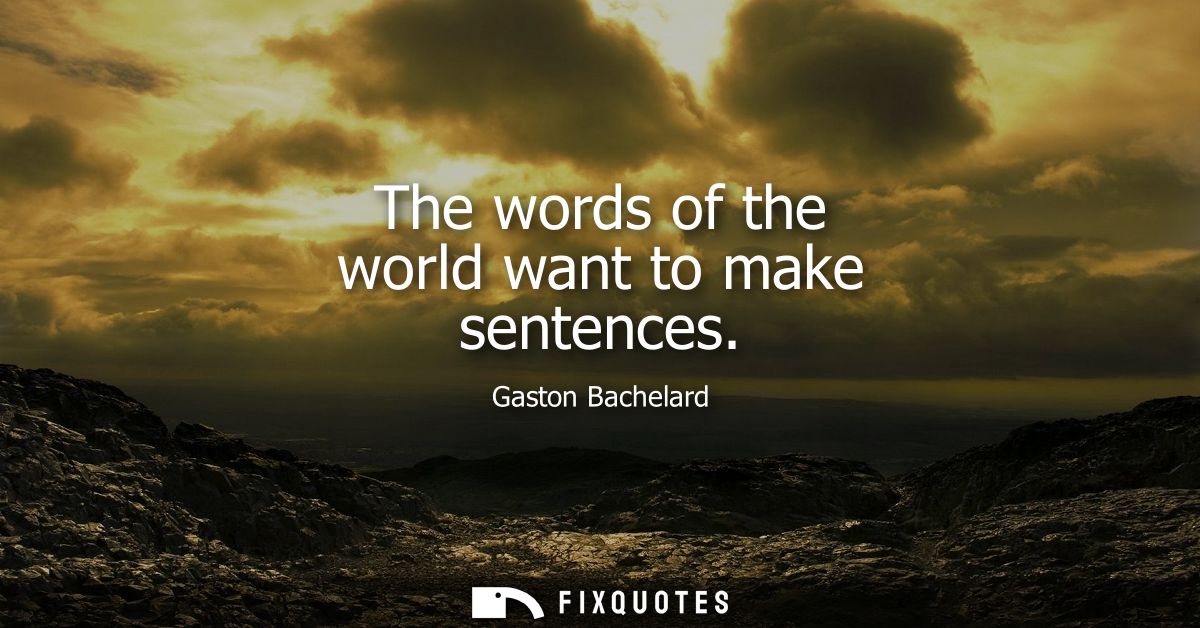
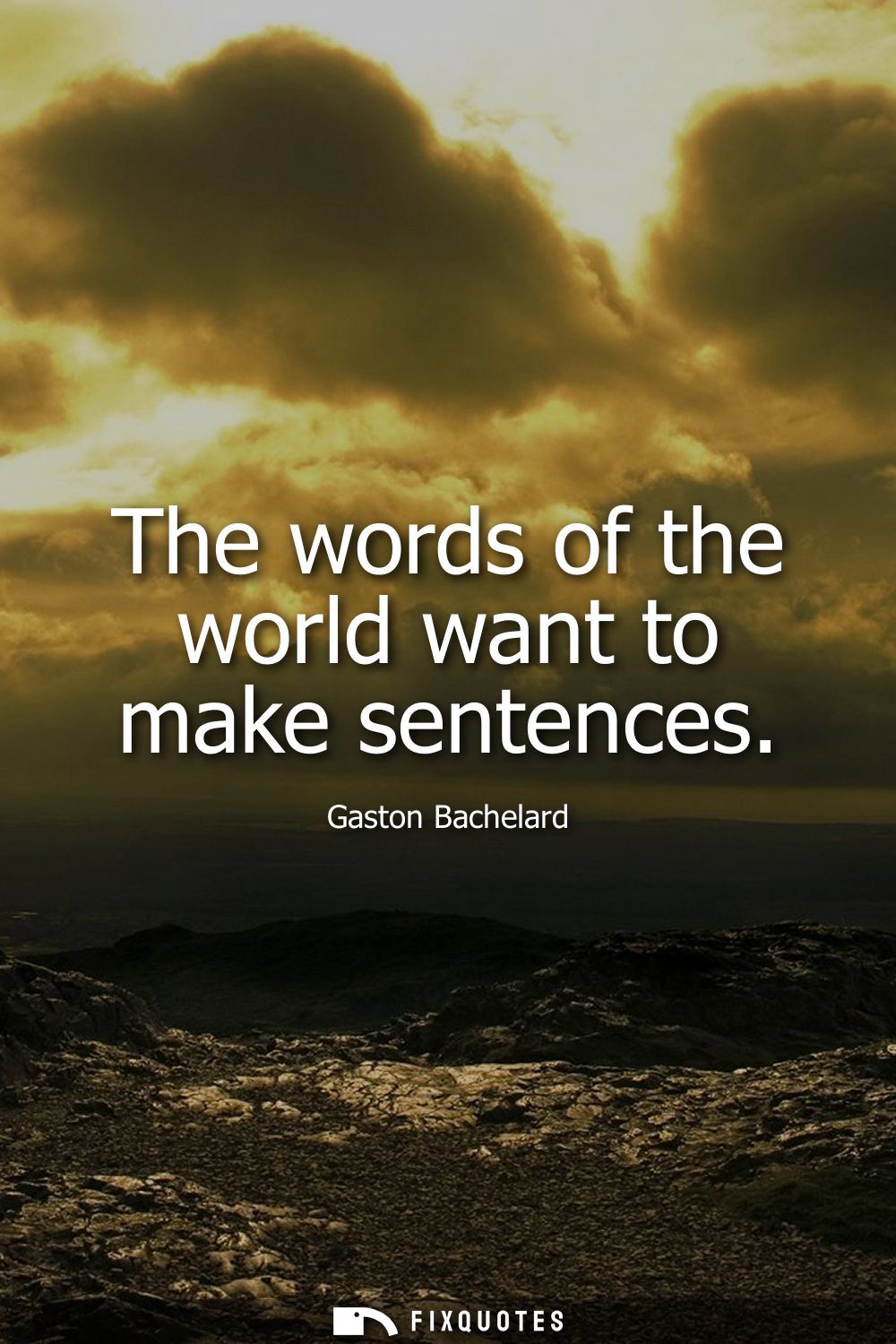
"The words of the world want to make sentences"
About this Quote
Language isn’t presented here as a tidy toolbox; it’s a restless force with its own gravity. Bachelard’s line turns words into agents that “want” something, and that small anthropomorphism matters: it suggests that meaning is not simply imposed by a speaker but solicited by the material of language itself. “The words of the world” is a sly hinge phrase, too. It can mean the world’s words (the social stock of language) and also the words that belong to the world (naming, description, the urge to say what’s there). Either way, words aren’t neutral tokens; they arrive already tugging toward form.
The verb “want” is doing philosophical heavy lifting. Want implies appetite, pressure, and incompleteness. A single word is a fragment that yearns for relation, and relation is syntax: sentences are where words become accountable to one another. Bachelard, a philosopher of imagination and reverie, often treats thought as something that happens in and through images rather than above them. This line fits that project: it frames writing as less command-and-control, more listening for the way words naturally cluster, how an image calls for a predicate, how a noun demands a world.
Contextually, it pushes back against overly austere rationalism that treats language as mere packaging for preformed ideas. The subtext is an ethics of attention: if words “want to make sentences,” the writer’s job is to cooperate with that desire without letting cliché do the driving. It’s a romantic claim, but not sentimental: it implies that the world is legible only when we let language complete its own momentum.
The verb “want” is doing philosophical heavy lifting. Want implies appetite, pressure, and incompleteness. A single word is a fragment that yearns for relation, and relation is syntax: sentences are where words become accountable to one another. Bachelard, a philosopher of imagination and reverie, often treats thought as something that happens in and through images rather than above them. This line fits that project: it frames writing as less command-and-control, more listening for the way words naturally cluster, how an image calls for a predicate, how a noun demands a world.
Contextually, it pushes back against overly austere rationalism that treats language as mere packaging for preformed ideas. The subtext is an ethics of attention: if words “want to make sentences,” the writer’s job is to cooperate with that desire without letting cliché do the driving. It’s a romantic claim, but not sentimental: it implies that the world is legible only when we let language complete its own momentum.
Quote Details
| Topic | Writing |
|---|---|
| Source | Help us find the source |
| Cite |
Citation Formats
APA Style (7th ed.)
Bachelard, Gaston. (2026, January 18). The words of the world want to make sentences. FixQuotes. https://fixquotes.com/quotes/the-words-of-the-world-want-to-make-sentences-22625/
Chicago Style
Bachelard, Gaston. "The words of the world want to make sentences." FixQuotes. January 18, 2026. https://fixquotes.com/quotes/the-words-of-the-world-want-to-make-sentences-22625/.
MLA Style (9th ed.)
"The words of the world want to make sentences." FixQuotes, 18 Jan. 2026, https://fixquotes.com/quotes/the-words-of-the-world-want-to-make-sentences-22625/. Accessed 4 Apr. 2026.
More Quotes by Gaston
Add to List