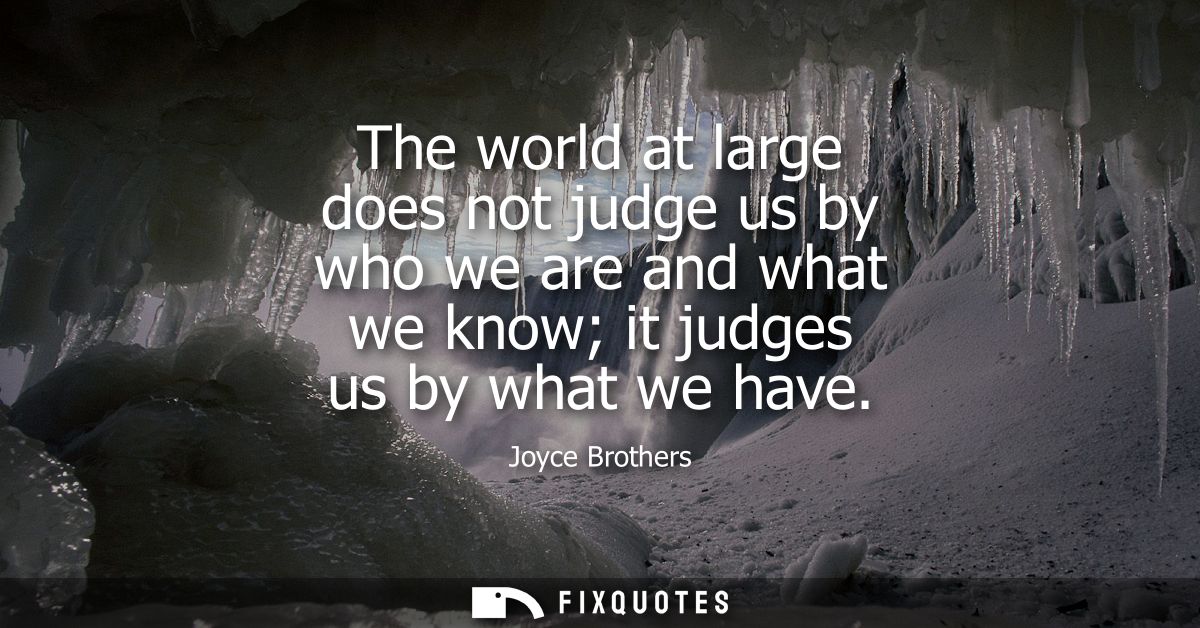
"The world at large does not judge us by who we are and what we know; it judges us by what we have"
About this Quote
The intent isn’t to endorse materialism; it’s to name the social rule so you can stop pretending it isn’t operating. Brothers spent decades translating psychology into daytime-TV language, and this has that same pragmatic edge: if you want to understand how people treat you, watch what they use as evidence. "Who we are" and "what we know" are invisible, slow to verify, easy to fake. "What we have" is legible at a glance: the house, the job title, the brand signals. In a crowded, fast-moving society, people default to shortcuts. Possessions become proxies for competence, virtue, even lovability.
The subtext carries a warning about self-worth: if the world’s grading system is external, you can end up living as a public relations project, acquiring proof you’re okay. Coming from a psychologist, the line also reads as an invitation to reclaim agency: recognize the metric, then decide whether you’ll perform for it, resist it, or build a life where your own measures count more than the world’s.
Quote Details
| Topic | Wealth |
|---|---|
| Source | Help us find the source |
| Cite |
Citation Formats
APA Style (7th ed.)
Brothers, Joyce. (2026, January 15). The world at large does not judge us by who we are and what we know; it judges us by what we have. FixQuotes. https://fixquotes.com/quotes/the-world-at-large-does-not-judge-us-by-who-we-142165/
Chicago Style
Brothers, Joyce. "The world at large does not judge us by who we are and what we know; it judges us by what we have." FixQuotes. January 15, 2026. https://fixquotes.com/quotes/the-world-at-large-does-not-judge-us-by-who-we-142165/.
MLA Style (9th ed.)
"The world at large does not judge us by who we are and what we know; it judges us by what we have." FixQuotes, 15 Jan. 2026, https://fixquotes.com/quotes/the-world-at-large-does-not-judge-us-by-who-we-142165/. Accessed 9 Mar. 2026.