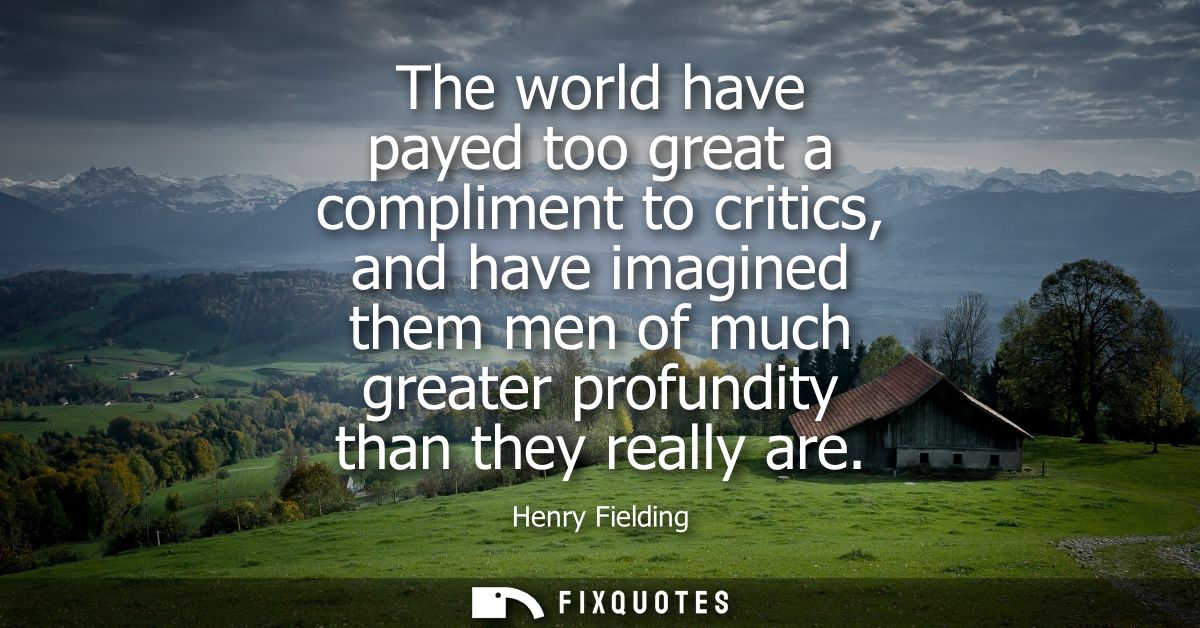
"The world have payed too great a compliment to critics, and have imagined them men of much greater profundity than they really are"
About this Quote
The jab at “profundity” is the key. He’s not claiming critics are useless; he’s claiming we confuse their posture with depth. Criticism often rewards the performance of insight - the clever takedown, the grand standard, the moralizing pronouncement - because it’s easier to applaud judgment than to sit with the messy pleasure of reading. Fielding, a comic novelist with a lawyer’s instinct for rhetoric, knows how “depth” can be manufactured: a few lofty abstractions, a tone of superiority, and suddenly opinion dresses up as philosophy.
Context matters. Mid-18th-century Britain is a booming print culture: new periodicals, coffeehouse debates, the rising professional reviewer. The critic becomes a gatekeeper in a marketplace where novels are still slightly suspect and constantly on trial for corrupting morals. Fielding’s subtext is defensive and aggressive at once: stop outsourcing your judgment to these self-appointed arbiters, and stop pretending they’re wiser than the artists they scold. It’s also a power move - a novelist insisting that creation carries its own intelligence, one critics often mistake for something to be graded rather than understood.
Quote Details
| Topic | Witty One-Liners |
|---|---|
| Source | Help us find the source |
| Cite |
Citation Formats
APA Style (7th ed.)
Fielding, Henry. (2026, January 15). The world have payed too great a compliment to critics, and have imagined them men of much greater profundity than they really are. FixQuotes. https://fixquotes.com/quotes/the-world-have-payed-too-great-a-compliment-to-143955/
Chicago Style
Fielding, Henry. "The world have payed too great a compliment to critics, and have imagined them men of much greater profundity than they really are." FixQuotes. January 15, 2026. https://fixquotes.com/quotes/the-world-have-payed-too-great-a-compliment-to-143955/.
MLA Style (9th ed.)
"The world have payed too great a compliment to critics, and have imagined them men of much greater profundity than they really are." FixQuotes, 15 Jan. 2026, https://fixquotes.com/quotes/the-world-have-payed-too-great-a-compliment-to-143955/. Accessed 30 Mar. 2026.