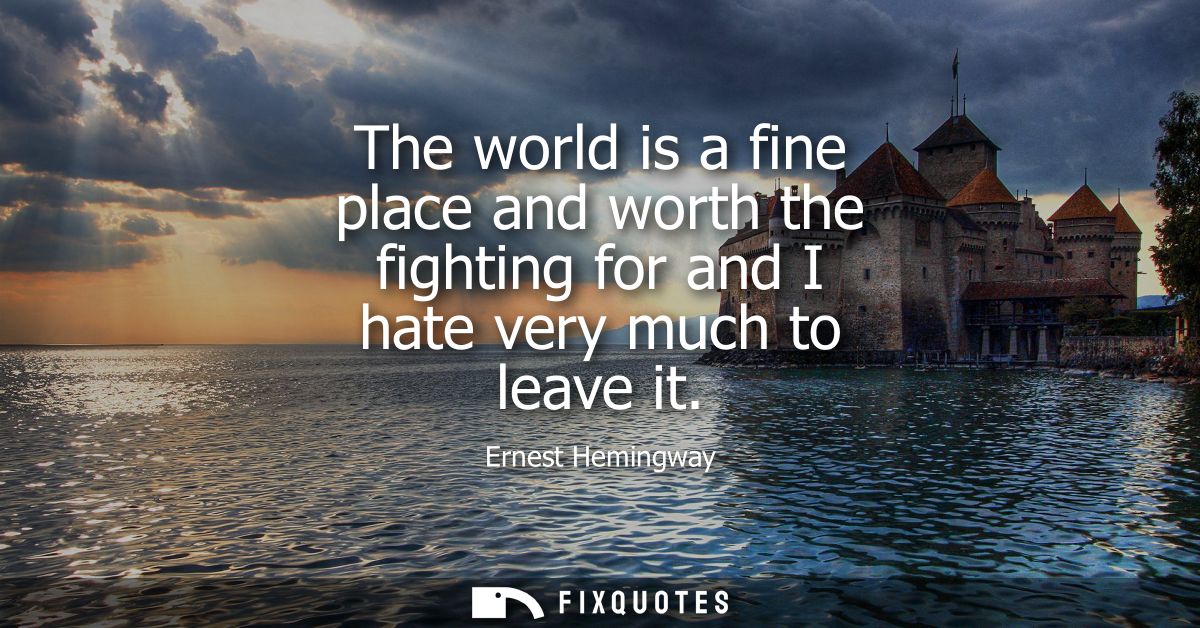
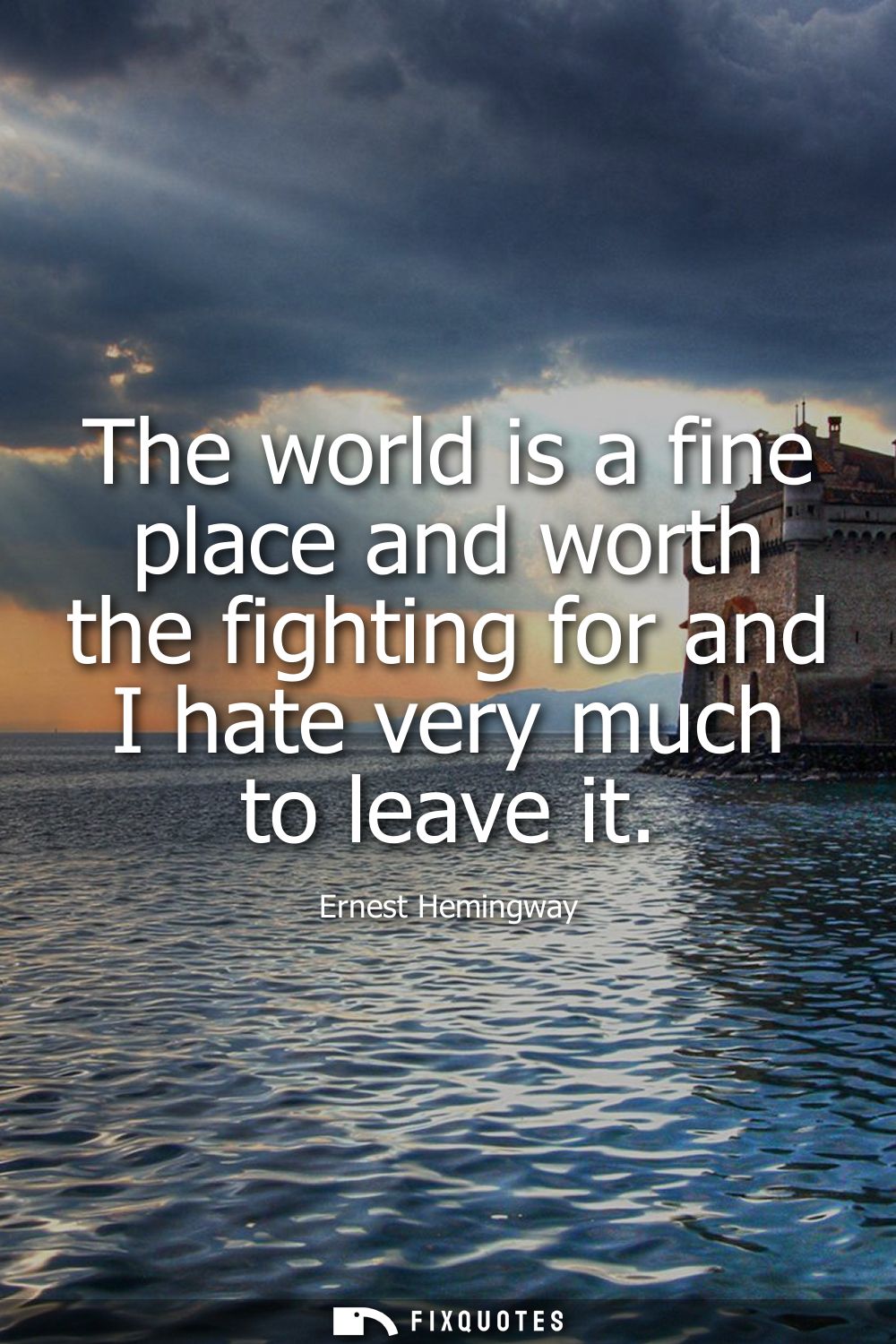
"The world is a fine place and worth the fighting for and I hate very much to leave it"
About this Quote
The pivot comes with “worth the fighting for.” In Hemingway’s universe, value is proven through action. Love, honor, and meaning don’t exist as ideas; they exist as something you’ll bleed for. The subtext is almost accusatory: if the world is worth fighting for, then you’re obligated to fight, even when the odds are stupid and the cause is compromised. That’s the Hemingway code stripped to its bones.
Then he undercuts his own stoicism: “and I hate very much to leave it.” It’s an admission of attachment that he usually masks behind toughness. The “very much” is nearly embarrassing in its sincerity, which is precisely why it lands. Context matters: the quote is widely associated with For Whom the Bell Tolls, a novel shaped by the Spanish Civil War and Hemingway’s obsession with courage under pressure. It’s a farewell that refuses transcendence. No afterlife, no consolation prize, just a hard-earned love for the mess we’re in.
Quote Details
| Topic | Mortality |
|---|---|
| Source | Unverified source: For Whom the Bell Tolls (Ernest Hemingway, 1940)
Evidence: Chapter 43 (page varies by edition). This line is spoken/thought by the protagonist Robert Jordan near the end of the novel. The primary/original appearance is in Hemingway’s novel For Whom the Bell Tolls, first published in 1940 by Charles Scribner’s Sons. Many quote sites shorten/misquote it as... Other candidates (2) Ernest Hemingway (Ernest Hemingway) compilation98.7% n everywhere the world is a fine place and worth the fighting for and i hate very much to leave it ch 43 t The New York Times Book Review (The New York Times, 2021) compilation95.0% ... Hemingway has struck universal chords , and he has struck them vibrantly . Perhaps it con- veys something of ... ... |
| Cite |
Citation Formats
APA Style (7th ed.)
Hemingway, Ernest. (2026, January 13). The world is a fine place and worth the fighting for and I hate very much to leave it. FixQuotes. https://fixquotes.com/quotes/the-world-is-a-fine-place-and-worth-the-fighting-19423/
Chicago Style
Hemingway, Ernest. "The world is a fine place and worth the fighting for and I hate very much to leave it." FixQuotes. January 13, 2026. https://fixquotes.com/quotes/the-world-is-a-fine-place-and-worth-the-fighting-19423/.
MLA Style (9th ed.)
"The world is a fine place and worth the fighting for and I hate very much to leave it." FixQuotes, 13 Jan. 2026, https://fixquotes.com/quotes/the-world-is-a-fine-place-and-worth-the-fighting-19423/. Accessed 14 Mar. 2026.