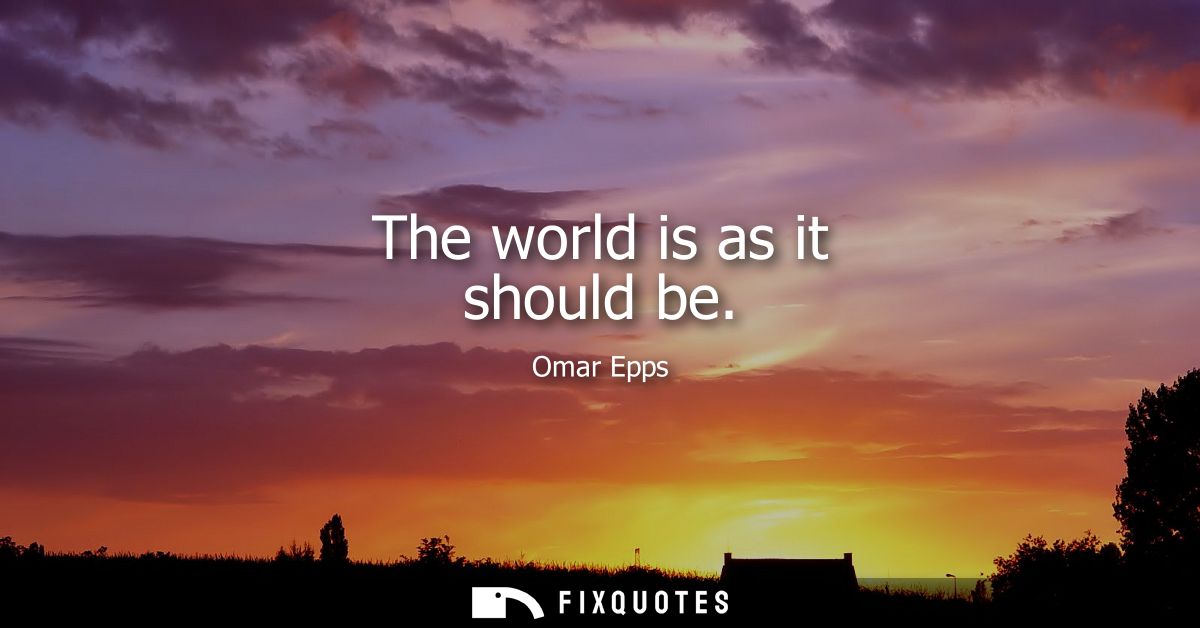
"The world is as it should be"
About this Quote
Omar Epps' "The world is as it should be" lands like a calm sentence that can read as either peace or provocation, depending on what you bring to it. Coming from an actor whose career has often orbited characters caught in systems bigger than themselves (medicine, law enforcement, institutional power), the line feels less like a victory lap and more like a stress test: do you hear reassurance, resignation, or a quiet dare?
The intent is deceptively simple. It's not "the world is good". It's "the world is correct". That word choice smuggles in an argument about order: that chaos has a shape, that outcomes reflect design, that whatever you're staring at is somehow deserved or inevitable. The subtext can be spiritual (accept what you cannot control), psychological (stop fighting reality), or political (a shrug toward injustice). That's why it works: it's a Rorschach statement that exposes the listener's relationship to power. If you're comfortable, it reads like gratitude. If you're not, it reads like gaslighting.
In pop-cultural terms, the line also echoes a familiar performance move: the stoic mask. Actors traffic in restraint, and Epps has made a career out of characters who communicate control by withholding. This sentence performs that same restraint - a neatly buttoned posture that invites you to look for what isn't being said. The real heat is in the implication: if the world is "as it should be", then who's responsible for how it is - and who's being asked to accept it.
The intent is deceptively simple. It's not "the world is good". It's "the world is correct". That word choice smuggles in an argument about order: that chaos has a shape, that outcomes reflect design, that whatever you're staring at is somehow deserved or inevitable. The subtext can be spiritual (accept what you cannot control), psychological (stop fighting reality), or political (a shrug toward injustice). That's why it works: it's a Rorschach statement that exposes the listener's relationship to power. If you're comfortable, it reads like gratitude. If you're not, it reads like gaslighting.
In pop-cultural terms, the line also echoes a familiar performance move: the stoic mask. Actors traffic in restraint, and Epps has made a career out of characters who communicate control by withholding. This sentence performs that same restraint - a neatly buttoned posture that invites you to look for what isn't being said. The real heat is in the implication: if the world is "as it should be", then who's responsible for how it is - and who's being asked to accept it.
Quote Details
| Topic | Free Will & Fate |
|---|---|
| Source | Help us find the source |
| Cite |
Citation Formats
APA Style (7th ed.)
Epps, Omar. (2026, January 16). The world is as it should be. FixQuotes. https://fixquotes.com/quotes/the-world-is-as-it-should-be-113097/
Chicago Style
Epps, Omar. "The world is as it should be." FixQuotes. January 16, 2026. https://fixquotes.com/quotes/the-world-is-as-it-should-be-113097/.
MLA Style (9th ed.)
"The world is as it should be." FixQuotes, 16 Jan. 2026, https://fixquotes.com/quotes/the-world-is-as-it-should-be-113097/. Accessed 12 Feb. 2026.
More Quotes by Omar
Add to List