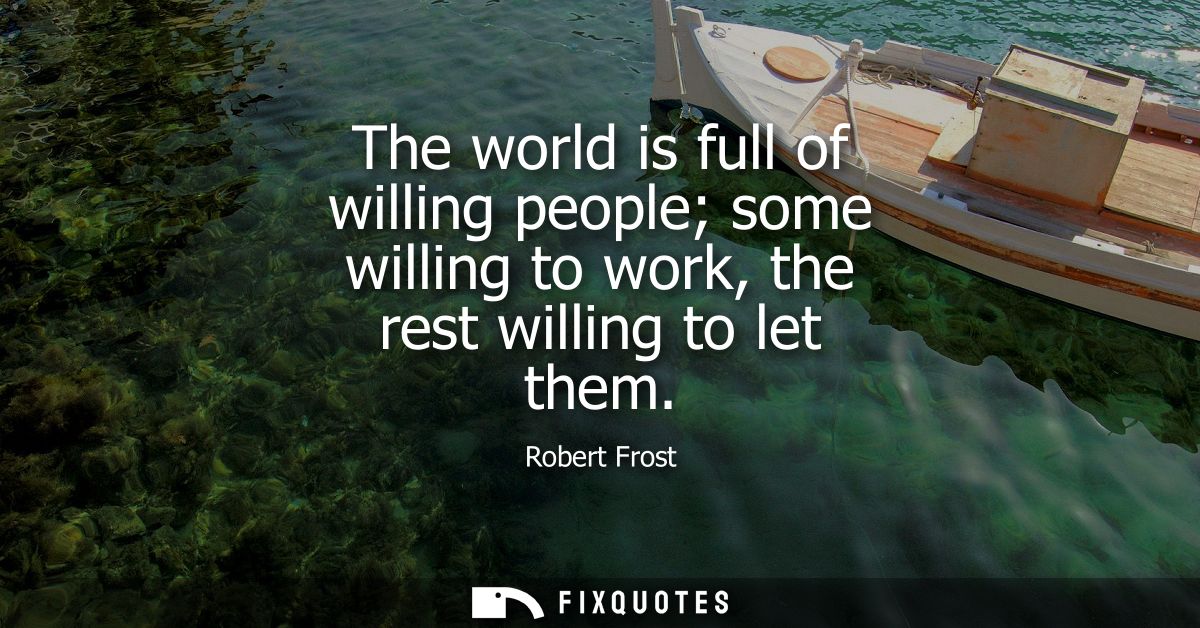
"The world is full of willing people; some willing to work, the rest willing to let them"
About this Quote
The subtext is class realism without the manifesto. Frost isn’t painting villains with top hats. He’s pointing at a social default: people will accept inequity if it costs them nothing and can be rationalized as “the way things are.” “Let them” is doing heavy lifting here. It implies permission, as if the workers have been granted the privilege of being used. That small verb makes dependency feel like governance.
Context matters because Frost’s public image often gets domesticated into pastoral comfort: stone walls, snowy woods, New England virtue. This aphorism complicates the postcard. It’s rural and American in cadence, but it’s also a sharp comment on industrial-era modernity, where productivity becomes moral currency and leisure becomes a quiet form of power.
The intent, then, isn’t to shame work or sanctify it. It’s to expose the cozy myth that “willingness” is an equalizer. Frost’s real target is the smug neutrality of the non-worker: the people who don’t have to oppose labor to benefit from it.
Quote Details
| Topic | Work Ethic |
|---|---|
| Source | Help us find the source |
| Cite |
Citation Formats
APA Style (7th ed.)
Frost, Robert. (2026, January 17). The world is full of willing people; some willing to work, the rest willing to let them. FixQuotes. https://fixquotes.com/quotes/the-world-is-full-of-willing-people-some-willing-28931/
Chicago Style
Frost, Robert. "The world is full of willing people; some willing to work, the rest willing to let them." FixQuotes. January 17, 2026. https://fixquotes.com/quotes/the-world-is-full-of-willing-people-some-willing-28931/.
MLA Style (9th ed.)
"The world is full of willing people; some willing to work, the rest willing to let them." FixQuotes, 17 Jan. 2026, https://fixquotes.com/quotes/the-world-is-full-of-willing-people-some-willing-28931/. Accessed 12 Feb. 2026.