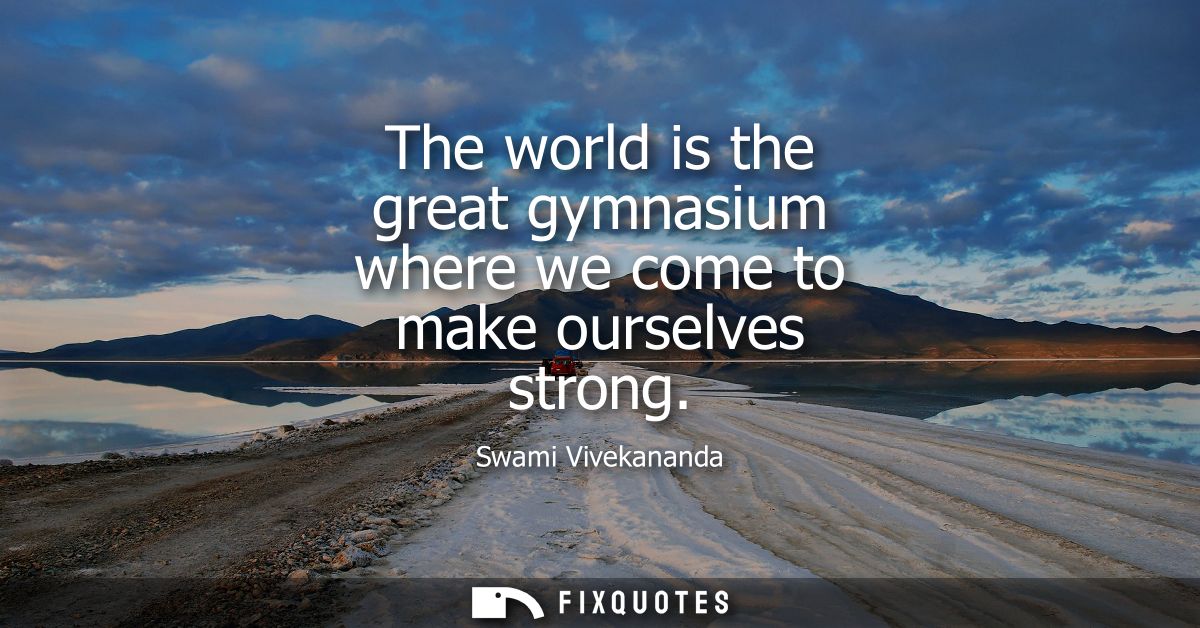
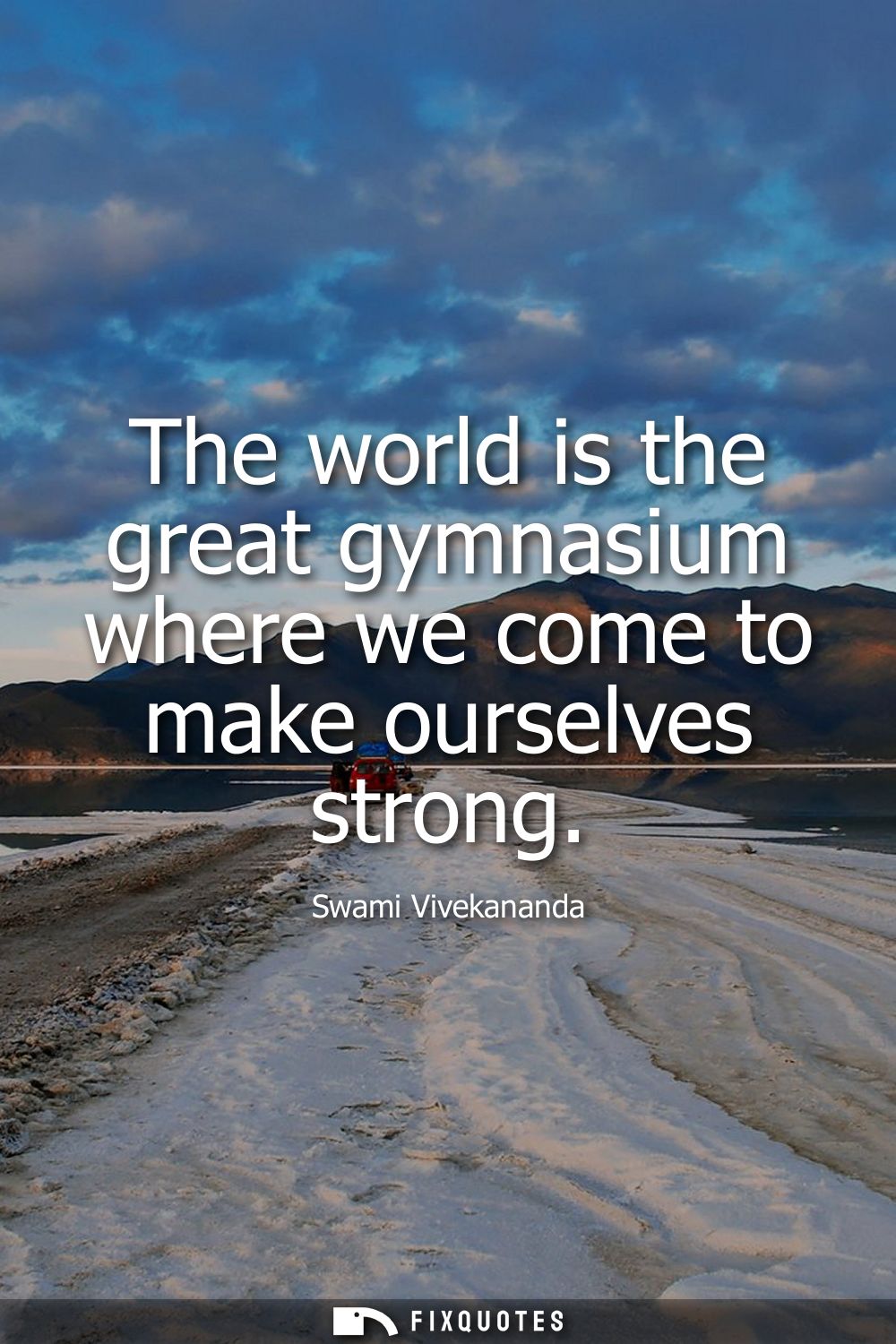
"The world is the great gymnasium where we come to make ourselves strong"
About this Quote
Vivekananda’s intent isn’t motivational fluff so much as a reframing of destiny. In a colonial era that routinely cast India as weak, passive, or “otherworldly,” he offers a counter-image: strength is built, not bestowed. The subtext is quietly defiant: if the world is a gym, then hardship is not evidence of inferiority; it’s the raw material of power. That’s a psychological pivot with political implications, especially for an audience navigating humiliation, reform movements, and the pressure to modernize without self-erasure.
The line also smuggles in a practical Vedantic ethic. Spirituality here isn’t escape from the “world” (often treated as illusion) but training within it - through work, restraint, service, and self-discipline. “Come to make ourselves strong” implies agency and repetition, not instant enlightenment. It’s an anti-victimhood theology without being cruel: life will press you; your task is to convert that pressure into capacity.
It works because it’s both compassionate and demanding. Vivekananda offers meaning without sentimentality, and he makes fortitude feel like a spiritual practice you can actually do.
Quote Details
| Topic | Motivational |
|---|---|
| Source | Unverified source: The Complete Works of Swami Vivekananda, Volume 5 (Swami Vivekananda, 1970)
Evidence: 16. This world is the great gymnasium where we come to make ourselves strong. (Chapter: “Sayings and Utterances”, item 16 (page 410 in this online pagination)). This is a PRIMARY-source occurrence within Vivekananda’s own collected writings as published in The Complete Works. In this edition/view... Other candidates (1) FINAL DEMANDZ- The Call Of Your Greatness (SINDHU SHEKHAR ROY (SS ROY), S.K PATRO) compilation95.0% ... THE WORLD IS THE GREAT GYMNASIUM WHERE WE COME TO MAKE OURSELVES STRONG . " -SWAMI VIVEKANANDA 1. Goal setting is... |
| Cite |
Citation Formats
APA Style (7th ed.)
Vivekananda, Swami. (2026, March 1). The world is the great gymnasium where we come to make ourselves strong. FixQuotes. https://fixquotes.com/quotes/the-world-is-the-great-gymnasium-where-we-come-to-14975/
Chicago Style
Vivekananda, Swami. "The world is the great gymnasium where we come to make ourselves strong." FixQuotes. March 1, 2026. https://fixquotes.com/quotes/the-world-is-the-great-gymnasium-where-we-come-to-14975/.
MLA Style (9th ed.)
"The world is the great gymnasium where we come to make ourselves strong." FixQuotes, 1 Mar. 2026, https://fixquotes.com/quotes/the-world-is-the-great-gymnasium-where-we-come-to-14975/. Accessed 19 Mar. 2026.