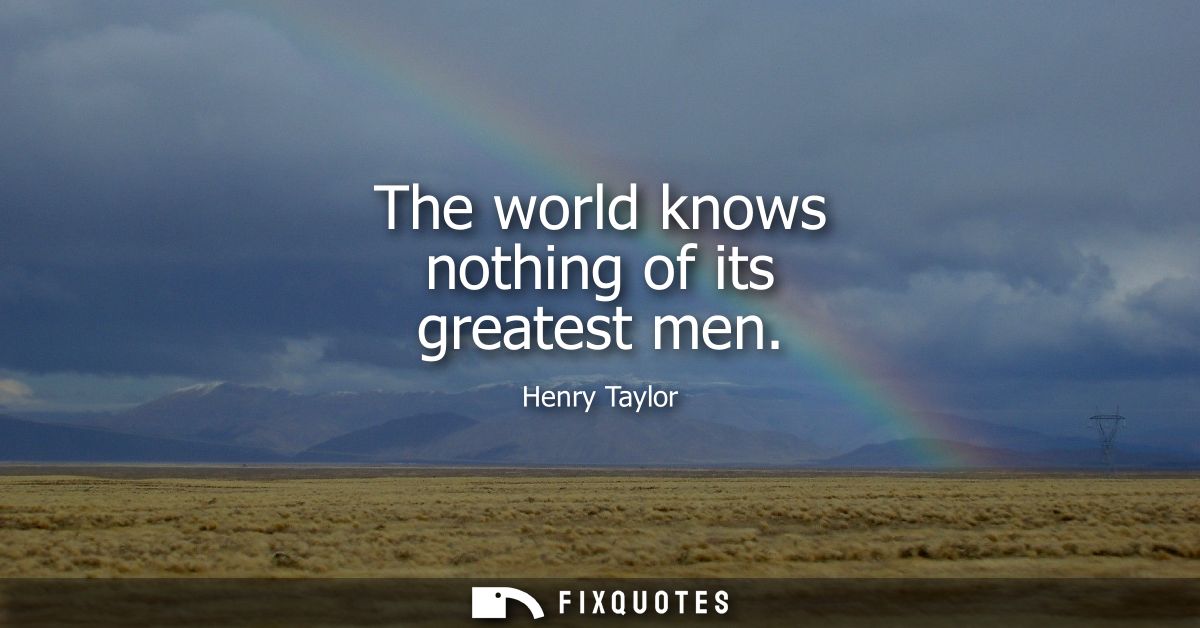
"The world knows nothing of its greatest men"
About this Quote
Greatness, Taylor implies, is largely invisible on the very stage where we insist it perform. "The world knows nothing of its greatest men" lands like a rebuke to public opinion: the crowd doesn’t merely overlook excellence, it lacks the instruments to recognize it. The line’s sting comes from its absolutism. Not "little", not "less than it should", but "nothing" - a pointed indictment of the way reputation is manufactured from surfaces, gossip, and convenience.
As a dramatist in Victorian Britain, Taylor worked in an era obsessed with moral exemplars and "great men" narratives, yet also one in which bureaucracy, empire, and mass print culture were turning individuals into types. The subtext is double-edged: it flatters the unacknowledged striver (your obscurity may be proof of depth), while quietly mocking society’s need to crown heroes it can digest. Taylor’s "greatest men" aren’t necessarily famous statesmen; they’re those whose most consequential acts may be private, slow, or structurally hidden - the kind of virtue and intelligence that resists easy story arcs.
The intent feels less like romantic mysticism than social critique. Public acclaim, he suggests, is a poor proxy for actual merit because it rewards legibility. The world can "know" a persona, a legend, a set of anecdotes. What it can’t know is the interior discipline, the unrecorded decisions, the ethical costs - the parts that would make a person truly great, and therefore hard to summarize, commodify, or celebrate on schedule.
As a dramatist in Victorian Britain, Taylor worked in an era obsessed with moral exemplars and "great men" narratives, yet also one in which bureaucracy, empire, and mass print culture were turning individuals into types. The subtext is double-edged: it flatters the unacknowledged striver (your obscurity may be proof of depth), while quietly mocking society’s need to crown heroes it can digest. Taylor’s "greatest men" aren’t necessarily famous statesmen; they’re those whose most consequential acts may be private, slow, or structurally hidden - the kind of virtue and intelligence that resists easy story arcs.
The intent feels less like romantic mysticism than social critique. Public acclaim, he suggests, is a poor proxy for actual merit because it rewards legibility. The world can "know" a persona, a legend, a set of anecdotes. What it can’t know is the interior discipline, the unrecorded decisions, the ethical costs - the parts that would make a person truly great, and therefore hard to summarize, commodify, or celebrate on schedule.
Quote Details
| Topic | Legacy & Remembrance |
|---|---|
| Source | Help us find the source |
| Cite |
Citation Formats
APA Style (7th ed.)
Taylor, Henry. (2026, January 14). The world knows nothing of its greatest men. FixQuotes. https://fixquotes.com/quotes/the-world-knows-nothing-of-its-greatest-men-161297/
Chicago Style
Taylor, Henry. "The world knows nothing of its greatest men." FixQuotes. January 14, 2026. https://fixquotes.com/quotes/the-world-knows-nothing-of-its-greatest-men-161297/.
MLA Style (9th ed.)
"The world knows nothing of its greatest men." FixQuotes, 14 Jan. 2026, https://fixquotes.com/quotes/the-world-knows-nothing-of-its-greatest-men-161297/. Accessed 12 Feb. 2026.
More Quotes by Henry
Add to List