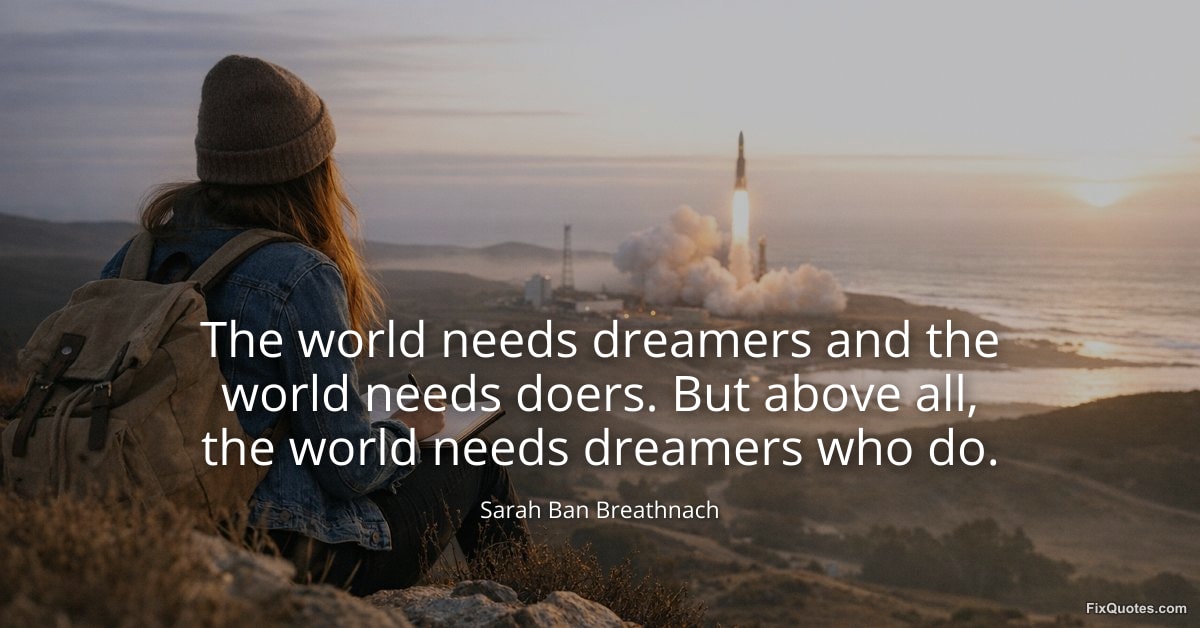
"The world needs dreamers and the world needs doers. But above all, the world needs dreamers who do"
About this Quote
The first two sentences set up a familiar moral economy. Dreamers supply possibility; doers supply momentum. It’s the kind of balance-on-a-poster sentiment you can nod along to. Then the pivot - “But above all” - quietly shifts the stakes. Suddenly, “dreamer” and “doer” aren’t personality types; they’re incomplete states. The phrase “dreamers who do” isn’t just a hybrid ideal, it’s a corrective to a common cultural dodge: using dreaming as a socially acceptable form of procrastination, or using doing as a way to avoid asking what any of it is for.
Ban Breathnach’s context matters. As a late-20th-century American lifestyle author, she’s writing into a market that sells aspiration as both comfort and identity. Her intent is to reroute that energy toward agency. The subtext is pragmatic and slightly impatient: inspiration is cheap; follow-through is the scarce resource. “Who do” also implies risk - public effort, potential failure, the loss of the fantasy’s perfection. The line flatters the reader with possibility, then nudges them toward the only proof that counts: action that makes the dream real.
Quote Details
| Topic | Motivational |
|---|---|
| Source | Unverified source: Simple Abundance: A Daybook of Comfort and Joy (Sarah Ban Breathnach, 1995)
Evidence: Primary attribution: Breathnach’s official website explicitly attributes the quote to her book “Simple Abundance: A Daybook of Comfort and Joy.” The earliest publication year for the work is widely listed as 1995 (e.g., library catalog metadata and bibliographic listings). However, I could not lo... Other candidates (1) The Dream Sorcerers: Cracking the Dream Code (David Sinclair, 2022) compilation95.0% ... Sarah Ban Breathnach said, “The world needs dreamers and the world needs doers. But above all, the world needs dr... |
| Video | Watch Video Quote |
| Featured | This quote was our Quote of the Day on March 10, 2026 |
| Cite |
Citation Formats
APA Style (7th ed.)
Breathnach, Sarah Ban. (2026, January 13). The world needs dreamers and the world needs doers. But above all, the world needs dreamers who do. FixQuotes. https://fixquotes.com/quotes/the-world-needs-dreamers-and-the-world-needs-76761/
Chicago Style
Breathnach, Sarah Ban. "The world needs dreamers and the world needs doers. But above all, the world needs dreamers who do." FixQuotes. January 13, 2026. https://fixquotes.com/quotes/the-world-needs-dreamers-and-the-world-needs-76761/.
MLA Style (9th ed.)
"The world needs dreamers and the world needs doers. But above all, the world needs dreamers who do." FixQuotes, 13 Jan. 2026, https://fixquotes.com/quotes/the-world-needs-dreamers-and-the-world-needs-76761/. Accessed 28 Mar. 2026.