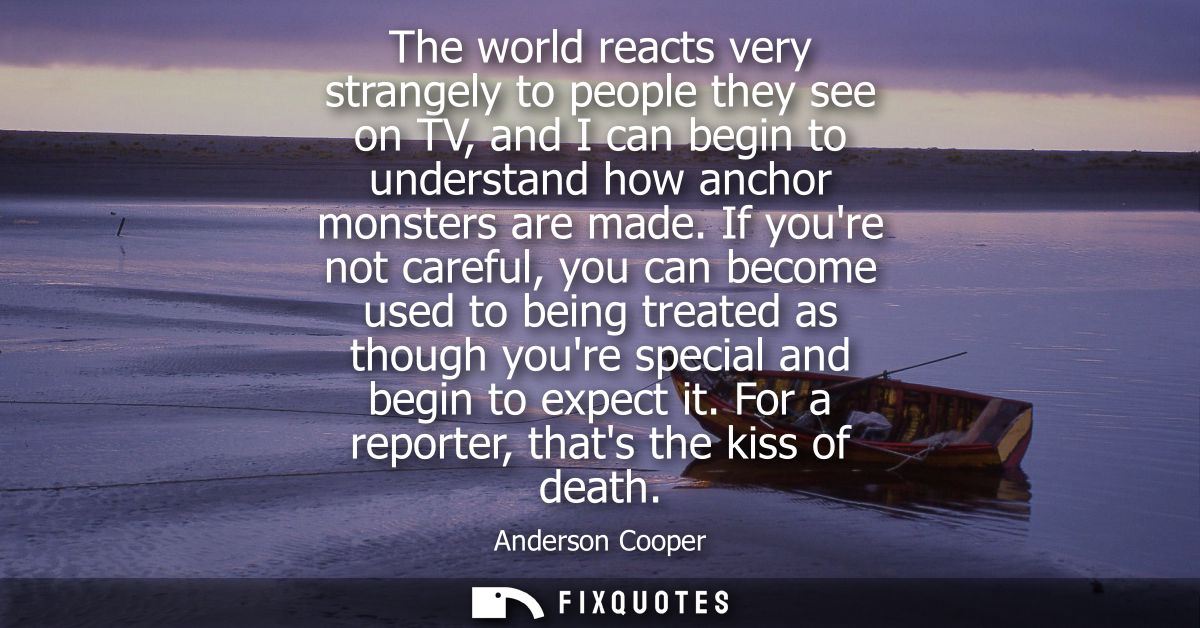
"The world reacts very strangely to people they see on TV, and I can begin to understand how anchor monsters are made. If you're not careful, you can become used to being treated as though you're special and begin to expect it. For a reporter, that's the kiss of death"
About this Quote
The engine of the quote is its blunt mechanics of corruption. The world treats you “as though you’re special,” and the real danger isn’t the treatment itself but habituation to it. Cooper is pointing at a feedback loop: strangers defer, doors open, producers build segments around your persona, social life tilts toward people who enjoy proximity to your perceived importance. Soon “special” stops feeling like an external mistake and starts feeling like the natural order. That shift is the “kiss of death” because reporting depends on a discipline of modesty: you’re supposed to be the instrument, not the story. Once you expect exception, you stop asking certain questions, stop lingering in uncomfortable rooms, stop being wrong in public. You protect the image.
There’s also a quiet indictment of audiences. “React very strangely” is a polite way of saying we participate in the making of these monsters, rewarding performance over precision and mistaking familiarity for credibility. Cooper’s intent reads as a warning to peers and a self-check in real time: the only way to stay human on television is to distrust what television turns humans into.
Quote Details
| Topic | Work Ethic |
|---|---|
| Source | Help us find the source |
| Cite |
Citation Formats
APA Style (7th ed.)
Cooper, Anderson. (2026, January 18). The world reacts very strangely to people they see on TV, and I can begin to understand how anchor monsters are made. If you're not careful, you can become used to being treated as though you're special and begin to expect it. For a reporter, that's the kiss of death. FixQuotes. https://fixquotes.com/quotes/the-world-reacts-very-strangely-to-people-they-15221/
Chicago Style
Cooper, Anderson. "The world reacts very strangely to people they see on TV, and I can begin to understand how anchor monsters are made. If you're not careful, you can become used to being treated as though you're special and begin to expect it. For a reporter, that's the kiss of death." FixQuotes. January 18, 2026. https://fixquotes.com/quotes/the-world-reacts-very-strangely-to-people-they-15221/.
MLA Style (9th ed.)
"The world reacts very strangely to people they see on TV, and I can begin to understand how anchor monsters are made. If you're not careful, you can become used to being treated as though you're special and begin to expect it. For a reporter, that's the kiss of death." FixQuotes, 18 Jan. 2026, https://fixquotes.com/quotes/the-world-reacts-very-strangely-to-people-they-15221/. Accessed 20 Mar. 2026.