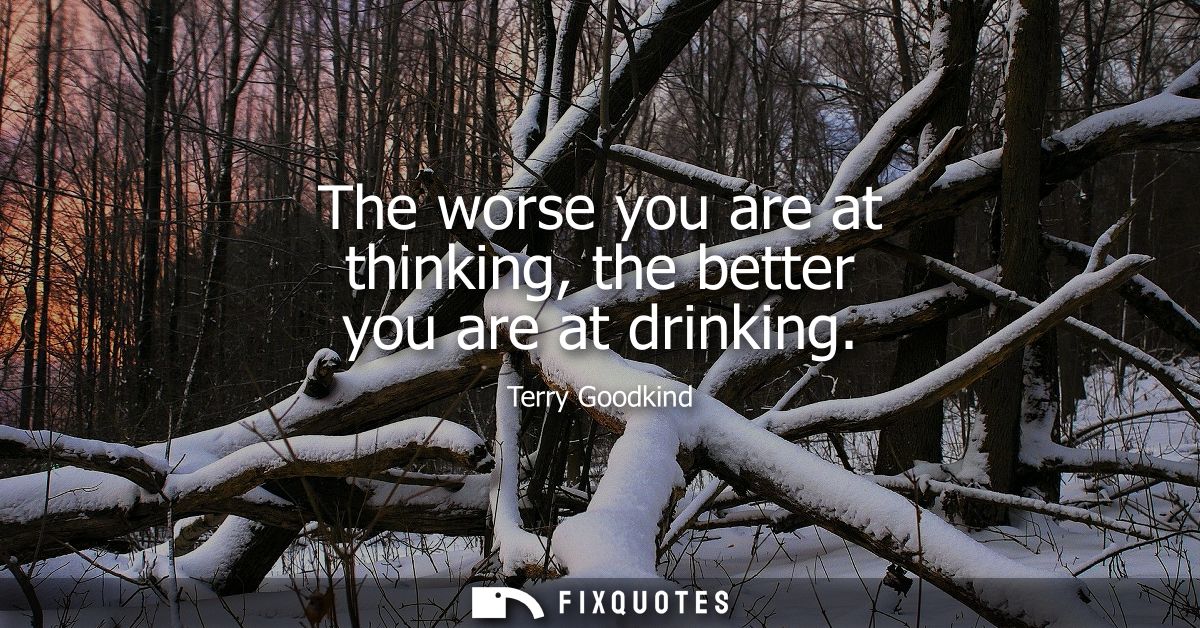
"The worse you are at thinking, the better you are at drinking"
About this Quote
A cheap epigram with a sharp edge: thinking is a liability, booze an upgrade. Goodkind’s line works because it flatters two opposing archetypes at once. If you’re the “deep thinker,” it lets you sneer at the oblivious drinker as someone self-medicating against complexity. If you’re the drinker, it offers a get-out-of-introspection-free card: maybe you’re not avoiding thought; maybe you’re optimized for pleasure. The sentence is a trap that reads as a joke but carries a moral diagnosis.
The intent feels less like a celebration of drinking than a cynical observation about avoidance. “Worse at thinking” doesn’t mean less intelligent so much as less willing to sit with ambiguity, consequence, or self-knowledge. Alcohol becomes the shortcut: blur the edges, lower the volume, turn the inner monologue into background static. The rhythm helps the jab land. It’s a neat little inverse relationship, almost mathematical, implying a law of human behavior: remove cognition, increase consumption.
Context matters. Goodkind wrote in a genre (fantasy) that often stages the battle between reason and impulse as literal conflict: magic versus logic, desire versus duty, slogans versus hard-earned understanding. Read that way, the quote echoes a recurring theme in his work and in modern culture more broadly: anti-intellectualism doesn’t always march under a banner; sometimes it pours itself a glass and calls it peace.
The subtext isn’t temperance; it’s indictment. If thinking hurts, the bottle starts looking like a solution. That’s the grim little engine under the punchline.
The intent feels less like a celebration of drinking than a cynical observation about avoidance. “Worse at thinking” doesn’t mean less intelligent so much as less willing to sit with ambiguity, consequence, or self-knowledge. Alcohol becomes the shortcut: blur the edges, lower the volume, turn the inner monologue into background static. The rhythm helps the jab land. It’s a neat little inverse relationship, almost mathematical, implying a law of human behavior: remove cognition, increase consumption.
Context matters. Goodkind wrote in a genre (fantasy) that often stages the battle between reason and impulse as literal conflict: magic versus logic, desire versus duty, slogans versus hard-earned understanding. Read that way, the quote echoes a recurring theme in his work and in modern culture more broadly: anti-intellectualism doesn’t always march under a banner; sometimes it pours itself a glass and calls it peace.
The subtext isn’t temperance; it’s indictment. If thinking hurts, the bottle starts looking like a solution. That’s the grim little engine under the punchline.
Quote Details
| Topic | Witty One-Liners |
|---|---|
| Source | Help us find the source |
| Cite |
Citation Formats
APA Style (7th ed.)
Goodkind, Terry. (2026, January 15). The worse you are at thinking, the better you are at drinking. FixQuotes. https://fixquotes.com/quotes/the-worse-you-are-at-thinking-the-better-you-are-168569/
Chicago Style
Goodkind, Terry. "The worse you are at thinking, the better you are at drinking." FixQuotes. January 15, 2026. https://fixquotes.com/quotes/the-worse-you-are-at-thinking-the-better-you-are-168569/.
MLA Style (9th ed.)
"The worse you are at thinking, the better you are at drinking." FixQuotes, 15 Jan. 2026, https://fixquotes.com/quotes/the-worse-you-are-at-thinking-the-better-you-are-168569/. Accessed 31 Mar. 2026.
More Quotes by Terry
Add to List