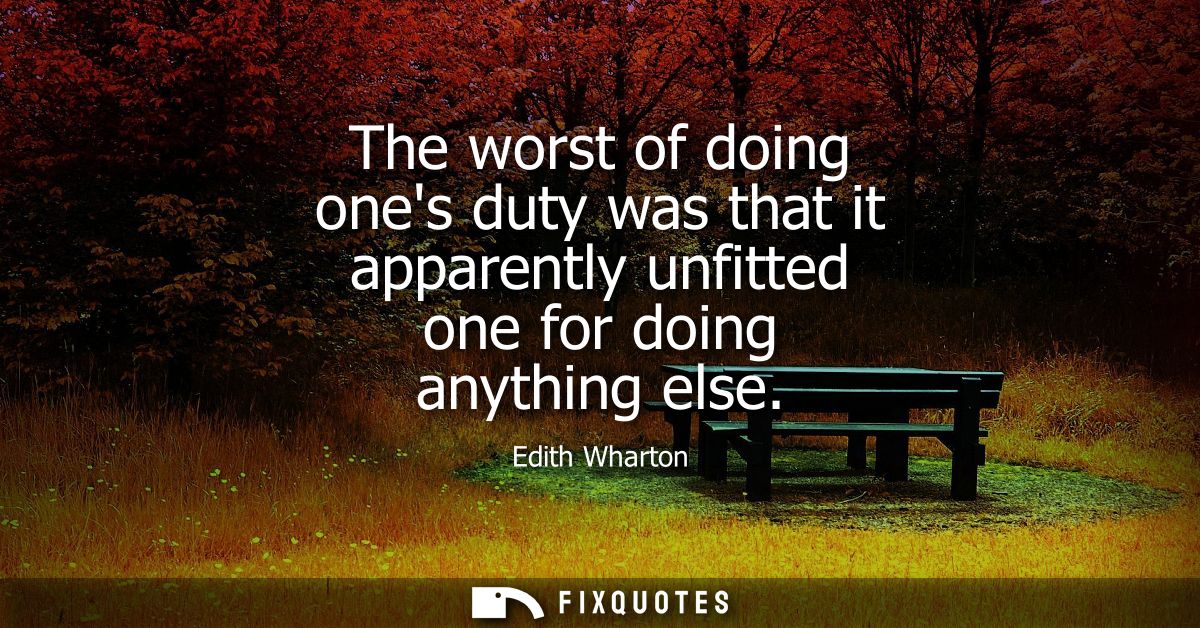
"The worst of doing one's duty was that it apparently unfitted one for doing anything else"
About this Quote
Wharton wrote from inside a culture that fetishized self-denial as refinement, especially for women of her class. “Doing one’s duty” sounds noble because it’s meant to; it’s the vocabulary of respectability, of old money etiquette that launders power into principle. The subtext is brutal: a life organized around obligation doesn’t just consume time, it colonizes possibility. You become legible only in terms of service, propriety, and sacrifice; desire starts to look like a character flaw.
What makes the line work is its double accusation. It critiques the individual (you choose duty, you internalize it) and the system (a society that rewards duty by trapping you in it). Wharton’s irony is quiet but surgical: duty is framed as the highest calling, yet it “unfits” you for the very human capacities that make a life expansive - spontaneity, ambition, pleasure, even creative risk. It’s a warning about moral specialization: if you practice being good in the approved way long enough, you may lose the muscles for being anything else.
Quote Details
| Topic | Wisdom |
|---|---|
| Source | Help us find the source |
| Cite |
Citation Formats
APA Style (7th ed.)
Wharton, Edith. (2026, January 15). The worst of doing one's duty was that it apparently unfitted one for doing anything else. FixQuotes. https://fixquotes.com/quotes/the-worst-of-doing-ones-duty-was-that-it-140602/
Chicago Style
Wharton, Edith. "The worst of doing one's duty was that it apparently unfitted one for doing anything else." FixQuotes. January 15, 2026. https://fixquotes.com/quotes/the-worst-of-doing-ones-duty-was-that-it-140602/.
MLA Style (9th ed.)
"The worst of doing one's duty was that it apparently unfitted one for doing anything else." FixQuotes, 15 Jan. 2026, https://fixquotes.com/quotes/the-worst-of-doing-ones-duty-was-that-it-140602/. Accessed 31 Mar. 2026.