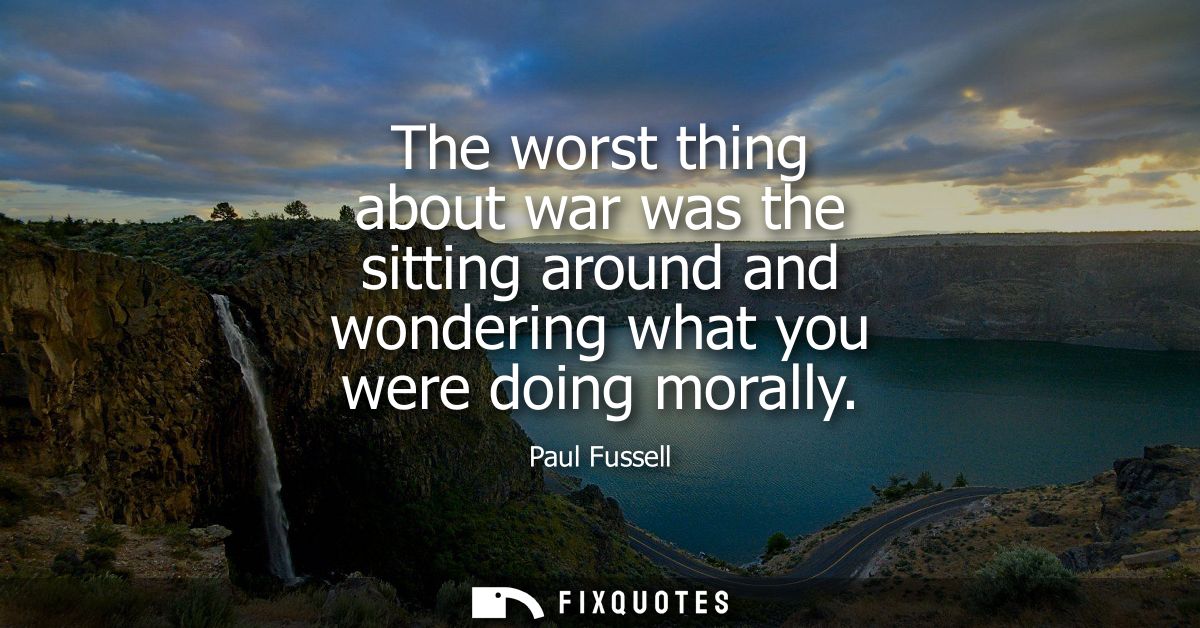
"The worst thing about war was the sitting around and wondering what you were doing morally"
About this Quote
The line works because it treats moral doubt as an occupational hazard, like trench foot or dysentery. “Wondering” is the key verb: not deciding, not testifying, just circling the same unresolved problem. That’s how conscience behaves under coercive systems. You can’t litigate ethics when orders arrive, when fear narrows your options, when your survival depends on group compliance. So the thinking gets postponed, then returns in the quiet, sharper for being delayed.
Fussell’s context matters. As a World War II infantryman turned literary historian, he spent decades dissecting the language that makes slaughter narratable - the euphemisms, the patriotic scripts, the pieties that convert chaos into “service.” This sentence is a small act of resistance against those scripts. It reframes war’s psychological toll as not just trauma from what you saw, but corrosion from what you suspect about yourself while you’re waiting: that the moral alibis are thin, and you have time to notice.
Quote Details
| Topic | War |
|---|---|
| Source | Help us find the source |
| Cite |
Citation Formats
APA Style (7th ed.)
Fussell, Paul. (2026, January 15). The worst thing about war was the sitting around and wondering what you were doing morally. FixQuotes. https://fixquotes.com/quotes/the-worst-thing-about-war-was-the-sitting-around-143420/
Chicago Style
Fussell, Paul. "The worst thing about war was the sitting around and wondering what you were doing morally." FixQuotes. January 15, 2026. https://fixquotes.com/quotes/the-worst-thing-about-war-was-the-sitting-around-143420/.
MLA Style (9th ed.)
"The worst thing about war was the sitting around and wondering what you were doing morally." FixQuotes, 15 Jan. 2026, https://fixquotes.com/quotes/the-worst-thing-about-war-was-the-sitting-around-143420/. Accessed 12 Feb. 2026.