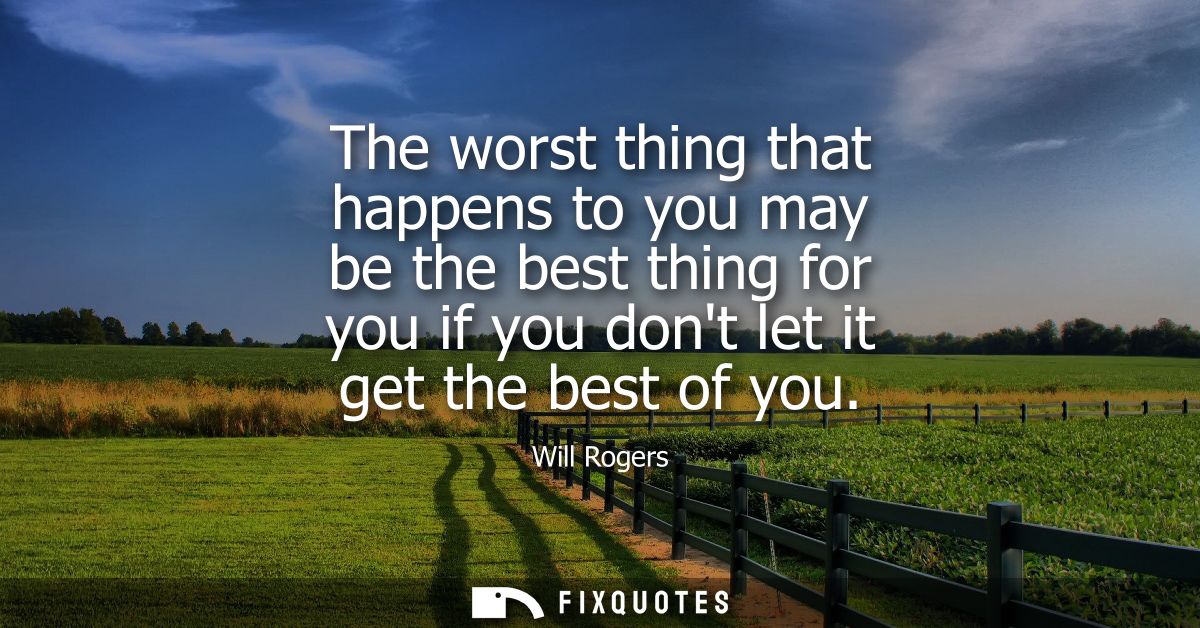
"The worst thing that happens to you may be the best thing for you if you don't let it get the best of you"
About this Quote
The subtext is almost sneaky in how it shifts responsibility. “May be” lowers the claim to something realistic, not inspirational poster certainty. Then Rogers slips in the real thesis: the decisive factor isn’t the event, it’s whether you “let it get the best of you.” That idiom is folksy, but it’s also strategic. It reframes suffering as a contest for narrative control: will the bad thing define you, or will you metabolize it into judgment, grit, timing, a new direction?
Context matters. Rogers worked through the Roaring Twenties into the Great Depression, when misfortune wasn’t an abstract self-help scenario but the ambient weather. His public persona traded in wry resilience, the kind that can live on a stage and in a breadline. The quote flatters the listener just enough to be motivating: you’re not powerless, even when life is. It’s not denial; it’s a dare to stay upright long enough for catastrophe to have consequences you can shape.
Quote Details
| Topic | Resilience |
|---|---|
| Source | Help us find the source |
| Cite |
Citation Formats
APA Style (7th ed.)
Rogers, Will. (2026, January 16). The worst thing that happens to you may be the best thing for you if you don't let it get the best of you. FixQuotes. https://fixquotes.com/quotes/the-worst-thing-that-happens-to-you-may-be-the-137831/
Chicago Style
Rogers, Will. "The worst thing that happens to you may be the best thing for you if you don't let it get the best of you." FixQuotes. January 16, 2026. https://fixquotes.com/quotes/the-worst-thing-that-happens-to-you-may-be-the-137831/.
MLA Style (9th ed.)
"The worst thing that happens to you may be the best thing for you if you don't let it get the best of you." FixQuotes, 16 Jan. 2026, https://fixquotes.com/quotes/the-worst-thing-that-happens-to-you-may-be-the-137831/. Accessed 3 Apr. 2026.