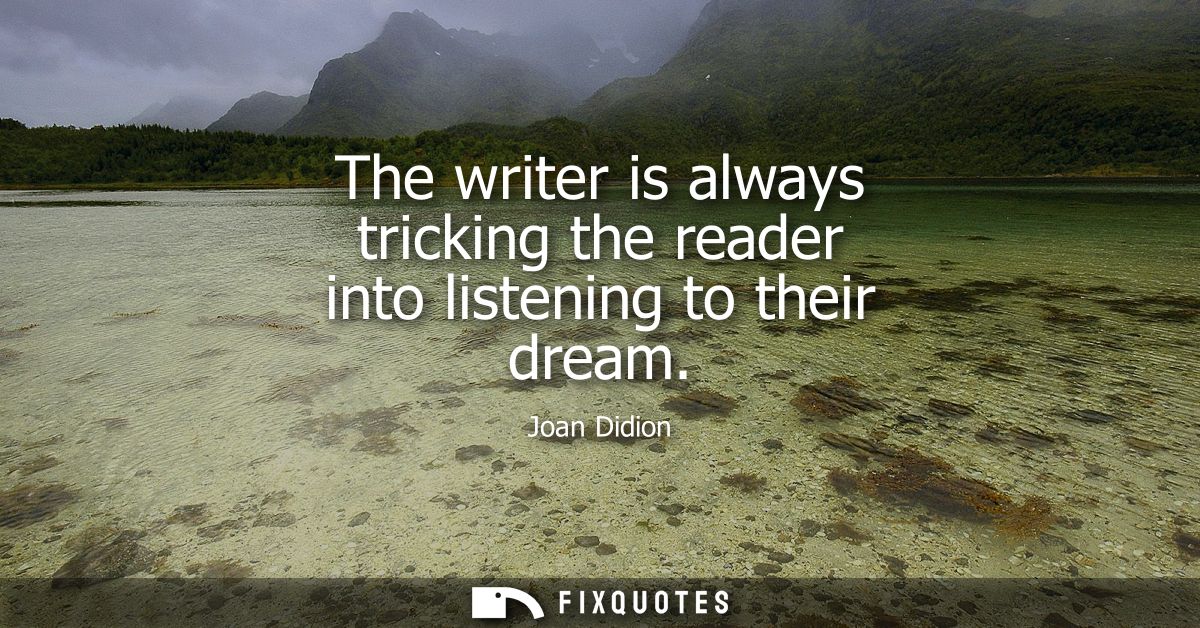
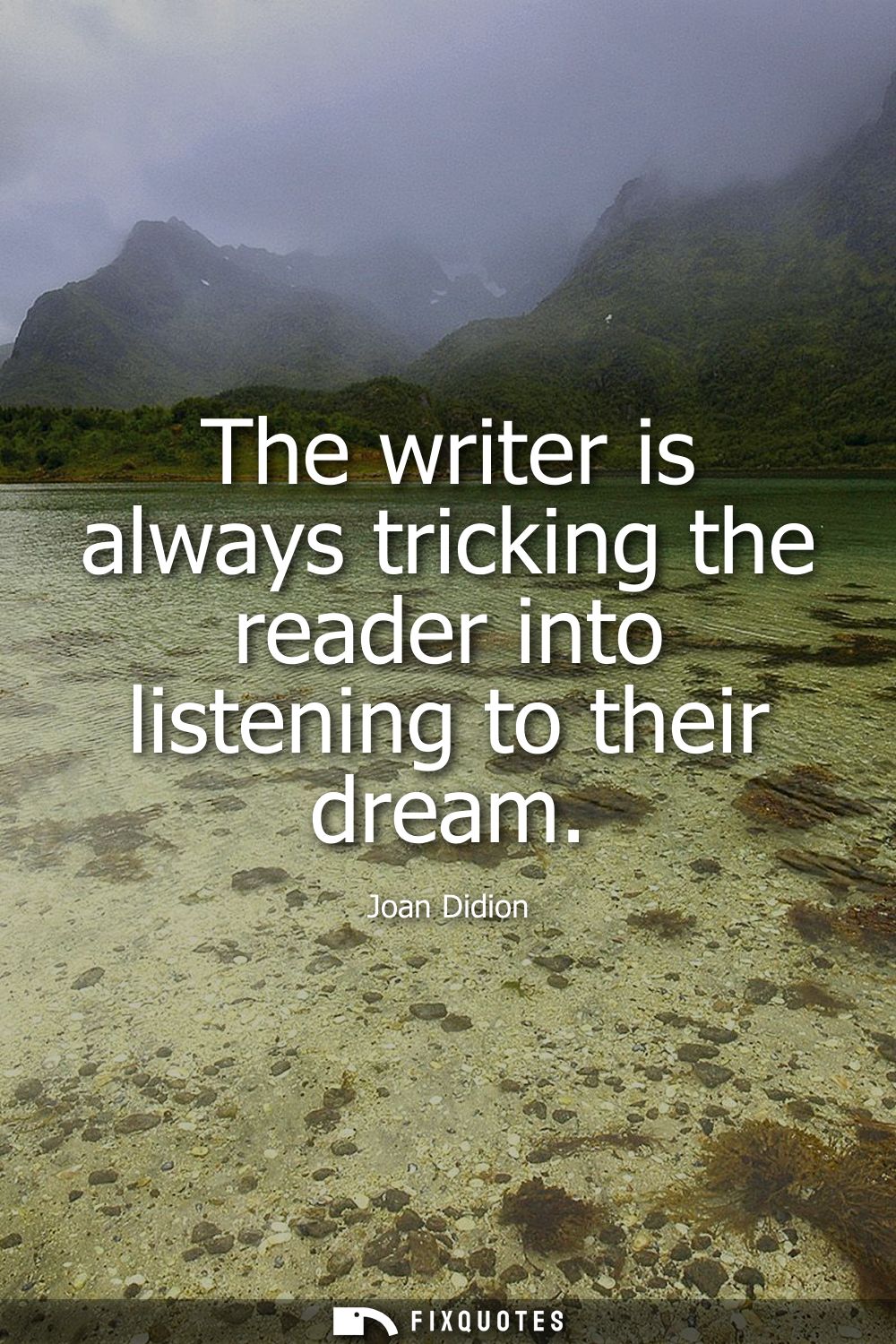
"The writer is always tricking the reader into listening to their dream"
About this Quote
Writing, for Didion, isn’t a polite transfer of information; it’s a con. “Tricking” is the tell: the writer doesn’t just hope to be heard, she engineers attention, smuggling an interior world past the reader’s defenses. The “dream” isn’t mere fantasy, either. It’s the private logic of association - the way memory splices scenes, the way fear and desire arrange facts into a pattern that feels inevitable while you’re inside it. Didion’s genius was making that pattern look like reportage.
The intent here is both confession and warning. Confession, because Didion’s own nonfiction often performs this sleight of hand: cool, declarative sentences that sound like public record, then suddenly you realize you’ve been led into her atmosphere - her dread, her glamour, her American vertigo. Warning, because “tricking” admits how narrative authority works: it seduces. You keep reading because the voice has made itself feel necessary, even when the subject is ambiguous or unresolved.
Subtextually, she’s also demystifying the romantic idea of inspiration. The dream is not sacred; it’s constructed, revised, timed. The trick is craft: pacing, omission, the strategic placement of detail that makes the reader’s imagination do the heavy lifting.
Context matters: Didion came up amid New Journalism, when writers blurred the line between observer and participant and were criticized for turning the world into material. Her line is a bracing ethical footnote to that era. Every sentence is a small act of power. The best writers use it knowingly; the worst pretend it isn’t there.
The intent here is both confession and warning. Confession, because Didion’s own nonfiction often performs this sleight of hand: cool, declarative sentences that sound like public record, then suddenly you realize you’ve been led into her atmosphere - her dread, her glamour, her American vertigo. Warning, because “tricking” admits how narrative authority works: it seduces. You keep reading because the voice has made itself feel necessary, even when the subject is ambiguous or unresolved.
Subtextually, she’s also demystifying the romantic idea of inspiration. The dream is not sacred; it’s constructed, revised, timed. The trick is craft: pacing, omission, the strategic placement of detail that makes the reader’s imagination do the heavy lifting.
Context matters: Didion came up amid New Journalism, when writers blurred the line between observer and participant and were criticized for turning the world into material. Her line is a bracing ethical footnote to that era. Every sentence is a small act of power. The best writers use it knowingly; the worst pretend it isn’t there.
Quote Details
| Topic | Writing |
|---|---|
| Source | Help us find the source |
| Cite |
Citation Formats
APA Style (7th ed.)
Didion, Joan. (2026, January 17). The writer is always tricking the reader into listening to their dream. FixQuotes. https://fixquotes.com/quotes/the-writer-is-always-tricking-the-reader-into-55729/
Chicago Style
Didion, Joan. "The writer is always tricking the reader into listening to their dream." FixQuotes. January 17, 2026. https://fixquotes.com/quotes/the-writer-is-always-tricking-the-reader-into-55729/.
MLA Style (9th ed.)
"The writer is always tricking the reader into listening to their dream." FixQuotes, 17 Jan. 2026, https://fixquotes.com/quotes/the-writer-is-always-tricking-the-reader-into-55729/. Accessed 19 Mar. 2026.
More Quotes by Joan
Add to List