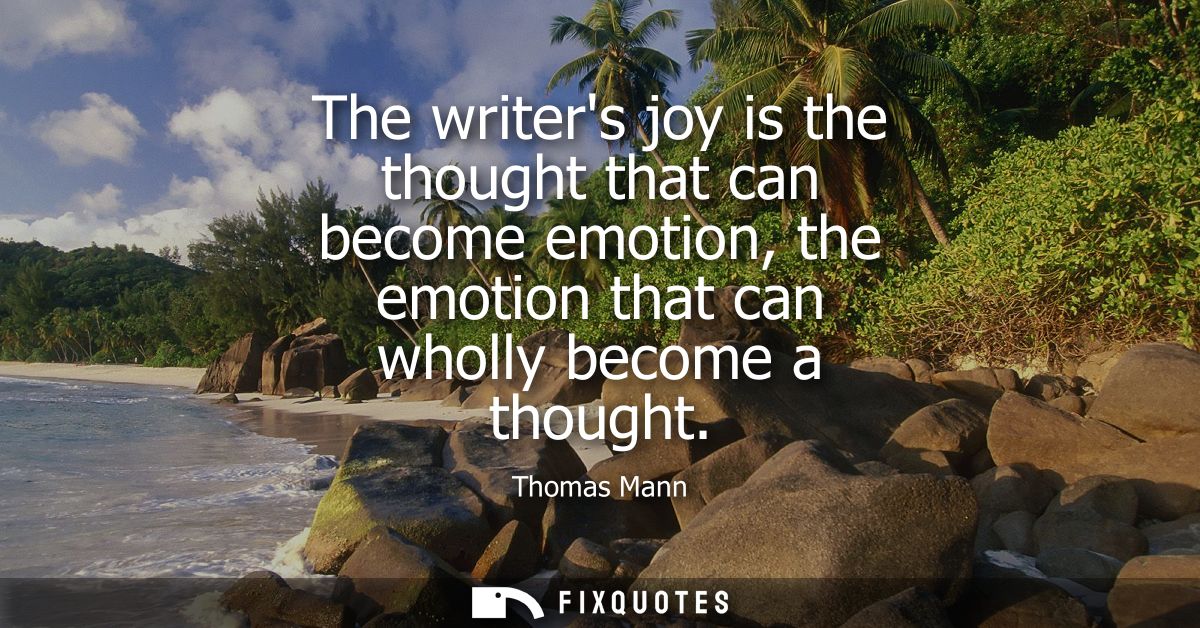
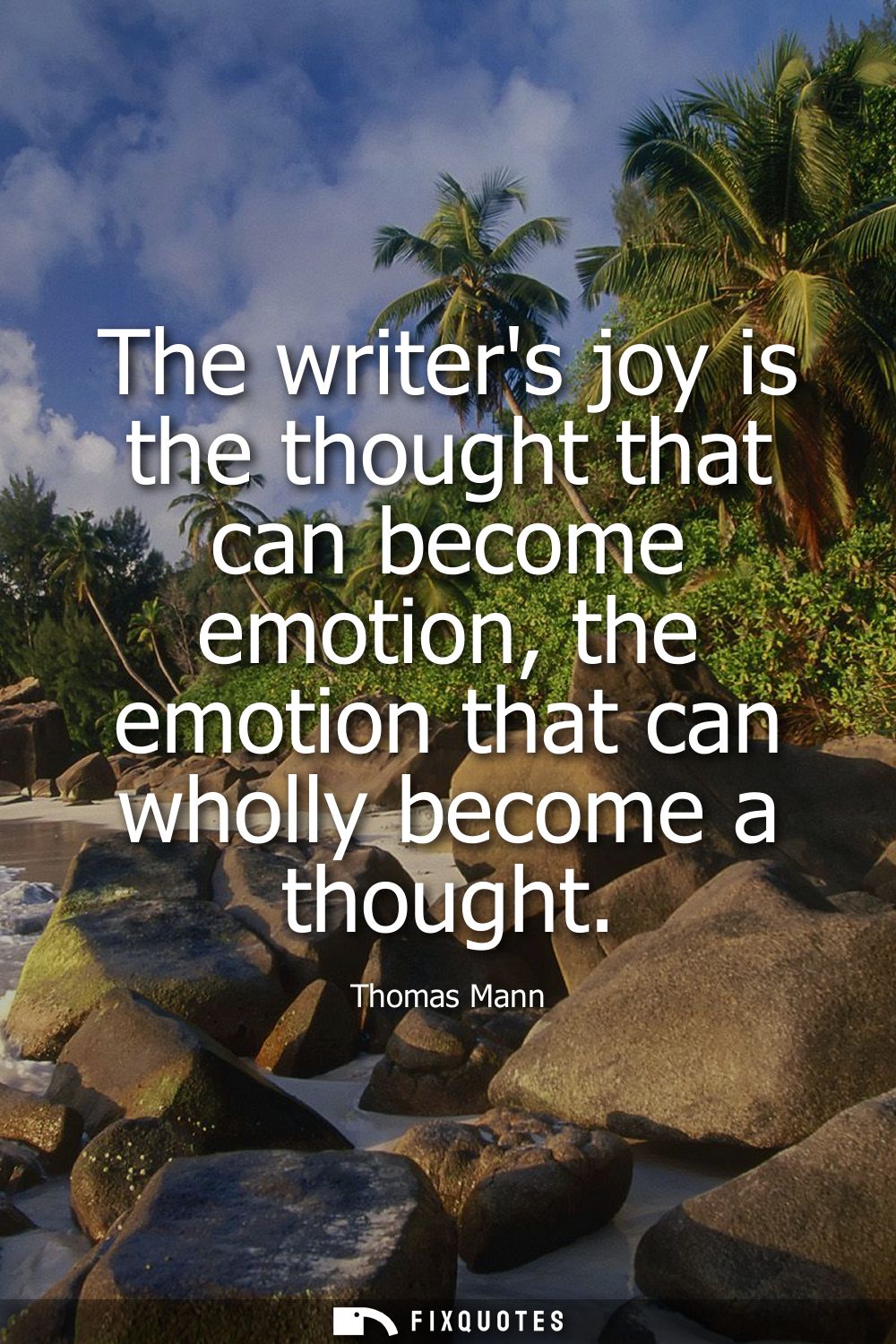
"The writer's joy is the thought that can become emotion, the emotion that can wholly become a thought"
About this Quote
The line works because it refuses the usual hierarchy. In popular talk, thought is clean and emotion is contamination, or emotion is authenticity and thought is sterile. Mann’s sentence collapses that false binary and replaces it with a loop: each state is incomplete until it risks becoming the other. “Wholly” is the dare. He’s not praising the half-translated feeling that stays vague to protect itself; he’s praising the writer who can take an inner surge and subject it to the rigors of articulation until it stands up as an idea.
Context matters: Mann wrote in an era obsessed with the tensions between reason and instinct, bourgeois order and subterranean desire. His own fiction lives in that pressure chamber, where refined surfaces hide fever. This is an ars poetica for modernity: art as the controlled conversion of private intensity into public meaning, and of abstract thought into something a reader can actually live through.
Quote Details
| Topic | Writing |
|---|---|
| Source | Help us find the source |
| Cite |
Citation Formats
APA Style (7th ed.)
Mann, Thomas. (2026, January 18). The writer's joy is the thought that can become emotion, the emotion that can wholly become a thought. FixQuotes. https://fixquotes.com/quotes/the-writers-joy-is-the-thought-that-can-become-11655/
Chicago Style
Mann, Thomas. "The writer's joy is the thought that can become emotion, the emotion that can wholly become a thought." FixQuotes. January 18, 2026. https://fixquotes.com/quotes/the-writers-joy-is-the-thought-that-can-become-11655/.
MLA Style (9th ed.)
"The writer's joy is the thought that can become emotion, the emotion that can wholly become a thought." FixQuotes, 18 Jan. 2026, https://fixquotes.com/quotes/the-writers-joy-is-the-thought-that-can-become-11655/. Accessed 20 Mar. 2026.