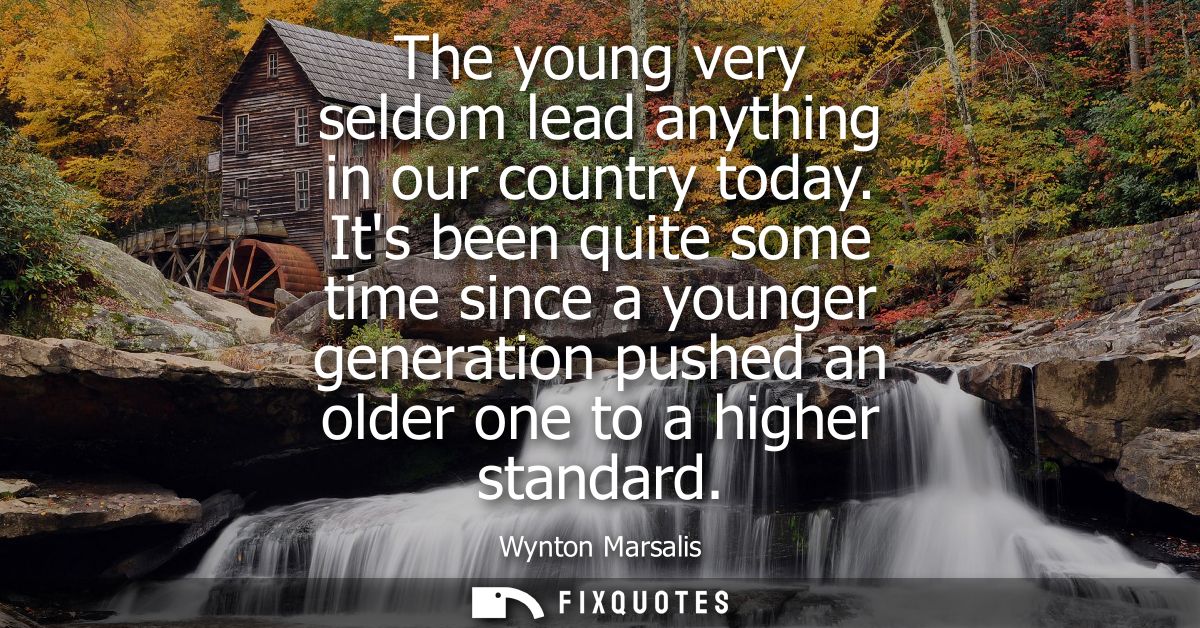
"The young very seldom lead anything in our country today. It's been quite some time since a younger generation pushed an older one to a higher standard"
About this Quote
Wynton Marsalis speaks from a tradition where the vitality of a culture depends on a disciplined handoff between generations. He values apprenticeships that create mastery and a conversation that is rigorous enough for the young to challenge the old and generous enough for the old to let themselves be changed. The lament is not about youth lacking talent or passion; it is about a stalled feedback loop in which elders hoard authority while the young are granted visibility but not power, novelty but not standards.
American history offers counterexamples that prove the point: student-led sit-ins and Freedom Rides that shamed older leaders into action; a bebop revolution driven by players barely out of their teens that redefined musical sophistication; tech founders who forced legacy industries to rethink distribution and communication. Those moments did not only celebrate youth; they compelled older generations to raise their game.
Today, institutions skew older and more risk-averse. Political leadership is geriatric, boards and universities are run by seasoned managers, and the pathways to decision-making are longer and more credentialed. Youth energy is channeled into platforms that reward immediacy over institution-building, branding over governance. Corporate culture markets youth aesthetics while keeping control with the same gatekeepers. Even movements with powerful youth leadership — climate strikes, March for Our Lives, the early phases of Black Lives Matter — run into structures that absorb, stall, or professionalize them before they can reset standards across society.
Marsalis is also defining leadership as more than attention. To lead is to set a bar of excellence and moral clarity that forces elders to improve or step aside. That requires depth of study as well as urgency, and it requires elders to create real lanes for authority rather than internships and panels. In music, swing happens when every player listens and responds; culture moves the same way. The young must bring mastery and insistence, the old must yield space and accept harder demands. Only then does the standard rise.
American history offers counterexamples that prove the point: student-led sit-ins and Freedom Rides that shamed older leaders into action; a bebop revolution driven by players barely out of their teens that redefined musical sophistication; tech founders who forced legacy industries to rethink distribution and communication. Those moments did not only celebrate youth; they compelled older generations to raise their game.
Today, institutions skew older and more risk-averse. Political leadership is geriatric, boards and universities are run by seasoned managers, and the pathways to decision-making are longer and more credentialed. Youth energy is channeled into platforms that reward immediacy over institution-building, branding over governance. Corporate culture markets youth aesthetics while keeping control with the same gatekeepers. Even movements with powerful youth leadership — climate strikes, March for Our Lives, the early phases of Black Lives Matter — run into structures that absorb, stall, or professionalize them before they can reset standards across society.
Marsalis is also defining leadership as more than attention. To lead is to set a bar of excellence and moral clarity that forces elders to improve or step aside. That requires depth of study as well as urgency, and it requires elders to create real lanes for authority rather than internships and panels. In music, swing happens when every player listens and responds; culture moves the same way. The young must bring mastery and insistence, the old must yield space and accept harder demands. Only then does the standard rise.
Quote Details
| Topic | Youth |
|---|
More Quotes by Wynton
Add to List