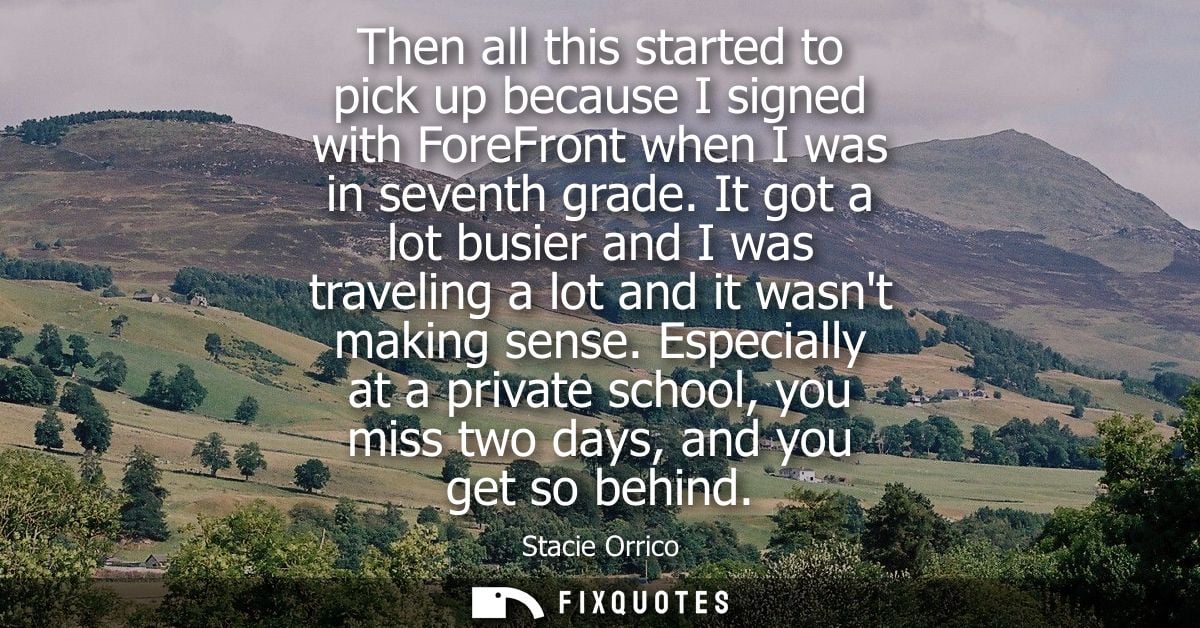
"Then all this started to pick up because I signed with ForeFront when I was in seventh grade. It got a lot busier and I was traveling a lot and it wasn't making sense. Especially at a private school, you miss two days, and you get so behind"
About this Quote
The detail that snaps the quote into focus is “especially at a private school.” It’s a small status marker with big implications: a stricter academic regime, higher expectations, less flexibility, and a social environment where absence reads like unreliability. Orrico isn’t just saying she was busy; she’s describing an institution designed to punish disruption colliding with an industry that thrives on it. Two days missed becomes a moral ledger entry. The subtext is about competing forms of discipline: the school’s demand for consistency versus the label’s demand for availability.
Context matters, too. Signing with ForeFront places her in the Christian pop ecosystem of the late 90s/early 2000s, a world that often sells youth as sincerity and “wholesomeness” while quietly professionalizing children. The line “it wasn’t making sense” hints at a teenager recognizing the mismatch between adult-scale career momentum and adolescent infrastructure. What makes the quote land is its refusal to mythologize: the cost of early success is expressed in homework, catching up, and the creeping realization that the adults’ plan may not be built for a seventh-grader’s life.
Quote Details
| Topic | Student |
|---|---|
| Source | Help us find the source |
| Cite |
Citation Formats
APA Style (7th ed.)
Orrico, Stacie. (2026, January 17). Then all this started to pick up because I signed with ForeFront when I was in seventh grade. It got a lot busier and I was traveling a lot and it wasn't making sense. Especially at a private school, you miss two days, and you get so behind. FixQuotes. https://fixquotes.com/quotes/then-all-this-started-to-pick-up-because-i-signed-64916/
Chicago Style
Orrico, Stacie. "Then all this started to pick up because I signed with ForeFront when I was in seventh grade. It got a lot busier and I was traveling a lot and it wasn't making sense. Especially at a private school, you miss two days, and you get so behind." FixQuotes. January 17, 2026. https://fixquotes.com/quotes/then-all-this-started-to-pick-up-because-i-signed-64916/.
MLA Style (9th ed.)
"Then all this started to pick up because I signed with ForeFront when I was in seventh grade. It got a lot busier and I was traveling a lot and it wasn't making sense. Especially at a private school, you miss two days, and you get so behind." FixQuotes, 17 Jan. 2026, https://fixquotes.com/quotes/then-all-this-started-to-pick-up-because-i-signed-64916/. Accessed 23 Mar. 2026.