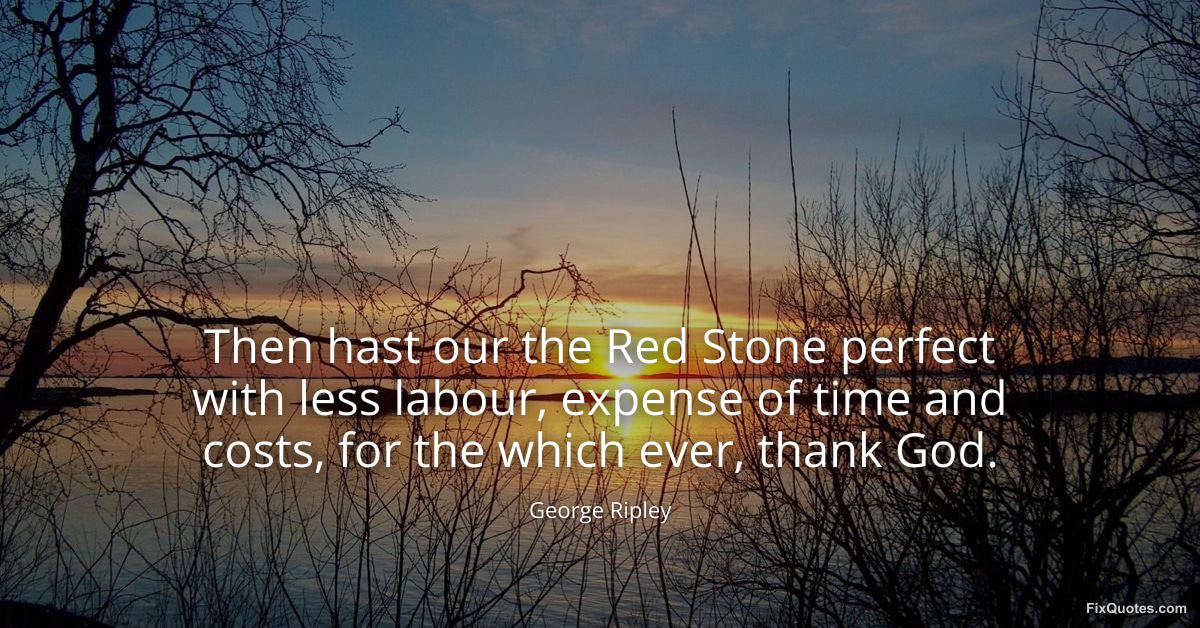
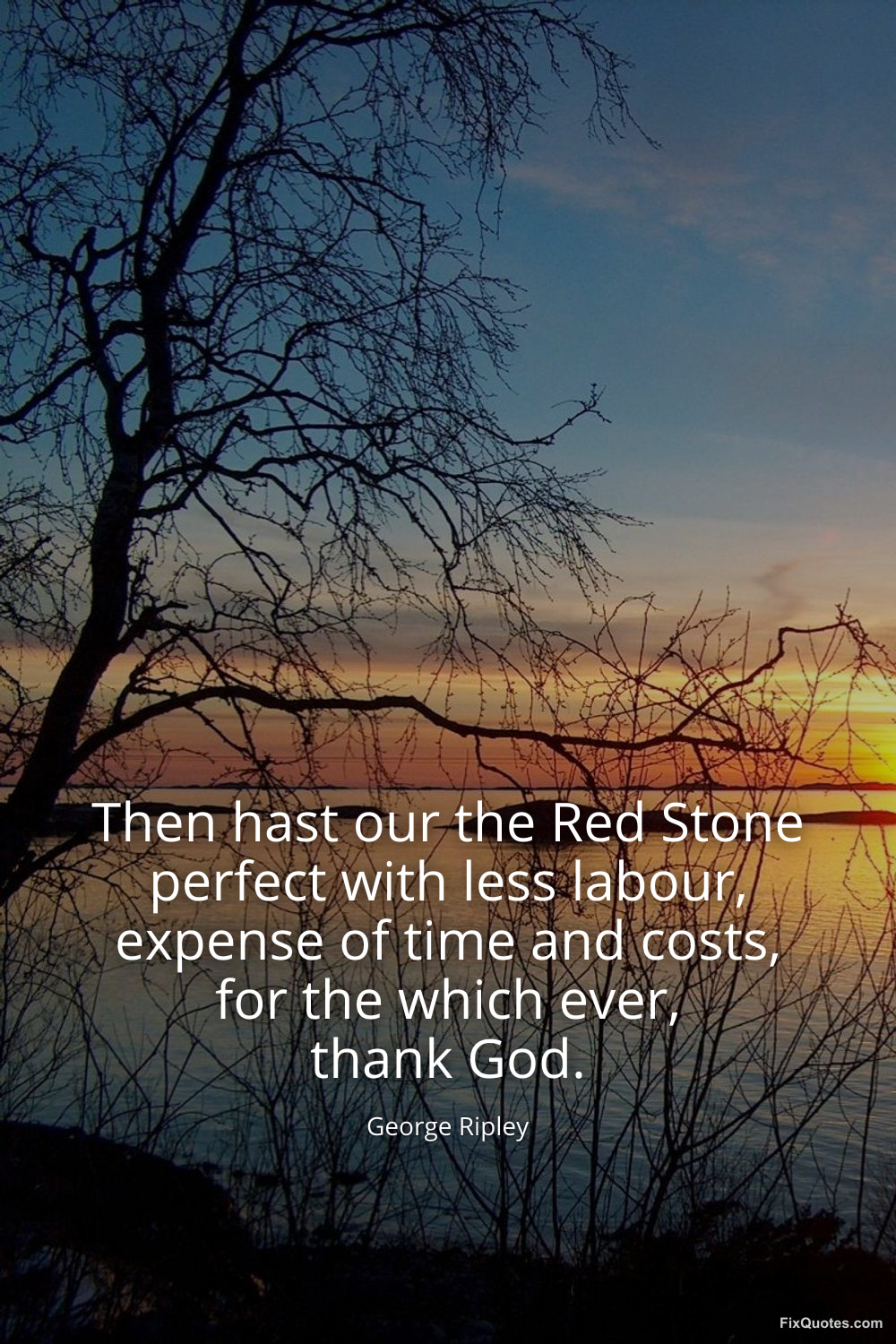
"Then hast our the Red Stone perfect with less labour, expense of time and costs, for the which ever, thank God"
About this Quote
That tension is the engine. Ripley is writing in a culture where moral legitimacy matters as much as results; gratitude to God functions like a safety seal on a dangerous promise. If you can get "perfection" cheaply, you're flirting with the era's anxieties about shortcuts, speculation, and fraudulent wonder-working. So the subtext is reassurance: our miracle is earned, our method is clean, our gains aren't stolen from the moral order.
As an activist, Ripley is also doing movement messaging. Reform projects - social experiments, utopian communities, educational crusades - always face the same skeptical audit: how much will this cost, how hard will it be, who pays? This sentence answers with a seductive fantasy of low-friction change, while framing success as providential rather than purely human. It's persuasion disguised as thanksgiving: a way to make radical improvement feel both practical and righteous.
Quote Details
| Topic | God |
|---|---|
| Source | Help us find the source |
| Cite |
Citation Formats
APA Style (7th ed.)
Ripley, George. (2026, February 17). Then hast our the Red Stone perfect with less labour, expense of time and costs, for the which ever, thank God. FixQuotes. https://fixquotes.com/quotes/then-hast-our-the-red-stone-perfect-with-less-111694/
Chicago Style
Ripley, George. "Then hast our the Red Stone perfect with less labour, expense of time and costs, for the which ever, thank God." FixQuotes. February 17, 2026. https://fixquotes.com/quotes/then-hast-our-the-red-stone-perfect-with-less-111694/.
MLA Style (9th ed.)
"Then hast our the Red Stone perfect with less labour, expense of time and costs, for the which ever, thank God." FixQuotes, 17 Feb. 2026, https://fixquotes.com/quotes/then-hast-our-the-red-stone-perfect-with-less-111694/. Accessed 28 Mar. 2026.