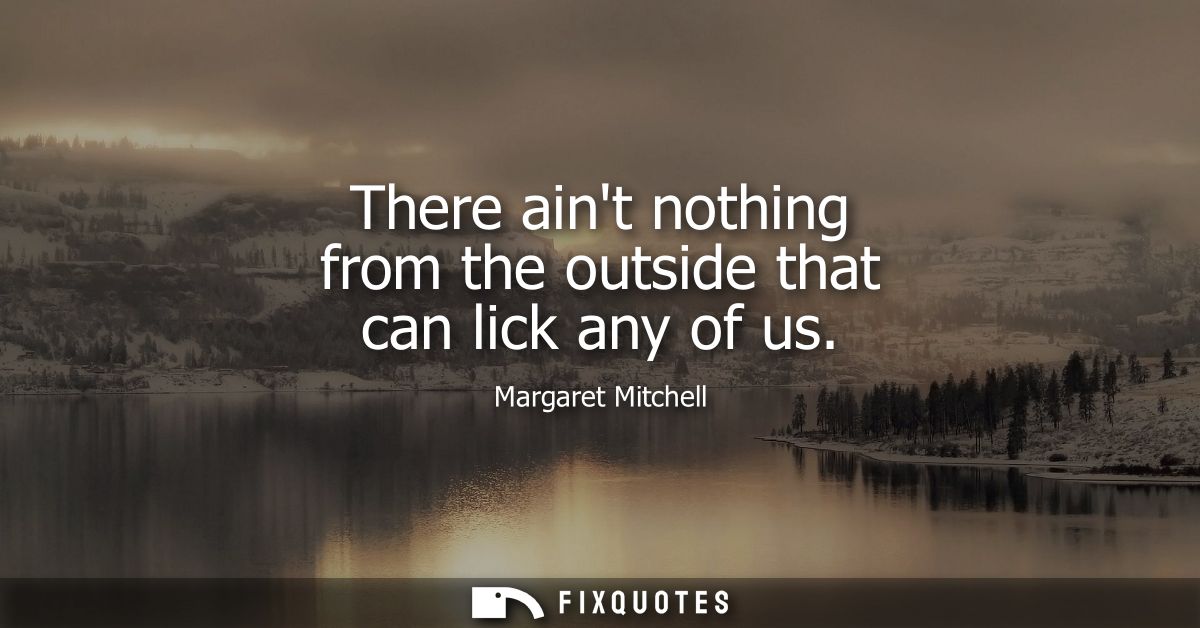
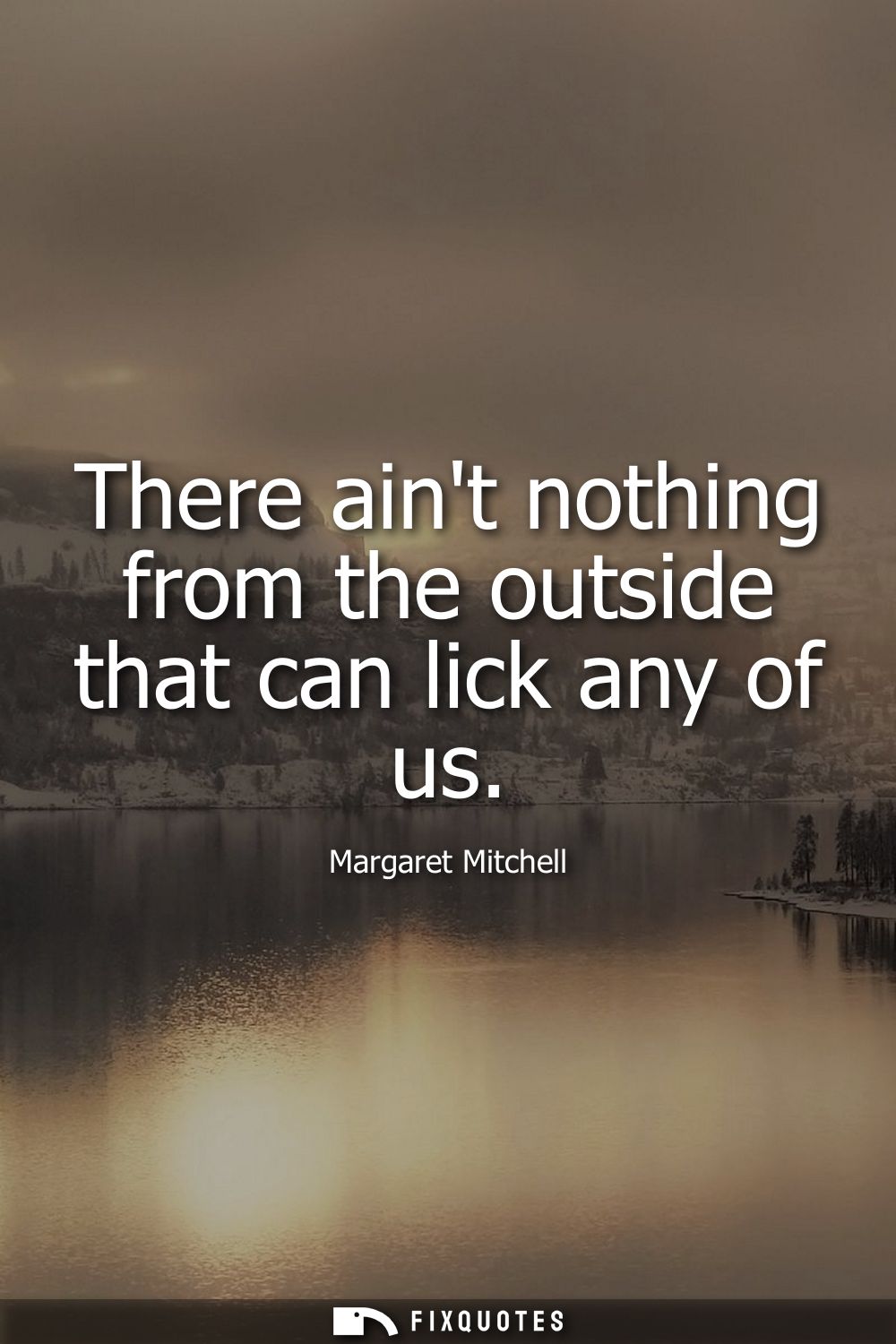
"There ain't nothing from the outside that can lick any of us!"
About this Quote
Defiance is doing heavy lifting here, but it isnt the clean, cinematic kind. "There ain't nothing from the outside that can lick any of us" lands in the ear like porch talk: plain grammar, blunt confidence, a phrase built to be repeated. The diction matters. "Ain't" and "lick" locate the speaker in a regional, classed voice that turns toughness into a local virtue. Its not a policy argument; its a self-administered sedative for fear.
Mitchell, writing out of the long shadow of the Civil War and Reconstruction (and the Lost Cause mythology that followed), understands how communities survive humiliation: they reframe vulnerability as moral superiority and call it resilience. The line draws a hard border between "us" and "the outside", a psychological fortification against forces that feel like invasion whether they arrive as armies, economic upheaval, or social change. It insists that danger is always external, never internal - which is exactly why it works. If the threat is outside, then the group is innocent; if the group is innocent, then endurance becomes proof of righteousness.
The subtext is less "we are strong" than "we cannot afford to admit how breakable we are". By casting adversity as something that can be "licked", the quote translates structural catastrophe into a fistfight you can win by grit alone. That simplification is energizing, even consoling - and it also masks the deeper, more troubling truth in Mitchells world: what breaks people most often comes from within their own systems, loyalties, and myths.
Mitchell, writing out of the long shadow of the Civil War and Reconstruction (and the Lost Cause mythology that followed), understands how communities survive humiliation: they reframe vulnerability as moral superiority and call it resilience. The line draws a hard border between "us" and "the outside", a psychological fortification against forces that feel like invasion whether they arrive as armies, economic upheaval, or social change. It insists that danger is always external, never internal - which is exactly why it works. If the threat is outside, then the group is innocent; if the group is innocent, then endurance becomes proof of righteousness.
The subtext is less "we are strong" than "we cannot afford to admit how breakable we are". By casting adversity as something that can be "licked", the quote translates structural catastrophe into a fistfight you can win by grit alone. That simplification is energizing, even consoling - and it also masks the deeper, more troubling truth in Mitchells world: what breaks people most often comes from within their own systems, loyalties, and myths.
Quote Details
| Topic | Resilience |
|---|---|
| Source | Help us find the source |
| Cite |
Citation Formats
APA Style (7th ed.)
Mitchell, Margaret. (2026, February 20). There ain't nothing from the outside that can lick any of us! FixQuotes. https://fixquotes.com/quotes/there-aint-nothing-from-the-outside-that-can-lick-23130/
Chicago Style
Mitchell, Margaret. "There ain't nothing from the outside that can lick any of us!" FixQuotes. February 20, 2026. https://fixquotes.com/quotes/there-aint-nothing-from-the-outside-that-can-lick-23130/.
MLA Style (9th ed.)
"There ain't nothing from the outside that can lick any of us!" FixQuotes, 20 Feb. 2026, https://fixquotes.com/quotes/there-aint-nothing-from-the-outside-that-can-lick-23130/. Accessed 6 Mar. 2026.
More Quotes by Margaret
Add to List